The Best RV Batteries For Both The House And Chassis

This article is going to be talking about choosing the best RV batteries for both the house and chassis. And about what will fit your needs best.

And first of all, let’s suppose you have a towable RV like a fifth wheel or a travel trailer.

Then most likely you just have house batteries in your RV. And that’s all you need to focus on.

But if you have a motorhome, very likely you’re going to have both kinds of batteries. You’ll have chassis batteries and house batteries.

Watch my video on the best RV batteries to choose

Table of Contents

Differences Between RV House And Chassis Batteries

So let’s explain the difference right away. House batteries are designed to run all the electrical needs in your RV when you’re not plugged in to shore power.

And they are designed to do that for a good long period of time as well.

But on the other hand, chassis batteries are designed mainly to start the RV engine. And then keep it running down the highway.

So what kind of batteries then do you need for the chassis in a motorhome?

The Best RV Batteries For A Motorhome Chassis

Well, actually they’re very similar to a car or auto battery. But they’re much more powerful.

Because what you need from them is a lot of cold cranking amps to get that engine started. Usually within two to five seconds or so.

And that’s often going to take around 1000 cold cranking amps or even more.

You see, those kinds of batteries have more plates in them. But they’re thinner plates.

So what that means is that you get a lot of power at once. But it doesn’t sustain that power level for a very long period of time.

Replacing RV Chassis Batteries

Now what happens when replacement is needed for your chassis batteries? And they all eventually need replacement.

Then I recommend that you use the batteries you already had in the chassis.

In other words, if the motorhome came from the factory with a battery in it, it’s a pretty good chance you need to go back with that kind of battery.

And very often you can get the information you need for replacement right off the battery itself.

But you also could consult your RV owner’s manual too. Very often they’ll tell you just what you need to get for your motorhome.

Of course, to make it simple, you also could just disconnect the battery. Then take it down to a local auto parts store and show it to them.

And very often they’ll know exactly what you need. And there’s a good chance they will have exactly what you need in stock.

But if they don’t, they can often get their hands on it in short order too.

The Best RV Batteries – Which Chassis Brands To Choose?

Now what about the best brands to choose from when you’re buying an RV chassis battery?

Well, in my case, I have used NAPA batteries quite a bit. And I’ve had very good success with their batteries too.

But I’ve also heard very good things about Interstate batteries in general as well.

Best RV Batteries - which RV chassis battery brands should you choose?
Best RV Batteries – which RV chassis battery brands should you choose?

The Best RV Batteries For The House

OK, now let’s talk about house batteries. And these are much more complicated to choose from.

Because what you choose really depends on what you want to accomplish with them.

Now there’s a lot of different kinds of batteries that could be used as RV house batteries.

But we’re going to talk about three main kinds of house batteries in use today.

Ones that are commonly used to power the RV’s house electrical needs. Especially when you’re not plugged in to shore power.

Now let me say this first. All of these kinds of batteries that I’m going to discuss will do the job.

But they all have pros and cons you need to consider.

RV House Battery Choice #1 – The Pros

So let’s start with the least expensive battery that you can get. And that is the flooded lead acid (FLA) battery.

A typical flooded lead acid RV battery
A typical flooded lead acid type of RV battery

It comes in both 12 volt versions and 6 volt versions. But with the 6 volt batteries, you have to use two of them together to make 12 volts.

And they’re often referred to as golf cart batteries because they are often used for that purpose.

Their plates are thicker, and therefore they often last longer for constant use. And that’s why golf courses love using them.

But first, let’s talk about the pros of FLA batteries. And the first pro is that they are the cheapest battery out there to buy.

So you can find them in a lot of places and you can often buy them at a great price too.

But they’re also rugged. And they can stand up to almost anything and keep on going.

So they’re very reliable and proven technology that’s been used for years and years.

And they’ll last somewhere around 500 discharge cycles on average.

What that means is discharging them all the way down and then charging them up again.

What Are The Cons Of RV Battery Choice #1?

So what are the cons? Well there’s several cons. And one of the big ones is that they are usually very heavy.

So if you have a bank of 2, 3, 4 or more of these, it’s really a lot of weight to put in your RV. And you have be sure your rig can handle that weight.

Now the other thing is that they off-gas a lot. They put off noxious and toxic fumes in the charging and discharging process.

So you can’t just put flooded lead acid (FLA) batteries inside your RV with you in most cases. In fact, it’s dangerous to do that.

And even if you put them in the RV’s outside compartment, make sure that it’s well ventilated.

Another con is that they’re going to need constant maintenance. It’s called “watering the batteries”.

That means that they have to have the water inside replenished regularly as it evaporates.

So that’s a constant thing you have to remind yourself to do if you own FLA batteries.

Another Big Disadvantage Of These Batteries

Also you really only get about half the power potential of the battery in real world use.

So for instance, when you have a rated 100 amp hour battery, actually you can only use about 50 amp hours out of it.

Because if you discharge the battery down below 50 percent, you could do damage to the battery.

And if you consistently do that you will shorten the life of the battery considerably.

So that means therefore that you really only have about half of the battery’s potential. And that’s all you can make use of for your RV.

So you have to often have a bank of several FLA batteries to get the job done.

The Best RV Batteries – The Pros Of Choice #2

OK, let’s move on to our second kind of battery. And that’s an AGM battery, or absorbent glass mat battery.

Absorbent Glass Mat batteries
The Best RV Batteries – Absorbent Glass Mat batteries

Now it’s actually still a type of flooded lead acid (FLA) battery. But there’s no liquid in it.

In this case, what they’re using instead is cell matting material in all of the battery cells. And it works very well for RVing purposes.

So now let’s talk a little bit about the pros and cons of AGM batteries.

And the first pro is that it’s mostly maintenance free and that’s a great feature that a lot of RVers love.

That means no more watering batteries on a regular basis to replace lost fluid. And it’s spill-proof too.

So they can often be installed in more places and not always in upright positions.

Also, there’s less off-gassing of toxic and noxious fumes as well. So clearly we’re moving in the right direction with this kind of RV house battery.

And you sometimes can discharge those batteries a little bit farther too. At least more than most liquid filled flooded lead acid batteries and still be okay.

Also, they’ll usually last longer too. In fact, they last roughly on average about 1000 discharge and charge cycles. Which is pretty good.

The Cons Of Choosing Battery #2

OK, now let’s move on to the cons about AGM batteries. And the big con is they are more expensive than liquid flooded lead acid batteries.

Also, they’re more sensitive to over-charging too. So you have to be very careful with them and make sure you have a quality AGM battery charger.

Now let’s move on to our last type of battery that we’re going to talk about in this article.

The Best RV Batteries – The Pros Of Choice #3

And it’s the LifePO4 lithium battery which is becoming much more popular now for RV use. In fact, we are starting to see them quite a bit.

Many consider the lithium battery to be the best RV batteries overall

So what are the pros? Well there’s a long list of pros because they really solve a lot of the issues of the first two kinds of batteries we talked about.

First of all, they are much lighter. So you can have a bank of these batteries and not really be adding as much weight to your RV.

Also, there’s essentially no maintenance to them either. And isn’t that nice? You just install them and let them do their job.

Also, there’s no off-gassing involved with RV LifePO4 lithium batteries. And that’s really great!

In fact, many RVers put these batteries right inside the house itself. You know, in a compartment inside the RV.

And that’s just fine because they don’t cause any toxic fumes that can harm people.

More Advantages Of RV Battery Choice #3

Now here’s a big pro. They can be discharged close to 100% of the rated battery power.

So you’re getting practically the full use of the power that’s stored in the battery. That’s a huge weight and space saver for RVers!

And they also charge faster as well. So they tend to bounce back quicker during the charge process.

And here’s a big one. They last a long time. In fact, they usually last between 3000 – 5000 discharge and charge cycles.

That is a very long time and way beyond the capabilities of most FLA batteries.

The Cons Of Choosing Battery #3

So what are the cons then? Well the big one is the cost! And yes, they really do cost quite a bit more than the other batteries I’ve covered.

Now just a few years ago they were pretty much $1000 per battery. But they’ve become a little more affordable at this point.

However, the cost is still more much more than either common flooded lead acid or AGM batteries.

Another con is that there’s a good chance you might need an upgraded charger at the same time that you switch to these batteries.

Because if the RV came from the factory with flooded lead acid batteries in it, very often the charger will not charge lithium batteries like it should.

And lithium RV batteries require a very specific charging process to protect the battery.

So suppose you make a complete switch of a bank of batteries you have in your RV’s house.

Well then, you may be not only replacing the batteries. But you might be replacing the charger as well and that’s an added expense.

More Cons Of Choosing RV Battery #3

Now the last con for lithium batteries is that there can be challenges for charging them in cold weather.

So in most cases you shouldn’t do it below freezing or you could damage the battery.

But of course, you could have them installed inside the RV and keep them warm that way.

And lately more and more of these lithium batteries are being made with internal heating systems. And that resolves much of that issue.

OK, so those are the pros and the cons of both house and chassis RV batteries.

Which Kind Of Battery Should You Choose?

Now let’s talk about who should choose what kind of battery for their RVing needs.

So let’s suppose that you are an RVer that’s usually found in RV parks and campgrounds. And you are most often hooked up to shore power.

Well in that case, you really don’t use your batteries all that much to run the electric components in your RV.

Because your electric needs are mostly being met by the campground power connection.

So common flooded lead acid batteries will work really well for you. And that’s especially true if you’re on a budget.

So what about AGM batteries? Well essentially they work best for the same kind of RVers.

You know, people that are in RV parks and campgrounds most of the time. Especially those that have a little bit more money to spend.

And as a result, they can afford to buy a battery that doesn’t require much maintenance.

Now who’s best for lithium LifePO4 RV batteries? Well those are great for RV boondockers.

For people who spend the majority of their time unplugged from shore power. And especially for those that enjoy a lot of off-road RVing.

Also, for those who have solar installed on their RV since lithium batteries can maximize the use of the sun’s power.

But they’re also a great choice for any RVer who can afford the higher cost of those batteries.

Now one thing needs to be said at this point. And that is the cost is certainly initially more for lithium RV batteries.

But consider the fact that they last much longer than the other kinds of batteries.

So then, the lifetime cost actually equalizes quite a bit between the various battery types.

Conclusion

Well, I hope that what I’ve covered here today in this article will help you choose the best RV batteries for both the RV house and chassis.

Have safe and happy RV travels!
The Largest US RV Dealers – Should You Buy From Them?

This article is about the largest US RV dealers. And whether or not you should buy an RV from a large national dealership chain.

And yes, it’s true that the RV industry is in a big consolidation phase right now.

So most of the brands that you see out there are owned by just a few companies at this point.

And the largest US RV dealers are buying up local RV dealers at a record pace. So is this a good thing for RV buyers or not?

Watch my video on buying from the largest US RV dealers

Table of Contents

The #1 Pro Of Buying At The Largest US RV Dealers

Well not necessarily. So let’s talk about both the pros and the cons of national RV dealer chains, starting with the pros first.

And the number one pro we’ll mention is that they often have a very large inventory of RVs to look at.

Of course, that is great for newer RVers that often aren’t sure what kind of RV they should buy.

In fact, it can be a big help to visit a large dealer chain. Because with all those RVs, you can go through all the different kinds of RVs at one time.

You can also view lots of sizes and floor plans in different categories of RVs.

And that’s a good way to find out what works best for you and your needs.

So it’s good to have a large inventory of RVs for educational purposes alone.

RV Buying Pro #2

But the second pro is that you’re also often going to find several brands at one dealership too. And that can be a good thing too.

Because it can take a lot of time and effort to find different RV brands. And comparing them when they aren’t side-by-side can be a challenge too.

The Best Advantage Of Buying At The Largest US RV Dealers

But the number three pro of the largest US RV dealers is really the big one.

And that is that by design they are very convenient. So you can buy an RV there and even finance it all in the same place.

In addition, you can also trade your RV in and that saves the hassle of selling it on your own.

Also, you can access their parts department, their service department and so on.

And all of that is super convenient, since it’s all in one location at these large dealerships.

OK, so those are all pros of the largest US RV dealers. But now let’s talk about the cons as well.

A Big Con Of Buying From Large RV Dealer Chains

And the number one con is that these large dealership chains are not locally owned.

So there’s no local reputation that they have to worry about keeping up in the community.

Small dealers are often more concerned about their overall reputation
Small RV dealers are often more concerned about their overall reputation

Now when you have a smaller RV dealer, the owner is part of the community in many cases.

So the owner will often see and meet their customers as they go around their daily activities.

And that is an incentive to keep their reputation in good repute among the community.

But that’s not true with a large national dealer chain. Because they rely instead on large advertising budgets to get people in through the door.

Con #2 Of Buying At The Largest US RV Dealers

Than another con is that many of the largest US RV dealers have adopted selling tactics that’s been used in the car industry for decades.

And I think we all know how much fun it is to go buy a car from a car dealer, right?

Usually it’s not very much fun for most people. And that’s because they love to use high pressure tactics that people hate.

Well, many in the RV dealer community have adopted very similar tactics. Especially in these large national dealer chains.

Con #3 Of Buying At Large RV Dealerships

Now another con is that because of all of that you are just a monthly number on the sales projection board.

You see, at the beginning of the month most dealers will make a projection of how many sales they want to make that month.

RV dealers usually make sales projections at the start of every month
The largest US RV dealers usually make sales projections at the start of every month

And then, they do everything in their power to meet that projection. Whether or not in many cases it’s good for you as a customer.

And it’s often called the “turn and burn” mentality in vehicle sales. And it does not usually work in favor of the average customer.

The Sales Process – Con #4

OK, the next con is that these dealers have a sales process that they want to use on you. One that gives them full control in the entire process.

So they’re really not there to listen to you or to even educate you. Instead, they want you to fall into their process and do what they want you to do.

Con #5 – What About The Salespeople?

Now the next con is the salespeople that you are going to encounter at large RV dealers.

In fact, many of them may not even know very much about the RVs that they’re selling you.

In fact, very often they’re not even RVers at all. They are just salespersons.

Salespeople at the largest US RV dealers often use high pressure tactics

So you may actually know more than the salesperson you are working with.

And what this means is that you can’t trust them as a means of learning about RVs. Or about what will work best for your particular situation.

Because many times the things they’re going to tell you are just to sell you an RV. And they will often say almost anything to get the sale.

So all of this makes it hard to trust a salesperson that you often find at large RV dealership chains.

#6 – What The Largest US RV Dealers Really Want

OK, the next con is that these kind of dealers want you to buy purely on emotion.

Because they realize that emotions are very powerful. And they will get people to do something they don’t always want to do if they had time to think about it.

Large national RV dealers often like it when you by purely on emotion

So they want you to buy quickly based on emotions. They want to move you through the sales process and get you out the door quickly.

And the interest is not in educating you as a consumer. Or in finding out what you want and need. Just on turning sales.

Con #7 For Buying At National RV Chains

Now the next con is about RV financing at large RV dealers. And it’s often not really the best deal that you could make for an RV loan.

In fact, the finance department of an RV dealership in many cases is the most profitable part of the whole dealer. Why?

Be careful with RV loans at large national RV dealerships

Because they’re marking up their loans considerably to make profits for the RV dealer.

So financing is often not good for you as a consumer at these large dealer chains.

OK, the next con is that while you’re in the finance office they will love to sell you upgrades for your RV. But at very high profit margin!

Things like extended warranties, fabric protection, exterior protection and so on.

And they are all marked up very high to begin with. But when the cost is put in your RV loan, you really can’t tell how much it’s actually costing you.

Large US RV Dealers And Con #9

Then another con is that they often do very little if any pre-delivery inspection. And that’s true on both new and used RVs.

And as an RV inspector I can tell you this happens a lot, especially with large RV dealers.

So if they do a pre-delivery inspection at all, very often it’s a cursory one.

And very often, it’s done by someone who is not really qualified to do an RV inspection too. Many times by a very low paid employee.

Con #10 – What About RV Inspections?

Now moving on to the next con. And that is that a lot of the largest US RV dealers don’t like RV inspectors.

And they don’t want an RV inspection to be performed on their lot. In fact, more and more, they’re often refusing them all together.

Some of the largest US RV dealers deny RV inspections on their lot

Or if they allow them, they’ll make them very hard to perform. And why is that?

Well remember, their sales process means that they want to move you in and out of that dealership as fast as possible.

And they don’t want you thinking about things that could stop you from buying an RV.

Well, an RV inspection slows down that process. And it allows you to start thinking about whether it’s really a good buy or not.

So many of these large RV dealer chain stores don’t like RV inspections.

The Last Con When Buying From The Largest US RV Dealers

Now our last con that we’re going to talk about is an important one to consider.

So suppose they do allow you to inspect the RV you’re looking at.

Then suppose you take delivery of that RV before the quality issues that the inspector found are fixed?

Well you may have to wait weeks or even months to get those issues fixed. And this is common at these large RV dealer chain stores.

OK, those are a lot of cons about the largest US RV dealers to consider and mull over.

An Important Point About RV Dealers In General

Now let me say this. The cons that I mentioned here are not just restricted to large national RV dealership chains.

In fact, they can often take place with smaller RV dealers as well.

However I can say that in general they are more or less part of the fabric of these large national RV dealer chains.

Definitely, more so than most smaller local RV dealers that you come across.

Here’s My Recommendations To Protect Yourself

So here is what I recommend. If you’re going to buy from one of the largest US RV dealers, be careful every step of the way.

Watch what you’re doing and don’t just let them move you through in their sales process.

Always be careful about every step of the buying process and take nothing for granted.

So number one, know what you want before you buy. Don’t just go to the dealer and let them educate you.

Be educated about the RV you want to buy before visiting a large RV dealer's lot
Be educated about the RV you want to buy before visiting a large RV dealer’s lot

Because they’re often going to direct you where they want you to buy. To what they want to sell you because it makes them more profit.

Instead, be an educated RV buyer before you even start the RV buying process.

More Ways To Protect Yourself At Large National RV Dealers

Then number two, have your financing already set and lined up in advance. Don’t just blindly accept whatever the dealer offers you.

And don’t discuss financing in any way, or monthly payments, until the price for the RV that you’re buying is settled.

Number three, don’t buy your extras for your new RV from the RV dealer.

Because usually you can get extras and add-ons yourself with no problem. And you can usually get them at a much better price elsewhere.

Also, the upgrades you buy will often be better quality than what you will get at the dealer too.

For instance, let’s take extended warranties or service contracts after the sale.

Those can be very useful. And I personally have used them with good success on my RV.

But I recommend you go to wholesalewarranties.com because they are a broker in RV extended warranties or service contracts.

They can find the extended warranty that’s going to fit best for you and your RV.

Wholesale Warranties is a great place to get a good deal on a quality RV extended warranty

So just follow this link to learn more about what they have to offer.

One More Piece Of Advice For Buying At The Largest US RV Dealers

Now number four is always, and I mean always, insist on a full third party inspection of the RV you intend to buy.

And be sure to use a certified NRVIA RV inspector to do the inspection for you. Do not allow the dealer to talk you out of it.

Always get any RV you buy inspected by a certified NRVIA inspector

Or allow them to tell you that their pre-delivery inspection takes care of all of that. And that it doesn’t cost you anything. That’s usually not true!

So always insist on that third party inspection. And if the dealer refuses, I can’t tell you what to do.

But I can tell you what I would do. I would leave, because that’s telling me everything I need to know about that dealer.

And about how much they value me as a customer. Or are interested in my having a positive RV buying experience.

OK, the final point I want to share with you is something very few buyers do.

The Final RV Buying Recommendation I Can Give You

And that is never take delivery of any RV before all the issues that the RV inspector found are resolved to your satisfaction.

Because if you take delivery beforehand, then you’re often going to be put at the back of the dealer’s service line.

And you’re probably going to experience a lot of frustration and anxiety trying to get all those issues resolved.

Or at least that’s the way it works for a lot of RV buyers who complain online about their buying experience.

Conclusion

Well if you follow the advice that I’ve given you here in this article you really can get the RV that you want.

Not only the one you want, but the one you also need as well. And you can make sure that it works like it should from the first day of ownership.

And all of this can be accomplished even at one of the largest US RV dealers.

Have safe and happy travels my friends!

RV Downsizing – Why And How You Should Do It

This article is about RV downsizing. And about why and how to do it.

Of course, when you start out RVing there’s a lot of things you just don’t know.

And one of those things for many people is how little space they can live in comfortably.

Watch my video on RV downsizing

Table of Contents

Why Many People Buy Big RVs

Also, many come from houses that have 1000 – 3000 or more square feet of living area.

And it can be really daunting to think about living in only 300 square feet or maybe even less.

And that’s the kind of living space that you often find in RVs. So lots of folks just choose a bigger rig to start with.

That’s in order to make the transition a little bit easier for them from a stationary home to an RV.

And quite frankly, that’s really not a bad idea in many cases as they are just starting their RV life.

But there can be lots of reasons why RVers eventually choose to downsize their rig after a while. And we’ll talk about that now.

But before we get started, let me mention something else at this point.

And that is that this is also a very good discussion for you newer RVers too. Even those that don’t have an RV yet.

That’s because some of the points we’re going to cover could actually be things you need to think about before making your first RV purchase.

And knowing this information can help you buy the right size RV the first time.

RV Downsizing Reason #1

OK, let’s get started. And the first possible reason for downsizing is it could that your rig is hard for you to maneuver and drive around.

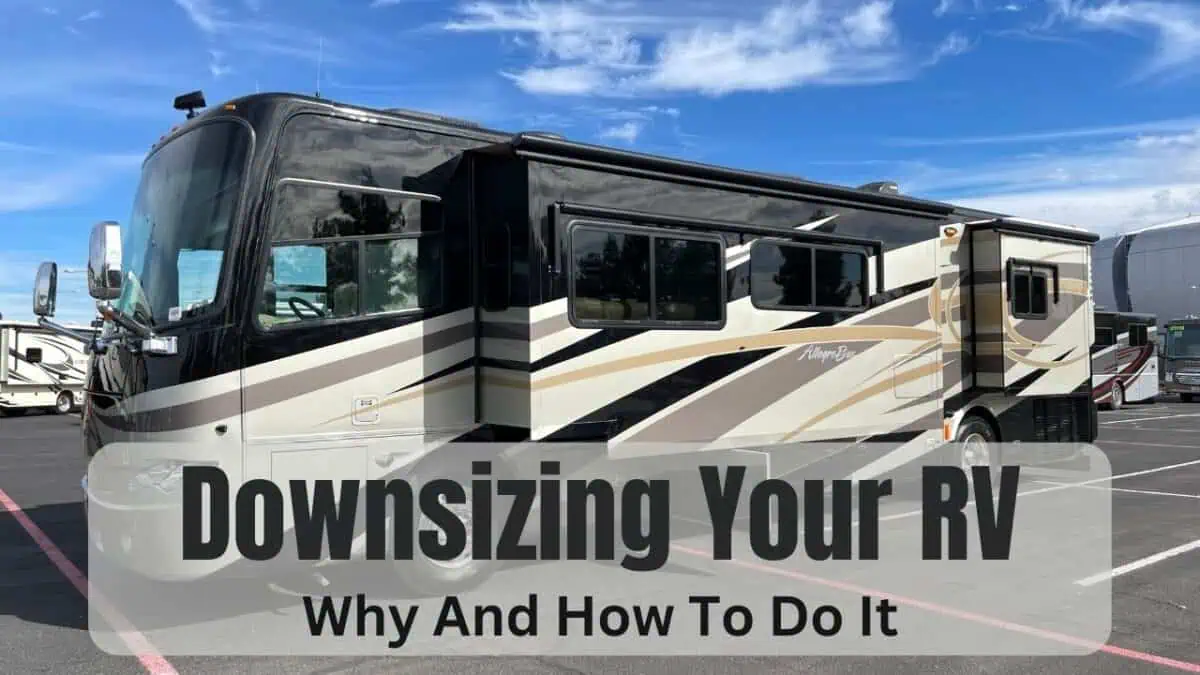
Now take it from me, because I have a 40 foot diesel pusher motorhome. And we flat tow a Honda CRV behind it.

Here's our big rig - a diesel pusher towing a CRV
Here’s our big rig – a diesel pusher towing a CRV

So when it’s all hooked up, it’s a big rig! In fact, it rivals even many commercial truck and trailer combinations in length.

Also, when I’m all hooked up I don’t have a reverse gear at that point. At least that’s the way I look at it anyway.

Because you really can’t back up when you have a flat towed vehicle connected.

So that means that I can only move in one direction when I’m driving my motorhome.

And that’s something you should think about before buying an RV.

Because when you have a big heavy rig and you’re towing a vehicle, maneuverability is cut down drastically.

For me, I have just decided to use bigger roads and interstate highways when I travel.

Because secondary roads could be a real challenge and it’s not hard to get into tough situations there. So all of that could be a reason for downsizing.

#2 – Downsizing For RV Parks And Campgrounds

OK, the second reason for downsizing is that many campgrounds these days are still not big rig friendly.

They were built decades ago for RVs that were generally a much smaller size back then.

RV downsizing - Campgrounds are often a challenge for bigger RVs
Campgrounds are often a challenge for bigger RVs

So the campground roads are more narrow. And in many cases, the corners can be narrow and make turning challenging too.

Also, in many of these older RV parks the sites themselves are tight. Making them more difficult to get into and out of with a bigger rig.

So all of this could be a very good reason for downsizing into a smaller and more nimble RV.

RV Downsizing Reason #3

OK, our third reason for downsizing has to do boondocking. Or off-grid camping. And lots of folks love to do that.

In fact, that’s what many people want to do with their RV. They aren’t interested in staying in RV parks or campgrounds.

RV downsizing helps when you like to boondock a lot

Instead, they want to go to remote places. Where you’re going to see things that you just can’t see any other way.

Well if you have a bigger rig, I’m going to tell you that’s going to be more of a challenge.

It’s just a fact that off-road camping is a lot easier in smaller RVs in general.

Now it doesn’t mean you can’t do it in bigger rigs. But it’s more of a challenge for sure!

#4 – What About Maintenance And Repair?

Now our next reason for downsizing is that big rigs often require more maintenance and repair overall.

That’s because if manufacturers have a bigger RV to work with, they often stuff a whole lot more amenities and other things in it.

Things that can require more maintenance and more expense to keep up and repair.

Now I made a video a little while ago about the annual cost of maintaining our particular rig.

And quite frankly, I was very surprised when I found out how much it was costing us.

So I think it would be helpful for you to watch that video. Because it might help you decide whether downsizing is a good idea for you or not.

Watch my video on what our large motorhome cost to repair and maintain

Especially if you want to avoid some of those extra costs of RV maintenance and repairs.

RV Downsizing Reason #5

OK, our next reason for downsizing is that big rigs require a lot more focus to drive.

And I can testify to that. Because when I’m driving I’m always watching everything.

And by that, I mean I’m scanning the gauges in front of me constantly.

That helps me make sure that all of the mechanical things on the RV are operating correctly.

Then I’m also looking at the car we tow along with us in the rear camera too. Just to make sure it’s okay and tracking along behind us well.

And I’m also checking my tire pressure monitoring system from time to time.

Then I’m also looking at the coach’s mirrors to see what’s coming up behind me.

And besides all of that, I’m looking at the road ahead, the road conditions and even the weather.

So all of these things require focus on the part of the RV’s driver. And more focus than usual because it’s a bigger rig.

Because if something goes wrong, you need to be prepared for it if you can.

Now all of that focus and attention can honestly wear you out. And it doesn’t take very long to do that.

So if you want to enjoy the journey more as you travel, maybe a smaller RV might be good for you.

The Cost Of Large RV Rigs – #6

Now our next reason for downsizing is that larger rigs often just cost more to buy up front.

And that means that if you downsize to a smaller rig, you can probably save money. That’s because the RV itself is not costing you as much.

What About Fuel Mileage? – #7

Also, another reason for downsizing is that smaller RVs tend to get better fuel mileage.

So that means you can travel more and farther for less money. And that’s a great thing!

RV Downsizing Reason #8

Now another reason for downsizing is that when you get your fuel, you actually can have access to a lot more fuel stations with a smaller rig.

For us, with the big rig we have, we only feel comfortable going to fuel stations where commercial trucks get their fuel.

That’s because with a bigger rig going into a normal fuel station you have to be very careful.

Because you might get in at that fuel station. But you may not get out very easily. And we learned that lesson the hard way!

So having a smaller rig is a lot easier to fuel up and maneuver in more fuel stations.

#9 – What About RV Storage Choices?

The next reason for downsizing is that you may not have to store your RV at a storage facility while you’re not using it.

So for those that aren’t RVing full-time, what do you do with your RV when you’re not using it?

Well if it’s a bigger RV, you’re probably going to need to store it at a storage facility.

But if it’s smaller, it very often can fit right there at home with you. And that’s a big savings on storage costs.

#10 – Lifestyle Changes

OK, our next reason for downsizing is maybe you’ve been RVing for a while.

And now you’ve discovered that your space and living area needs have changed.

So you now feel that you can live in a smaller area. And if that’s the case, then downsizing could be a good idea for you.

RV Downsizing Reason #11

Also, another reason for downsizing is that we all reach a point in life where it becomes physically challenging to have a larger rig.

That’s because there’s just so much more physical work that goes with a big RV.

It takes more effort to maintain it and care for it. And even in setting up and breaking down camp each time you stop.

So maybe you want to continue RVing. But you don’t want to have to expend the physical effort that’s involved with a bigger rig.

Well if that’s the case, downsizing could be a very good thing for you at that stage of life.

The Last Reason For Downsizing – #12

Now the last thing to cover in this article is that a lot of folks want to live a more minimalistic lifestyle these days.

In fact, they want to get rid of stuff and material things rather than accumulate them.

So if you feel that way, it may make a lot of sense for you to consider downsizing your rig.

For instance, it may be important to you to live a greener lifestyle in general. Or just a more more minimalistic one.

And in that case, downsizing your RV will help. Because it will really force you to not be able to carry as much stuff along with you.

Because you just can’t afford to do that with the weight and space that you have in a smaller RV.

Well, these are all good reasons to think about RV downsizing in the near future.

How Can You Downsize A Motorhome Successfully?

Now let’s talk about how to do it. And let’s assume that you’re a motorhome owner and you’ve got a big rig.

It might even be a Class A diesel pusher or it could be a Super C RV as well. So how do you downsize from those larger rigs?

Well for you Class A diesel pusher owners, you could downsize down to a a gasoline-powered Class A instead.

Downsizing to a gas Class A can be a good choice for diesel pusher owners

Something around 30 feet or so. And that could be a very good choice for you.

Or you could go even farther and downsize into a class C RV. Because some of them go down to around 25 feet or so.

That could be a very good choice for you and still keep you in a motorhome.

What About Towable RVs?

But now what about you luxury fifth wheel owners? Of course, you’ve got a rolling apartment going down the road, right?

Well the good news is that again you can downsize to a smaller fifth wheel.

In fact, there’s a lot of them on the market that are 30 feet or a little bit more. And that could be a very good choice for you instead.

But remember, you also have access to travel trailers as a towable RV too.

Travel trailers let you downsize as far as you want to go

So you could drop down in size to almost any size RV you want using a travel trailer.

Conclusion

But the bottom line is that if you have a motorhome, there are ways to downsize your RV.

And if you have a towable RV, there’s ways to successfully downsize from there as well. But before I finish here, let me say this.

Not everyone feels the need to downsize their rig or their RV. In fact, there’s a lot of folks that want to go the opposite direction.

They want even more room than they currently have. But the great thing about RVing is the flexibility that it allows you.

You can adjust your living space to choose whatever you feel is going to make you happy. And that is a very good thing!

Have safe and happy travels my friends!

Get My FREE Camping Guide

“The Top 5 Ways To Save Money On Campground Costs”

Get My Newsletter

Save on RV repairs

Get the best RV gear

Learn about RV life

RV tips and tricks

And get my free guide – The Top 5 Ways To Save Money On Campground Costs”