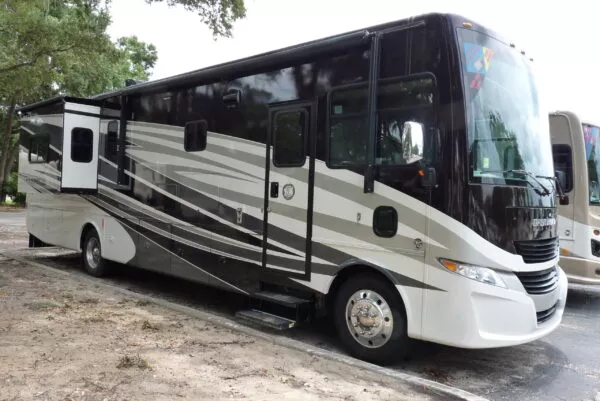
Learn About The Top 5 Tips For Buying A Motorhome

Before you can think about buying a motorhome, let’s identify what a motorhome is. It’s an RV that has an engine and drivetrain built into the RV.

In other words, a motorhome does not need to be towed to go somewhere. It can travel down the road under its own power.

So what kind of RVs could be classified as a motorhome? Class A, Class B, Class C, and Super C RVs certainly meet those criteria.

That’s a lot of RVs to choose from. So how do you know which kind of RV will be best for you and the way you like to camp?

The tips I’m going to share with you will help you know whether or not the RV you are looking at is in good shape. Whether it has major issues that need attention or not.

But before you implement the 5 tips in this article you need to do some work in advance.

Watch my video about the top 5 tips for buying a motorhome

Table of Contents

Buying A Motorhome – Advance RV Knowledge Needed

Yes, before you start getting serious about any one RV, get to know RVs in general. That means that you need to visit dealer lots and RV shows for a while.

Go through as many different kinds of RV motorhomes as possible. See what the differences are between the various motorhome classes.

Try to decide which class of motorhome will fit your needs and your budget. Then decide whether buying a motorhome that is new or used will be your best choice.

The more motorhomes that you walk through and investigate, the more knowledge you will gain about them. And pretty soon you will get a feel for the kind of motorhome that you feel fits your situation best.

Take your time in this stage. Don’t rush it. Even if it takes several months or even years, that’s OK. Getting to know the various motorhome classes is vital to making a good decision.

Tip #1 – Get To Know The RV Living Space

Once you have decided which motorhome class fits you, it’s time to look at individual RVs. And one of the most important considerations in any RV is – how does the living space work for you?

In general, there are only so many ways that the living area can be designed in an RV. And not everyone likes the sames layout.

So is the kitchen big enough for you? What is the location of the kitchen? Is the sitting area located in a logical place? How about the bedroom, is it laid out the way you like?

When it comes to the furniture in the motorhome, is it comfortable? It’s a good idea to lay on the bed, sit in the chairs and on the couch. See if you feel at home in that RV.

One big consideration is the bathroom. Is the toilet in a convenient place? When you sit on it, is it relatively comfortable? Is there enough storage space in the bathroom?

Then check out the shower too. Go ahead and stand in it to see if you have enough room to move around comfortably. Is it tall enough for you?

Note the position of the TV. Is it in a spot where it can easily be viewed from the sitting area? Or do you have to crane your neck to see it?

All of these considerations should be done before buying a motorhome. That way you will know whether that particular motorhome will meet your daily needs.

Tip #2 – Check For Water Intrusion

Water damage is the biggest threat to the life of a motorhome or any RV. It silently enters and weakens walls, ceilings, and floors.

If it goes on long enough, the motorhome will start crumbling from the inside. At that point, major repairs that are very expensive have to be made.

So it’s critical to try to stop water intrusion in its tracks as soon as it appears. Of course, prevention is the best course of action in this case. But you are looking at an RV that someone else has maintained now.

The best place to start to see how well the motorhome has been maintained is often on the roof. Look carefully at the roof material itself. Is there evidence of rips and tears that have not been repaired?

What about the sealant. Are there any gaps in the sealant that can be seen? Is the sealant old, brittle and cracked?

Now make the same examination on the sides, front and rear of the motorhome. Do you see areas where sealant is cracking, drying out, or even missing?

Now go inside the RV and look for water stains everywhere on the walls, ceilings and floors. Go inside the cabinets and closets and look all over for evidence of water intrusion.

Press against the walls and walk on the floors to see if you can detect any soft areas. That could be evidence of water intrusion that could be expensive to fix.

This is one of the most important inspections you can make on a motorhome. And you may be surprised to find that RVs that otherwise look fabulous may have these kind of issues.

Tip #3 – Inspect The Motorhome Tires

Another important area you need to examine closely is the tires before buying a motorhome. This is because replacement of tires is one of the biggest ongoing expenses for RV owners.

And the first thing you want to look for is the tire date of manufacture. It is stamped on the side of the tire and is represented by a four letter code.

The first two letters are the week that the tire was made and the second two letters are the year of manufacture. Why is this important to know?

The tire date of manufacture is stamped on the side of the tire with a four letter code
The tire date of manufacture is stamped on the sidewall

Many RV tire manufacturers recommend replacing your tires between 5 – 6 years after the date of manufacture. This is regardless of the tread wear. So follow the manufacturers recommendation about tire replacement.

The reason for this is that RV tires rarely wear out before they age out. They are simply not usually driven enough for major tire tread wear to take place.

Instead the sun’s UV rays and other elements often dry out the oils in the tire rubber first. Then they start to crack and there is the opportunity for a major blowout to happen.

So the best prevention for that scenario is to just replace them every 5 – 6 years. That way you are erring on the side of safety.

So if the motorhome tires you are examining are near the end of their useful life, note that. And realize that you will need to replace your motorhome tires soon after buying that RV.

It’s best to know about this kind of upcoming expense before buying a motorhome. You may even be able to adjust the price of the RV downward due to the condition of the tires.

Tip #4 – Get a Fluid Analysis Done

Motorhomes by definition have a motor and drivetrain somewhere. And many of them have permanently mounted generators too.

If the engine, transmission or generator requires a major repair, that is a huge expense. So how do you find out the condition of these components?

First, it wouldn’t hurt to have a qualified mechanic take a look for any signs of possible upcoming repairs. But there is an even better way to find out as much as you can about the mechanical parts of the motorhome.

In fact, the best way to learn about the condition of almost any mechanical engine or transmission is through fluid analysis.

This means that you simply extract some of the engine oil and coolant. Then do the same with the generator. And finally get a sample of the transmission fluid as well.

A sample fluid analysis kit
A fluid analysis kit

Then send the samples to a qualified lab to have them examined. They will send you back a complete breakdown of what the fluids indicate may be going on inside those mechanical components.

Here is a link where you can get fluid analysis kits

This is because long before major failure of an engine or transmission part, it starts to leave residue in the lubrication fluid. This residue is a clue to future probelms.

And a trained technician who examines that fluid can give you a warning before the failure happens. But the lab has to be familiar with RV components to be able to read the fluids correctly.

So be sure to have the motorhome fluids checked if you don’t have a complete history of the maintenance that has been done on these mechanical items.

Tip #5 – Get An RV Inspection Before Buying A Motorhome

You had to see this one coming, right? I mean, what else would a certified RV inspector recommend?

Seriously though, getting an inspection by an NRVIA certified inspector is one of the smartest things you can do before buying a motorhome.

The inspector will give you a complete report on the condition of the motorhome and all of its systems. You will have a full rundown on the RV from the roof to the tires.

And getting a motorhome inspection is a good idea whether it’s new or used. In fact, many new RV buyers are getting them inspected before taking delivery of the coach.

This is because so many newer RVs and motorhomes are coming from the factory with multiple defects. And the manufacturers are expecting the RV dealers to fix these issues for the customer.

When you have a certified inspector go over the RV, they can list all of those problems in their report. And then the issues can be handled under warranty all at one time.

The inspection is well worth the cost in my opinion as it can save you from major hidden repair costs if it is used. And the inspector can even perform the fluid analysis on the mechanical components as well.

Conclusion

Just to review, here are the top 5 tips for buying a motorhome:

  • Get to know the living space well. Try it out as much as you can and see if you feel comfortable with the motorhome layout and furnishings.
  • Look everywhere for evidence of water intrusion that has already occurred. And then check for sealant problems that could lead to water intrusion in the near future.
  • Carefully inspect the tires for the manufacture date and for signs of drying out and cracking. If they are beyond the recommended tire life from the manufacturer, replace them.
  • If you don’t have full maintenance records on all of the engine and drivetrain components, get a fluid analysis done. This will help you know whether major component failure may be looming or not.
  • Get the motorhome inspected by an NRVIA certified RV inspector. This will help you know the overall condition of the RV better than anything else you can do.

My Five Best RV Road Trip Travel Tips

In this article I’m going to share with you my top 5 RV road trip tips.

We are going to discuss ways to make your road trip more pleasant and enjoyable. And this is important, because for many an RV road trip is stressful and sometimes dreaded.

But it doesn’t have to be that way. Just a few RV tips from the pros who have learned how to make time on the road more fun, can be all that’s needed.

So let’s get started right away with my first tip!

Watch my video about the top 5 RV Road Trip Tips

Disclosure: Please note this post may contain affiliate links. This means โ€“ at no additional cost to you โ€“ I earn a commission if you make a purchase using our affiliate links. I only link to products and companies I use and feel comfortable recommending. The income goes toward supporting the free content on this website

Table of Contents

RV Road Trip Tip #1 – Don’t Be In A Hurry!

When you are on the road traveling in an RV, it’s so easy to get in a hurry. After all, you have to break camp in the morning, drive for hundreds of miles, and set up camp again.

Add into this mix stopping for fuel, for food, for bathroom breaks and so on.

And quickly a go, go, go mindset starts to take over. For many RVers it becomes more about the destination rather than the journey.

When this happens, stress starts to rise and mistakes are easy to make. Tempers can flare, and then the RV road trip becomes a nightmare.

So how do you avoid all of this? Well for us, the start of the day often sets the tone for the whole trip.

We make sure that we get up in time to leisurely wake up and have a bite to eat.

Then we use a checklist to steadily work through breaking camp. That way we don’t miss anything by simply forgetting to do it.

Once we are on the road, we make good use of the rest stops along the way to take a break. We often get out of the RV and take a good brisk walk around the rest stop area and have a snack.

It’s amazing how this simple activity can change a dull and boring RV road trip into one that is more pleasurable.

And that brings me to my second RV road trip tip.

Tip #2 – Practice The 3/3/300 Rule

A surefire way to increase stress and anxiety on a road trip is to try to cover too much ground each day.

So we use the 3/3/300 rule on our RV road trips. That is, we only travel 3 days in a row without stopping for a few days to rest. Then we only travel a maximum of 300 miles in a day and we plan to get to our destination by 3 o’clock.

Traveling no more than 3 days in a row is a big stress reliever. That’s because breaking down and setting up camp every day in an RV is a real chore.

It adds so much more effort to traveling on the road. And many campsites and hookups require you to be flexible and a good problem solver too.

So not having that added anxiety for more than three consecutive days is a good thing.

And making sure that the day’s driving is no more than 300 miles limits the fatigue that inevitably sets in after several hours on the road.

Finally, getting to the next campsite by 3 o’clock insures that you won’t be arriving in the dark or during rush hour traffic.

This is huge because if you have ever tried to set up camp in the dark, you know how challenging that can be.

If you leave by 9AM in the morning and plan to travel 300 miles that day, you will probably be arriving by 3 o’clock.

This is because we have found that counting rest stops and lunch breaks, we tend to average 50 MPH. So do the math and you can see that it all works well together.

The 3-3-3 travel rule for RV road trips
The 3-3-3 RV travel rule

Now for my next road trip tip.

RV Road Trip Tip #3 – Plan Ahead

I know that a lot of folks love to live their life in the most spontaneous way possible. And there is nothing wrong with that.

But if you have a rig any larger than a Class B van, you will really benefit by planning ahead more.

Large Class Cs, Class As, 5th wheels and travel trailers need to know what is ahead of them. This keeps the trip more manageable and stress-free.

This is because bigger rigs require more advance thought when you are in areas that you don’t know well.

So we like to use an online trip planner called RV Trip Wizard to plan out our long trips in advance.

It will let you know where rest stops, fuel stations and campgrounds are located all along your planned route.

And you can print out the route and have a handy guide for that day’s travels right in your hands as you go.

The yearly membership to the site is really affordable, and it has been a very reliable source of on-the-road information for us. I highly recommend it!

But one more suggestion in this area is to make sure that you also have a reliable and trustworthy road atlas handy too. Don’t just rely on online maps or GPS units to always steer you correctly.

The truth is that no one RV trip planning tool does everything and is infallible. So have some printed backups on hand at all times, just in case.

Learn more about RV Trip Wizard by clicking here

Click here for the Rand McNally Road Atlas

(Some of these are affiliate links for the product on Amazon. It does not cost you any extra to buy the product using my affiliate link if you choose to do so)

Now for the fourth tip.

Tip #4 – Use Helpful Apps And Guides

There are several useful guides to travel on the road but we have found a couple of them to be exceptionally useful.

There is a real need to know what services are available at each exit before you get there.

For instance, you may need to fuel up, or maybe stop off for a bite to eat, or even a sudden bathroom break.

But how do you know about all the services that are located at each exit?

One of the best sources of information we have found is a book called “The Next Exit”. It conveniently lists pretty much all of the offered services at each exit and gives you valuable information about them.

There is also an app that does a very good job of providing this kind of information too if you prefer apps. The one we like to use is called “I-Exit”.

Again, it’s not a bad idea to have more than one tool in this area. It helps to give you a complete picture of the offerings available at each exit.

This allows you to avoid wasting time searching at exits for needed services. Instead, you will know what to expect from every exit before you get to it.

This is another real stress reliever on an RV road trip!

Click here for the Next Exit Guidebook

Click here for the I-Exit app

(Some of these are affiliate links for the product on Amazon. It does not cost you any extra to buy the product using my affiliate link if you choose to do so)

Now for the fifth and final road trip tip.

RV Road Trip Tip #5 – Stow Anything That Can Move

One of the biggest irritations of traveling on the road is having to clean up a mess after a long day.

And traveling down the highway subjects all RVs to all sorts of bumps and shakes that can move things around in your RV.

So before you leave for the trip that day, stow anything that can move. Tie it down. Tape it down. Bungee it down. Put fragile items on the couch or bed.

Whatever you do, just make sure that RV travel is not going to make a mess in your RV.

The end of a day’s travel is not the time to be dealing with a mess. Especially so, because you now have to set up camp and get dinner going too.

A little advance preparation in this area will make the end of the day much more pleasant.

We have found that having a checklist helps us remember what needs to be done in this area too. Just follow the checklist and most spill accidents will be avoided.

Conclusion

RV road trips have their own set of unique challenges and difficulties.

But if you are well organized and do a little advance planning, road trips can be much more enjoyable.

So how do you make RV road trips better?

  1. Don’t be in a hurry
  2. Use the 3/3/300 rule
  3. Plan ahead with RV Trip Wizard and an Atlas
  4. Use guides or apps to know what is at each exit
  5. Before you go, stow anything that can move

I hope this information has been helpful for you.

Have safe and happy travels my friends!

5 Essentials For Your RV Water System

Your RV water system has a greater impact on your daily life than almost any other system in your RV. And it can directly affect your health as well.

So it makes sense to do your best to keep your RV water system in good working order. That way you can make sure that the water you use each day is high quality and safe.

So I’m going to share 5 essential tips about water usage that every RVer should know.

None of these tips are expensive. But they will make your RV travels so much easier if you use them.

So let’s get started with the first essential tip.

Watch my video about campground water hookups

Disclosure: Please note this post may contain affiliate links. This means โ€“ at no additional cost to you โ€“ I earn a commission if you make a purchase using our affiliate links. I only link to products and companies I use and feel comfortable recommending. The income goes toward supporting the free content on this website.

Table of Contents

#1 – Get The Right Kind Of RV Water Hose

In our brick and mortar homes, water is dispensed to us through pipes. And there are safety regulations in place to govern the materials used in those pipes.

This is because unsafe compounds in the piping materials can leach into the water and over time damage our health.

In an RV, we also have water pipes once the water reaches the inside of the RV. But in between the campground source and the RV, we rely on a flexible hose to convey the water.

So what kind of materials is that RV water hose made of? Is any old hose OK to use for your drinking water?

If you ask the average person, they would probably say that any hose will do the job just fine. But that is not true!

What Kind Of Hose Should You Use?

Most water hoses found in a hardware or building supply store are designed for use in a garden or outside area. So the materials used in those hoses do not have to meet strict food safe standards.

And some of the materials used in the construction of those water hoses are not safe for drinking water use.

So are there water hoses that are safe to use in your RV water system?

Yes, but you have to look for a hose that specifically says that it is “food safe” or “drinking water safe”. And yes, these kind of RV water hoses will cost more than the typical water hose.

But when you are talking about the water you drink every day, don’t go cheap here. Make sure that it is made of high quality materials and “drinking water safe” to use.

Click here for a “drinking water safe” RV hose

(This is an affiliate link for the product on Amazon. It does not cost you any extra to buy the product using my affiliate link if you choose to do so)

#2 – Get An RV Water Hose That Will Last

In addition to getting a water hose that is safe to use for drinking water, you need to get an RV water hose that will last.

After all, as RVers we put these hoses through some pretty hard times. And the connections are usually the part of the hose that goes first.

I can certainly recall some times where I needed to apply some serious torque to get my water hose to connect properly.

This is especially true in RV campgrounds where the water faucet connection is old and worn.

Well, all of that extra tightening can easily and quickly wear out a water hose with plastic connectors. In fact, I have had them break apart in my hands after a while.

So getting a quality water hose for your RV water system also involves getting one that has strong metal connectors on both ends.

Again, this is going to cost more money than the hoses with plastic connectors. But that’s why the manufacturers make them that way. To keep the cost down.

And if you only go RV camping every now and then, it may last a while. But if you use your RV regularly, that kind of hose is actually going to cost you more in the long run.

This is because you will be replacing it long before the hose itself is worn out. The connectors will fail first.

So make sure to get a hose that will stand up to the unique challenges of regular RV water system use.

Click here for an RV hose with metal connectors

(This is an affiliate link for the product on Amazon. It does not cost you any extra to buy the product using my affiliate link if you choose to do so)

#3 – Get A Water Pressure Regulator With A Gauge

My next essential tip is about RV water pressure regulators. Make sure not only to get one for your RV, but also make sure that it has a readable gauge.

RV travels take you to lots of places and lots of different water hookups. Water pressure regulators are needed because some of those water connections can have extremely high or low water pressure.

If the water pressure from the campground connection is very high, it could damage the pipe connections in your RV water system.

And since those connections are usually hidden, you can imagine how difficult it is to repair. And costly too!

So an RV water pressure regulator helps resolve that issue. It reduces the water pressure to a safe level for your RV.

But there are some regulators that just have a readout dial. Nothing tells you what the water pressure reading is that is going into your RV.

And you can’t adjust the pressure to your specific rig or needs. Of course, it’s nice to have the color-coded readout, but a gauge is much better.

So be sure that the RV water pressure regulator you buy tells you what the exact water pressure is in PSI. And also that it allows you to adjust that pressure as needed.

Click here for my recommended RV water pressure regulator with a readable gauge

(This is an affiliate link for the product on Amazon. It does not cost you any extra to buy the product using my affiliate link if you choose to do so)

What Is A Safe RV Water Pressure?

The answer to this question is dependent on the age and condition of your rig. But there are some general guidelines that many RVing websites agree on.

Generally speaking, if your RV is more than just a couple of years old, you may want to keep the water pressure between 40 – 50 PSI.

If it is a fairly new rig, the plumbing has probably been tested up to 100 PSI at the manufacturer. But you don’t want a steady diet of that kind of water pressure going into your RV.

So for newer rigs, many RVers have successfully adjusted the pressure to 60 PSI and had good results.

But what about low water pressure?

There is only so much pressure that you can get out of a hookup with low PSI. But an adjustable water pressure regulator allows you to get as much as you can.

In most cases you will find a screw on the top of the regulator that can adjust the water pressure.

By tightening the screw, you can often raise the water pressure. And by loosening it, the water pressure going into your RV is reduced.

The real point is that having an adjustable water pressure regulator with a gauge puts you in control. It allows you to set the water pressure in your RV water system to the level that you desire.

#4 – Use A 90 Degree Elbow Water Connector

As mentioned above, you will encounter all kinds of water hookups when you travel in an RV. And some of those hookups are very close to the ground.

In fact, sometimes the connection is so close that it makes it difficult to get the hose connected without kinking it.

This is especially true if you use an RV water pressure regulator. These units work best when they are first in line at the campground water connection.

So when you add the water pressure regulator to the hose connection at the faucet, more room is needed. And if the water faucet is close to the ground you may run out of room fast.

Also, the water connection that goes into the RV is usually on a vertical wall. If you like to use a water filter or other accessory before the water enters your RV, this can be a problem.

The weight of the filter or accessory can put downward pressure on the water connection going into the RV. Over time, this can weaken that connection and leaks develop that are hard to resolve easily.

So in both scenarios mentioned above, using a 90 degree elbow can solve the problem.

How A 90 Degree Elbow Can Solve These Problems

If the faucet is too low, just attach the 90 degree elbow. Then you can put the water pressure regulator and anything else you wish on the hose without running out of room.

And if you attach the 90 degree elbow when the hose goes into the RV, this solves the weight issue at the wall connection.

Since the 90 degree elbow points down at the connection, now gravity is working for you and not against you in this critical area.

These little 90 degree connectors are so cheap, but they help so much to make your RV water system last without developing leaks prematurely. So get a few of them and keep them on hand!

Click here for a 90 degree RV water connector

(This is an affiliate link for the product on Amazon. It does not cost you any extra to buy the product using my affiliate link if you choose to do so)

#5 – Cold Weather RVing Tips

My last essential tip for your RV water system is about what you should do with your campground water connection in really cold weather.

When I say cold weather, I mean when the temperatures will be falling to freezing or below for a few hours. Above freezing, your water hookup should be fine.

But if you know that freezing temperatures could be in store, I recommend unhooking from the campground faucet altogether.

Of course, before you unhook, be sure to put sufficient water in your fresh water tank first. Then just use the water pump to feed your faucets and shower.

In fact, I just had a little bit of a wakeup call on this subject recently.

I saw that the temps were going to go below freezing for a few hours, so I unplugged my hose from the RV. But I forgot and left the outside water filter on the faucet.

The next morning the water had frozen in the filter, expanded, and tore it in half!

This was a real reminder of the damage that can done to RV plumbing by freezing water.

Of course, many RVers seem to ignore this advice and many get away with it too.

But nobody likes big plumbing repair bills. Especially when they happen simply because you didn’t take a few minutes and unplug your RV water connection.

So be sure to take freeze warnings seriously and prepare well for them. This includes unhooking any water filters and storing them in a warmer area.

Conclusion

None of the RV gear recommended above is expensive. In fact, they are very cheap compared to some other RV related items and gear.

But they can make sure that your RV water system is the best that it can be. And having these items can make your RV travels less costly and frustrating.

In the case of RV water hoses, many people don’t give them a second thought. So they just buy the cheapest one they can find.

But that can be a bad choice for many reasons. Just getting a “drinking water safe” hose with metal connections is the right choice for this section of your RV water system.

Then getting 90 degree elbows can make sure that you are ready for almost any water hookup issue you may encounter.

And finally, don’t tempt freezing temperatures when you are RV camping!

Unhooking at the campground pedestal is the smart move in these cases every time.

I hope these 5 essential tips have been helpful for you.

We would love to hear about your own experiences with RV water hookups. So please comment below and share your knowledge with us as well.

As always, have safe and happy travels my friends!

Get My FREE Camping Guide

“The Top 5 Ways To Save Money On Campground Costs”

Get My Newsletter

Save on RV repairs

Get the best RV gear

Learn about RV life

RV tips and tricks

And get my free guide – The Top 5 Ways To Save Money On Campground Costs”