Class A vs Class C RVs – The Pros And Cons Of Each

One of the most common comparisons that many new RVers make is Class A vs Class C RVs. Especially if you are intent on having a motorhome instead of a towable RV.

In the motorhome world, these are the two RV classes that have the most room. So naturally, they are ripe for comparisons between the two.

Therefore, let’s take a look at both RV classes and try to determine which kind of RVer fits each class best.

Watch my video about Class A vs Class C RVs

Table of Contents

Class A vs Class C RV Comparison

Class A RVs are often built on a bus or commercial truck chassis. And they usually resemble a bus in appearance.

Because of the strength of the chassis used in these RVs, they can safely handle quite a bit of weight.

They can range in size from around 30 feet to about 45 feet in length. And the longer ones are the luxury kings of the RV world, with all kinds of amenities onboard.

A Class C RV though, is usually built on a heavy duty truck or van chassis instead. A common Class C chassis is the Ford F350 or F450.

And this means that they can’t safely handle quite as much weight as a Class A.

Note – in this article I am not referencing Super C RVs. They are more or less in a class of their own.

B the best way to identify a normal Class C RV is by the sleeping area that usually juts out over the driving area.

Since the RV part is higher than the cab, it allows this space to be used. And most often that space is turned into a sleeping area above the cab.

Now, let’s get to the pros and cons in this discussion of Class A vs Class C RV types.

Class A Advantages
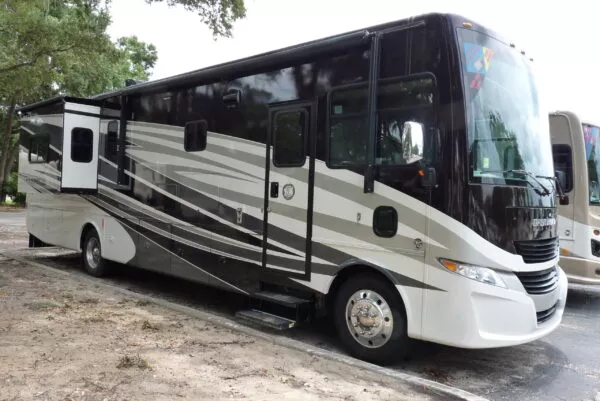
Class A RV

Each class of RV has it’s strengths, and here are the pros of buying a Class A RV:

  1. More living space – Class A RVs are usually longer, wider and taller than most Class Cs. This means that you get more living space to move around the RV inside.
  2. More amenities – Because the frame and chassis can safely handle more weight, you can have more amenities in a Class A. Things like washer/dryers, larger refrigerators and kitchens, bigger beds and so on become possible.
  3. More slides – They also can handle more and bigger slide-outs, which also contributes to more living area.
  4. More storage – Typically, Class A storage is greater than what you find in a Class C. But the difference becomes even greater when it’s a diesel pusher Class A. Again, all of this is possible because of the extra weight carrying capacity of the Class A chassis.
  5. Larger tanks – Usually the fresh water, gray water and black water tanks will be larger. This allows you to go longer before filling up or dumping your tanks.
  6. More towing capacity – When comparing Class A vs Class C RVs, the engine can be a factor too. In diesel powered engines, the towing capacity is much greater than most gas powered Class Cs.
  7. Better visibility – When driving, it’s hard to beat the view and visibility provided by a Class A RV.

Class C Advantages

Class C RV

Now, let’s take a look at the advantages of Class C RVs instead:

  1. Smaller and more nimble – Usually Class C RVs are smaller than Class As. That means that they can fit in more campsites. And they will be easier to find a site for boondocking too.
  2. Price – Most often, the price of Class C RVs will be much less than a Class A. This is true of both new and used RVs. That makes it easier for new RVers to get started with a Class C.
  3. More sleeping options – If you have a family, the number of sleeping spots can be important. And Class C RVs tend to shine in this area. Very often they provide sleeping arrangements for 8 – 10 people.
  4. Easier to drive – Because Class C RVs are smaller, they are also easier to maneuver in traffic. Many newer RVers like Class C RVs because of their driving characteristics alone.
  5. Easier to repair – Because they are built on a common truck and van chassis, there are plenty of places where they can be repaired. Engine work is also more easily done on a Class C engine, even by DIYers.
  6. Better fuel economy – Because a Class C RV is usually smaller than a Class A, they often get better gas mileage on the road.
  7. Less trip planning – Since Class Cs are smaller they can fit in many fuel stations and restaurant parking lots. So this eliminates the extra planning needed for stops made in a Class A because of its size and length.

Class A vs Class C – Which Is Best For You?

So having considered the above advantages of Class A vs Class C RVs, which is the best choice for you? What is best for the kind of RVer you are? And for the way you like to travel and camp?

Well, generally speaking, Class A RVs are good choices especially for full-time RVers. The extra living space is a big reason why a full-timer would often want a Class A.

But they are also best for those who really want their luxury items as they travel down the road.

The extra weight carrying capacity of a Class A means that you can essentially have a rolling home. And that appeals to a lot of RV glampers.

Class As are also great for storage, and towing along an everyday vehicle too. So again, this plays into the needs for a full-time RVer.

On the other hand, Class C RVs are great for weekend campers who don’t need all of the extra space in a Class A.

And they work very well as the first choice of RV for those who are just breaking into RV life.

Families also benefit from the extra sleeping options of a Class C RV. And even fulltimers who like to travel light and fit into smaller campsites benefit from a Class C too.

Which Should You Choose?

As with so many other matters in the RV world, there is no one solution to everyone’s needs. And both of these motorhome types have their place.

And that’s why you see so many of both Class As and Class Cs on the road. Obviously, each class fits the needs of a large number of RVers.

So if the Class A vs Class C comparison is one that you are making now, hopefully this article has helped.

I recommend that you define your own camping and travel priorities first. Then try to determine which type of motorhome will best answer those needs.

If you do your homework in advance, you will be able to make the choice that is best for you!

How To Find The Best RV Campgrounds And Campsites

We all want to stay at the best RV campgrounds and campsites possible on our RVing travels.

And there are plenty of places to stay in this country. But not all are equal. Some are well maintained and a pleasure to stay at. But others are not.

So how do you find the camping spots that are good places to stay if you haven’t been there before?

Fortunately, there is plenty of information about RV campgrounds and campsites online. And if you know where to look you can get the information you need very quickly.

I like to use a few tools online to search for the best RV campgrounds and I’ll share them with you here.

Please keep in mind that I am not affiliated with these websites in any way. So my recommendation is based purely on my own personal experiences with them.

Watch my video about how to find the best campgrounds

Table of Contents

Best RV Campgrounds Resource #1

The best resource that I have found overall for information about RV campgrounds in general is CampgroundReviews.com .

First of all, it’s completely free to sign up for and use. I like the fact that you don’t have to have another membership to get the information that you need. So this is a big plus.

I also like the fact that all of the reviews are submitted by people who have no vested interest in swaying your opinion about the campground one way or another.

And on top of that, all of the reviews go through a vetting process before they are published. This means that someone makes sure that it is a legitimate review first. Then it is posted after being approved.

Resource #2 For The Best RV Campgrounds

I honestly like to use CampgroundReviews.com for the vast majority of my campground searches.

But there is another site that also provides great information on campgrounds as well. In my book, it comes in a close second to my first resource.

That site is TheDyrt.com . There is plenty of information available about campgrounds throughout the country here too.

But overall, I have found that it has fewer reviews per campground in most cases. And that is the main reason why I give it the second place on my list of best RV campgrounds resources.

But I often find that I can get a very accurate picture about campgrounds I am considering when I use these first two resources together.

Resources For The Best Boondocking Campsites

Finding campsites for boondocking is a little bit different from finding campground information.

RV boondocking sites are sort of in a category by themselves. And most of what you want to know comes from those who have camped in those spots already.

Campground information like the kind of hookups available, site length, amenities and so forth, aren’t needed.

Instead, you need to know about things like the condition of access roads, how level the sites are, and what kind of internet access is found there.

So having previous campers share their experiences on these kind of matters is absolutely invaluable.

And the best resource I have found for this kind of information is Campendium.com .

Lots of boondockers use this website to find out what boondocking spots are available and where. And many boondockers recognize the need to share their experiences so there are always new reviews being added.

A second resource that also provides great RV boondocking information is FreeCampsites.net . This resource is a little more clunky than Campendium.com, but it has a lot of useful information though.

When I am considering boondocking spots, I almost always use both of these online resources together. When I do, I find that I get a really good picture of the campsites I am interested in.

Your Part In Providing The Best RV Campgrounds

So far, I have covered some of the most useful online resources that I know of for finding the best RV campgrounds and campsites.

But none of the sites I have mentioned could provide this information without reviews from RV travelers. The key to getting accurate campground and campsite information is getting unbiased reviews from RVers themselves.

So I highly recommend that everyone who travels by RV resolve to contribute their own reviews to help other RV travelers.

The more information provided on RV campgrounds and campsites, the better overall picture we have about them.

Also, when RVers post reviews of RV campgrounds online, you can be sure that the campground management reads them too.

And when the reviews are becoming increasingly negative about certain issues in that campground, that often gets results.

In fact, unbiased word of mouth is the best and worst advertising that RV campgrounds can have. So they know that it is in their best interest to keep the reviews as positive as they can.

So I encourage you to accept the responsibility for posting your own online reviews as a way to help make RV travel better for everyone.

My Five Best RV Road Trip Travel Tips

In this article I’m going to share with you my top 5 RV road trip tips.

We are going to discuss ways to make your road trip more pleasant and enjoyable. And this is important, because for many an RV road trip is stressful and sometimes dreaded.

But it doesn’t have to be that way. Just a few RV tips from the pros who have learned how to make time on the road more fun, can be all that’s needed.

So let’s get started right away with my first tip!

Watch my video about the top 5 RV Road Trip Tips

Disclosure: Please note this post may contain affiliate links. This means โ€“ at no additional cost to you โ€“ I earn a commission if you make a purchase using our affiliate links. I only link to products and companies I use and feel comfortable recommending. The income goes toward supporting the free content on this website

Table of Contents

RV Road Trip Tip #1 – Don’t Be In A Hurry!

When you are on the road traveling in an RV, it’s so easy to get in a hurry. After all, you have to break camp in the morning, drive for hundreds of miles, and set up camp again.

Add into this mix stopping for fuel, for food, for bathroom breaks and so on.

And quickly a go, go, go mindset starts to take over. For many RVers it becomes more about the destination rather than the journey.

When this happens, stress starts to rise and mistakes are easy to make. Tempers can flare, and then the RV road trip becomes a nightmare.

So how do you avoid all of this? Well for us, the start of the day often sets the tone for the whole trip.

We make sure that we get up in time to leisurely wake up and have a bite to eat.

Then we use a checklist to steadily work through breaking camp. That way we don’t miss anything by simply forgetting to do it.

Once we are on the road, we make good use of the rest stops along the way to take a break. We often get out of the RV and take a good brisk walk around the rest stop area and have a snack.

It’s amazing how this simple activity can change a dull and boring RV road trip into one that is more pleasurable.

And that brings me to my second RV road trip tip.

Tip #2 – Practice The 3/3/300 Rule

A surefire way to increase stress and anxiety on a road trip is to try to cover too much ground each day.

So we use the 3/3/300 rule on our RV road trips. That is, we only travel 3 days in a row without stopping for a few days to rest. Then we only travel a maximum of 300 miles in a day and we plan to get to our destination by 3 o’clock.

Traveling no more than 3 days in a row is a big stress reliever. That’s because breaking down and setting up camp every day in an RV is a real chore.

It adds so much more effort to traveling on the road. And many campsites and hookups require you to be flexible and a good problem solver too.

So not having that added anxiety for more than three consecutive days is a good thing.

And making sure that the day’s driving is no more than 300 miles limits the fatigue that inevitably sets in after several hours on the road.

Finally, getting to the next campsite by 3 o’clock insures that you won’t be arriving in the dark or during rush hour traffic.

This is huge because if you have ever tried to set up camp in the dark, you know how challenging that can be.

If you leave by 9AM in the morning and plan to travel 300 miles that day, you will probably be arriving by 3 o’clock.

This is because we have found that counting rest stops and lunch breaks, we tend to average 50 MPH. So do the math and you can see that it all works well together.

The 3-3-3 travel rule for RV road trips
The 3-3-3 RV travel rule

Now for my next road trip tip.

RV Road Trip Tip #3 – Plan Ahead

I know that a lot of folks love to live their life in the most spontaneous way possible. And there is nothing wrong with that.

But if you have a rig any larger than a Class B van, you will really benefit by planning ahead more.

Large Class Cs, Class As, 5th wheels and travel trailers need to know what is ahead of them. This keeps the trip more manageable and stress-free.

This is because bigger rigs require more advance thought when you are in areas that you don’t know well.

So we like to use an online trip planner called RV Trip Wizard to plan out our long trips in advance.

It will let you know where rest stops, fuel stations and campgrounds are located all along your planned route.

And you can print out the route and have a handy guide for that day’s travels right in your hands as you go.

The yearly membership to the site is really affordable, and it has been a very reliable source of on-the-road information for us. I highly recommend it!

But one more suggestion in this area is to make sure that you also have a reliable and trustworthy road atlas handy too. Don’t just rely on online maps or GPS units to always steer you correctly.

The truth is that no one RV trip planning tool does everything and is infallible. So have some printed backups on hand at all times, just in case.

Learn more about RV Trip Wizard by clicking here

Click here for the Rand McNally Road Atlas

(Some of these are affiliate links for the product on Amazon. It does not cost you any extra to buy the product using my affiliate link if you choose to do so)

Now for the fourth tip.

Tip #4 – Use Helpful Apps And Guides

There are several useful guides to travel on the road but we have found a couple of them to be exceptionally useful.

There is a real need to know what services are available at each exit before you get there.

For instance, you may need to fuel up, or maybe stop off for a bite to eat, or even a sudden bathroom break.

But how do you know about all the services that are located at each exit?

One of the best sources of information we have found is a book called “The Next Exit”. It conveniently lists pretty much all of the offered services at each exit and gives you valuable information about them.

There is also an app that does a very good job of providing this kind of information too if you prefer apps. The one we like to use is called “I-Exit”.

Again, it’s not a bad idea to have more than one tool in this area. It helps to give you a complete picture of the offerings available at each exit.

This allows you to avoid wasting time searching at exits for needed services. Instead, you will know what to expect from every exit before you get to it.

This is another real stress reliever on an RV road trip!

Click here for the Next Exit Guidebook

Click here for the I-Exit app

(Some of these are affiliate links for the product on Amazon. It does not cost you any extra to buy the product using my affiliate link if you choose to do so)

Now for the fifth and final road trip tip.

RV Road Trip Tip #5 – Stow Anything That Can Move

One of the biggest irritations of traveling on the road is having to clean up a mess after a long day.

And traveling down the highway subjects all RVs to all sorts of bumps and shakes that can move things around in your RV.

So before you leave for the trip that day, stow anything that can move. Tie it down. Tape it down. Bungee it down. Put fragile items on the couch or bed.

Whatever you do, just make sure that RV travel is not going to make a mess in your RV.

The end of a day’s travel is not the time to be dealing with a mess. Especially so, because you now have to set up camp and get dinner going too.

A little advance preparation in this area will make the end of the day much more pleasant.

We have found that having a checklist helps us remember what needs to be done in this area too. Just follow the checklist and most spill accidents will be avoided.

Conclusion

RV road trips have their own set of unique challenges and difficulties.

But if you are well organized and do a little advance planning, road trips can be much more enjoyable.

So how do you make RV road trips better?

  1. Don’t be in a hurry
  2. Use the 3/3/300 rule
  3. Plan ahead with RV Trip Wizard and an Atlas
  4. Use guides or apps to know what is at each exit
  5. Before you go, stow anything that can move

I hope this information has been helpful for you.

Have safe and happy travels my friends!

Get My FREE Camping Guide

“The Top 5 Ways To Save Money On Campground Costs”

Get My Newsletter

Save on RV repairs

Get the best RV gear

Learn about RV life

RV tips and tricks

And get my free guide – The Top 5 Ways To Save Money On Campground Costs”