Class B RVs – The Pros And Cons You Need To Know

Class B RVs are becoming very popular. In fact, they are one of the fastest growing segments of the RV industry.

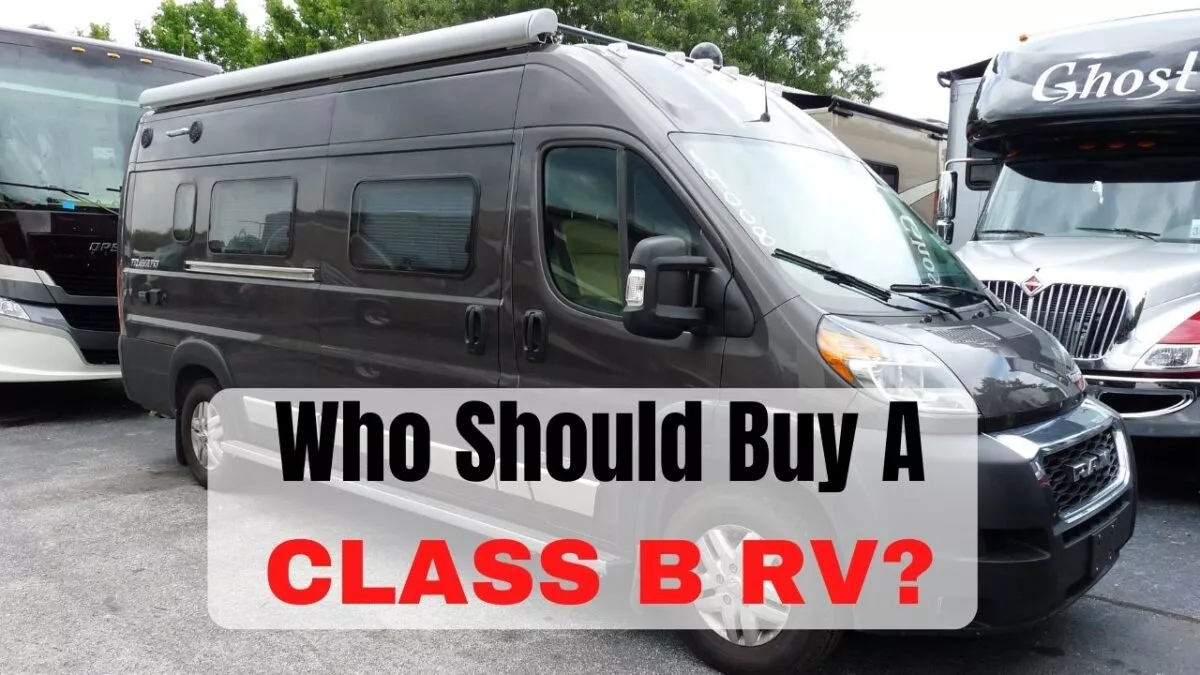
But what is a Class B RV anyway? Well, usually they are built on a van chassis. For instance, either a Mercedes Sprinter, Ford Transit, or Ram ProMaster frame and chassis.

Watch my video on Class B RVs

That means that they are often about 15 – 20 feet in length. And they can come in either gasoline or diesel powered versions.

So you may have seen plenty of Class B RVs on the road and just didn’t know it. That’s because they tend to blend in more with passenger vehicles because of their size and shape.

But like all RVs, they have pros and cons that you should know about before buying one. So let’s talk about those advantages and disadvantages of Class B RVs now:

Class B RVs boondocking

Table of Contents

The Pros Of Class B RVs

  • Easiest RV to drive – in fact they drive pretty much the same as a passenger van. This is great for newer RVers and those who find Class As and Class Cs too much to handle.
  • Great gas mileage for an RV – Much better than a Class A or Class C motorhome. And much better than most tow vehicles that pull either a 5th wheel or travel trailer too.
  • Class Bs can go places that larger RVs can’t – if you like boondocking in nature, this is a big plus. They also travel well on almost any kind or size of road.
  • They can fit in most campsites – their size allows them to fit into almost any campsite out there. This is especially great for National Park and National Forest campgrounds.
  • Often have the latest technology – they can come with equipment like a solar system installed. Also lithium batteries, instant-hot water heaters, and more.
  • Repair facilities are easy to find – this is because they are built on a common passenger vehicle van chassis. So the engine and drivetrain can be repaired almost anywhere.
  • Can be stored in your driveway – this is a big plus for some. Class A and Class C motorhomes are often prohibited from being parked in a home’s driveway. But Class B RVs look pretty much like any another passenger vehicle.
  • Can be used for stealth camping – they fit in so well that you can even stay in them overnight on many city streets.

The Cons of Class Bs

  • Smallest living space of any RV – very tight living quarters for more than two people.
  • Limited storage space – you won’t find many storage compartments on these RVs. Most of your storage is inside the RV.
  • No tow vehicle – this means that if you go anywhere, you must disconnect your campsite hookups whenever you leave. And when you return, you have to connect them again.
  • More expensive per square foot than other RVs – this is due to not being mass produced yet. As time goes on and they gain in popularity the prices may moderate more.
  • No permanent bed – in most cases the bed is often used as a sitting or dining area during the day. So every night the sitting or dining area must be changed into a bed.
  • Small bathrooms – these truly are tiny bathrooms. And that could be an issue with larger or older RVers with health issues.
  • Tiny kitchens and refrigerators – there just isn’t much room for counter space or a larger fridge.
  • Small fresh and waste water tanks – there just isn’t much room for them either. So you will have to refill the fresh water tank and dump the waste water tank more often.

Who Should Consider a Class B RV?

Class Bs are a great choice for solo RVers or couples that get along well in small spaces.

They do not work nearly as well for more than a couple. As you add more people, the available living space shrinks dramatically.

They are also good choices for RVers who don’t need many luxuries or amenities to be happy. There just isn’t space for lots of extras in these RVs.

They can also be great for weekend campers and tailgaters at sporting events. In fact, lots of people use them for shorter camping trips and overnights with great success.

Who Might Not Be A Good Candidate For A Class B?

RV couples that are fulltimers or part-timers should probably think twice about getting a Class B RV. Of course, that doesn’t mean that it is impossible.

But I have seen several couples who started out fulltiming in smaller RVs decide that more space was needed. And this seems to become more apparent as they spend more time in the rig.

Also, maybe you really like things like washer/dryers, residential sized refrigerators, larger showers. Then maybe a larger motorhome like a Class A will fit your needs better.

Conclusion

It is good to remember that there are no hard and fast rules about who should buy what kind of RV. There are just too many variables in people’s preferences to make that kind of call.

So if you still aren’t sure whether a Class B RV should be in your future after reading this article, that’s understandable.

Perhaps the best way to know for sure whether a Class B fits your style best is to try before you buy.

There are many RVers that rent out their RV during the times of year that it isn’t in use by them. So you could rent a Class B through a site like Outdoorsy.com and try it out first.

Go camping in the rental for a while. Get to know the little quirks of using a Class B RV on your own. Then you’ll have a much better picture of what it’s like to travel and camp in a Class B.

You can also ask other Class B owners that have similar traveling and camping styles to your own. See what they say about their rig and what they like and dislike about it.

By doing your homework in advance, you can put your mind at rest and determine whether or not a Class B RV is right for you.

As always, have safe and happy travels out there ……

Glamping VS Camping – What Kind Of RVer Are You?

Glamping VS Camping – what does that phrase mean to you? Actually it can mean different things to various kinds of RVers.

But for now, lets define what both “glamping” and “camping” mean as used in the text of this article.

For instance, this article will consider that “glamping” is the kind of RVing that is linked to the comforts that full hookups bring. So if you are a glamper, you most likely will be spending most of your time in campgrounds.

On the other hand, “camping” in this article means that you like to spend much of your time without hookups. And probably a lot of your RV camping experiences will be out in nature away from campgrounds.

Watch my video about glamping vs camping

Table of Contents

Glamping VS Camping – What It Means For You

So why do you even need to be thinking about whether you are a glamper or a camper anyway?

Well, the answer to that question will affect almost every decision that you will make about RVing.

Glampers and campers both enjoy RVing, but they come at it from two different directions.

And neither direction is better than the other. They both work equally well depending on what you want to receive from the RV lifestyle.

For instance, a glamper is more focused on enjoying the comforts that can be experienced in a rolling home.

But a camper usually prefers more challenging adventures in their RV travels.

So, in the glamping vs camping dilemma, is there shame in either choice? Is one style of RVing inherently better than the other?

Not at all! So if you recognize yourself as either a glamper or a camper in the material below, own it!

Because once you know what style of RVing you naturally prefer, it makes a lot of your RVing choices much easier.

So What Is Glamping?

If you tend to be a glamper, the size of your RV doesn’t matter much. You can even get a big rig if you want because many commercial campgrounds can handle it.

In fact, the larger you go, the more comforts you will typically see in an RV. This is especially true in diesel pusher motorhomes!

So if you are usually in a campground connected to full hookups, consider these “Do and Dont’s”:

  • Don’t worry much about solar power. I know that a lot of RVers may make it seem that if you don’t have solar power, you are missing out. But for those who spend the vast majority of their time hooked up to shore power, it’s just not necessary.
  • Don’t feel that you need an expensive generator either. Again, if you are going to be enjoying the comfort of full-time shore power, it’s not needed. In that case, a generator just becomes a backup for times when shore power is not working. So buy accordingly.
  • Don’t feel the need to invest in a lithium battery bank. That’s because lithium batteries are still very expensive. And they are overkill for situations where you are plugged into shore power most of the time. In fact, for those who spend most of their time in campgrounds, AGM batteries or lead acid batteries are fine.
  • Do focus on slide-outs. They open up space inside an RV like nothing else. So if you like space and comfort, get as much as you can afford.
  • Do get the best campground memberships. Glampers find that the most expensive part of camping for them is usually campground costs. So lower those costs with a good campground membership like Thousand Trails or RPI.
  • Do accept that nature can still be enjoyed on your RV travels, but by day trips instead of camping there. Glampers can still see lots of nature as they travel by finding campgrounds close to nature. Then travel to see whatever you want to see when you want to see it.

What You Need To Know About Camping

If you are a camper instead of a glamper, the following Do’s and Don’ts apply instead:

  • Do keep your rig to a manageable size if you like camping in nature. This probably means 30 feet or less. The smaller your rig, the more nimble you tend to be. And you can fit in more off-road spots when your RV is on the smaller side.
  • Do keep your RV weight down if boondocking in remote areas in on your camping menu. That will probably mean fewer slide-outs and amenities.
  • Do focus on power needs for your RV. If you are seldom hooked up to shore power, solar power and generators become more important. So do your research in these areas and buy quality equipment that won’t let you down.
  • Do get holding tanks that are as large as you can for your size rig. That’s because your waste water tanks will force you to have to move from your campsite at some point. So the larger the tanks, the less you have to move.
  • Do get familiar with ways to find good boondocking spots. For instance by using websites like Campendium. And get to know your way around National Park campgrounds. Learn about BLM land in the West and join boondocking groups on Facebook.
  • Don’t worry about finding campground memberships so much. Passport America may be helpful, but campgrounds will not be your normal thing.
  • Don’t get a residential refrigerator. You need the flexibility that a gas absorption fridge provides for boondocking.

Glamping VS Camping – My Conclusion

I see RVers making poor buying decisions all the time. And often it’s because they don’t base their decisions on the style of camping that they actually prefer.

Of course, some of the RV lifestyle influencers on YouTube don’t help much. Because some of them promote expensive equipment just to get higher commissions from the sale.

And they often make it seem that all RVers need this equipment regardless of the style of camping that they do.

But it’s simply not true. Glampers don’t usualy need solar power or lithium battery banks.

And campers don’t need campground memberships or residential refrigerators in most cases.

Instead, every RV buying choice that you make should be based on the style of camping you prefer. And if something doesn’t seem very useful for that kind of camping, you probably don’t need it!

I hope that helps, and as always, have safe and happy travels on your camping adventures!

How To Get Free RV Wifi For Internet Access Wherever You Go

In this article, I’m going to discuss how to get free RV wifi for internet access wherever you go.

But first, let’s reflect on the fact that internet connectivity is absolutely vital for many Rvers. And as time goes on, no doubt the need for mobile connectivity will only increase.

With that in mind, I have made a few videos that demonstrate how RVers can stay connected on the road. They cover subjects like what equipment you will need, the right kind of internet data plans for RVers, etc.

Those videos can be found here:

Click here for RV internet video #1

and also here:

Click here for RV internet video #2

The information in these videos is very helpful for those who need internet access wherever they go. So it’s probably a good idea to view those videos before finishing this article.

But is it possible to find yourself in an area where mobile connectivity is very poor? Places where all of the best mobile internet solutions just don’t seem to work well?

Cellular Mobile Internet Access

Actually, there are several ways to access the internet if you are a mobile RV traveler. But the most popular method by far is through cellular phone towers.

After all, the cellular carriers already provide a certain amount of internet access for phone users. So using a cellular network for internet connectivity makes a lot of sense.

But this means that you will need certain pieces of equipment to access cellular internet service. These include a dedicated hotspot, a good antenna, and probably even a cell booster.

And some RV travelers seem to indicate that if you are armed with that equipment, you are always online. But unfortunately, the truth is just not that simple.

Of course, a good mobile cellular internet setup will work in the vast majority of places you go. But the reality is that if you travel a lot in your RV, you will eventually find places where it doesn’t work well.

Why Cellular Internet Service Doesn’t Always Work

The reason for this is that cellular networks can sometimes get overloaded. This can happen easily when an area gets a sudden increase in cellular usage. For instance, when lots of tourists flood the area for a special event or season.

If there aren’t enough towers in the area to help out with the overload, the whole service slows to a crawl. In fact, it can become so slow that meaningful cellular internet service just disappears.

You may be able to check email and do some basic web surfing, but not much more than that.

And it doesn’t matter how fast or expensive your mobile internet equipment is. None of that means anything when the system it is using is clogged and unusable.

We faced just such a situation last year in the Pocono mountains of Pennsylvania. There was so many summer visitors in the area, that the few cell towers available were overwhelmed. And as a result , our mobile internet access was useless.

Free RV Wifi In RV Campgrounds

So if our mobile internet solution that we normally use on the road didn’t work, what then? What about the wifi offered by our campground?

After all, the RV park that we were staying in was a very nice park with lots of amenities. So, surely free internet wifi offered by the campground would solve our problem, right?

Well, the sad truth about RV campground wifi is that in most cases it is also pretty useless. Especially if there are a lot of campers in the park at one time.

You may see free internet wifi being advertised by RV parks and campgrounds. But that doesn’t mean that it is always a consistently reliable internet service.

Very often, the wifi systems installed in these parks simply can’t handle a lot of internet usage. So when the park fills up and lots of RVers want to stream movies, the whole system slows down.

We experienced this in the Poconos at the park where we stayed. The free wifi offered there just wasn’t very usable.

Other Places To Find Free RV Wifi

So, if you find yourself in an area where the cellular internet service is unusable, what can you do?

The good news is that there are lots of places that offer free internet wifi these days. It’s just that it may not come with the convenience factor that you are used to having for internet service.

But if you are anywhere near a town or a city, you most likely can get free internet access through wifi anyway.

Places like Starbucks, McDonalds, Panera Bread, Best Buy, Target, Office Max and others offer free wifi. You can also find free internet access at many public libraries and gyms.

Of course, they aren’t offering you free wifi for nothing. They want to entice you to visit them and hopefully buy some products while using their wifi.

But that doesn’t mean that you have to spend a lot of money while there. So you can grab a snack at places like Starbucks and McDonalds. Or make a small purchase at Best Buy or Office Max.

Believe me though, you will be happy to make a small purchase when you really need to get online.

So can we say that the wifi offered in these places is truly free then? Well, it’s up to you. But the low cost of a purchase is worth the internet access in my opinion.

Of course, public libraries can be an excellent choice for free internet wifi since it doesn’t have to involve a purchase. Very often, you can find a comfortable chair and get your internet work done in peace and quiet.

A Warning About Free RV Wifi

But one caution needs to be mentioned here. Make sure that you don’t send sensitive data while you are on a public network.

There are those who troll public wifi spots to steal data from unsuspecting users. So use encrypted sites that begin with https in the URL as much as possible.

And don’t carry out transactions that could reveal your credit card information over public wifi either.

What About Streaming Entertainment?

One of the favorite uses of internet access is to stream entertainment like videos. And of course, I am all for that since I have a YouTube channel with lots of videos to watch.

But video streaming eats up a lot of bandwidth, or available internet access. And free wifi services don’t usually have a lot of bandwidth to spare.

Of course, when you have your own personal hotspot and mobile cellular service, this is often not a problem. All you need is to have a robust data cellular plan and you are in business.

But when that kind of service is not available and free wifi services can’t handle streaming, what do you do?

Well, for the few times that you may find yourself in such a situation, there are some alternatives to consider. But it may involve altering your normal pattern for getting entertainment.

For instance, if you like videos, why not play some DVDs that you like? You may have some of your own or you can rent them in lots of places.

Or better yet, why not try unplugging from using digital entertainment exclusively for a while? Maybe you could read books, or play some games with a fellow traveler or family member.

Interestingly, you may find that you kind of enjoy engaging in other activities other than video streaming. It might even open up a new avenue for enjoying your leisure time that you hadn’t considered before.

Engaging in these activities also means that the time you have to spend on free internet wifi networks is lessened. So there is less pressure to rely on free wifi sources.

Conclusion

So clearly then, there are free wifi alternatives that can help when our normal mobile connectivity isn’t working.

These alternatives may not be as convenient as just connecting to our own mobile internet wifi. But they do work, and can help us get through until reliable internet access is restored.

And that brings me to my last point on this subject. If internet connectivity becomes too much of a problem for you as an RV traveler to handle, just move.

The odds are that you can find an area not far away that can allow you to use your normal RV internet access equipment.

That’s why there are wheels on your RV. You can choose to leave and go somewhere else whenever you choose.

And if you do, hopefully internet access will be better there. But hopefully what I have discussed in this article will be helpful in those few cases where free wifi is a necessity.

Get My FREE Camping Guide

“The Top 5 Ways To Save Money On Campground Costs”

Get My Newsletter

Save on RV repairs

Get the best RV gear

Learn about RV life

RV tips and tricks

And get my free guide – The Top 5 Ways To Save Money On Campground Costs”