
30 Amp vs 50 Amp – The Surprising Difference

Maybe you have been wondering “What is the difference between a 30 amp vs 50 amp RV electrical service anyway?

But if you are like most people, these electrical terms just get confusing after a while.

Well in this article, I want to help you understand the overall differences. That way you will know what kind of electrical service you need for your own RV.

And you will be better prepared to make the choice between a 30 amp vs 50 amp RV.

Watch my video on 30 amp vs 50 amp – what does it mean?

Table of Contents

  • Can You Plug A 50 Amp RV Into A 30 Amp RV Outlet?
  • Can You Plug A 30 Amp RV Into A 50 Amp Plug?
  • Don't Forget To Protect Your RV Wiring
  • Conclusion
  • What Does 30 Amp VS 50 Amp Mean?

    Probably the best way to help explain these RV electrical terms is to use the illustration of a water hose.

    All water hoses conduct water. But some hoses are bigger than others and therefore can conduct more water.

    Think of the difference between a regular garden hose and a fire hose. Obviously the fire hose has much greater potential for moving water through it at one time.

    And to get water to go through the hose you need some water pressure behind it. The more pressure behind the water, the faster the water goes through the hose.

    But the size of the hose determines how much water eventually comes out at the hose end.

    Now using that illustration think of the volts as the water pressure. Then think of the amps as the size of the water hose.

    The volts that we plug into at an RV campground is supposed to be 120 volts at all times.

    So how do we get more usable electricity for our RVs? We have to use an RV electrical wiring system that can carry more electricity.

    In other words, we need to make the hose bigger somehow. And how do we accomplish that?

    A 30 Amp RV Outlet – How Much Electricity?

    First of all, a 30 amp RV plug has 3 wires, 1 – 120 volt wire, 1 neutral wire, and 1 ground wire.
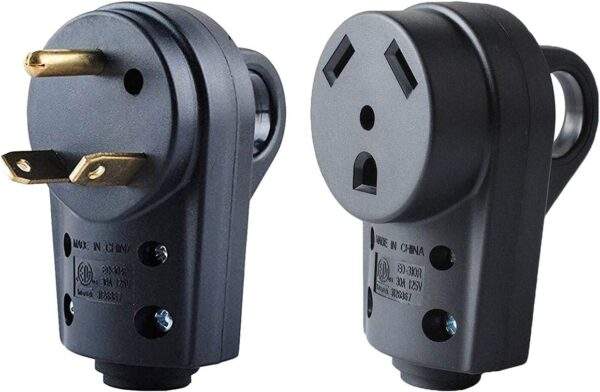
    What does a 30 amp RV plug look like?
    What does a 30 amp RV plug look like? Here it is!

    Now lets use an electrical formula that says that if you multiply volts times amps it will tell you how much total power (or watts) can be consumed.

    This means that if we have 120 volts and 30 amps, we multiply them and get a total of 3600 usable watts of power.
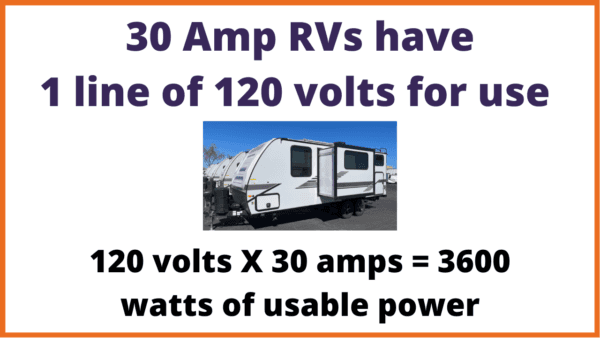
    3600 watts of power

    This is the maximum amount of power that 30 amp RV outlets can produce safely at one time.

    30 amp vs 50 amp - this is a 30 amp RV receptacle
    A 30 amp RV plug has 1 – 120 volt hot wire, 1 neutral wire and 1 ground wire rated for 30 amps

    So what can we run on 3600 watts of power? Usually most 30 amp RVs have 1 air conditioner, a microwave, a television and a refrigerator.

    These are the main power hungry devices. But they also have several AC wall receptacles for use of other electrical devices.

    But if you use too much power at one time by running too many power hungry devices, the system will be overloaded.

    And then it will shut down as a safety feature. This means that the main circuit breaker trips to prevent overheating the RV wiring. And potentially causing a fire.

    If you turn off some of the power hungry devices and turn the circuit breaker back on, you will usually be fine.

    As long as your power consumption is within the 3600 watts of power that 30 amp outlets can supply.

    So how do we get more power into an RV for more devices?

    A 50 Amp RV Outlet – How Much More Power?

    The best way to increase usable power for an RV is to buy an RV that is set up for 50 amps of power instead.

    At face value, it sounds like an RV 50 amp receptacle has just 20 amps more power for use. But it actually has so much more. And here’s why!

    An RV 50 amp receptacle plug has 2 – 120 volt wires, 1 – neutral wire, and 1 – ground wire.

    So that means that they did more than just increase the size of the one 120 volt wire of a 30 amp R V plug.

    Instead, they included two 120 volt wires and increased the capacity of each wire at the same time.
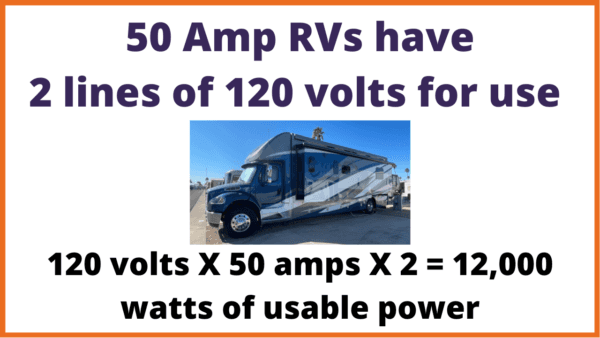
    12,000 watts of power

    So lets use our formula for power consumption again. Now we have 120 volts times 2 lines which equals 240 total volts.

    Then we multiply that by the 50 amps capacity of each line and we have a total of 12,000 watts.

    This is the amount of power that can be safely consumed by a 50 amp RV electrical system at one time.

    So what does a 50 amp plug look like? Here is a photo of one and you can see the two 120 volt lines in the center of it.
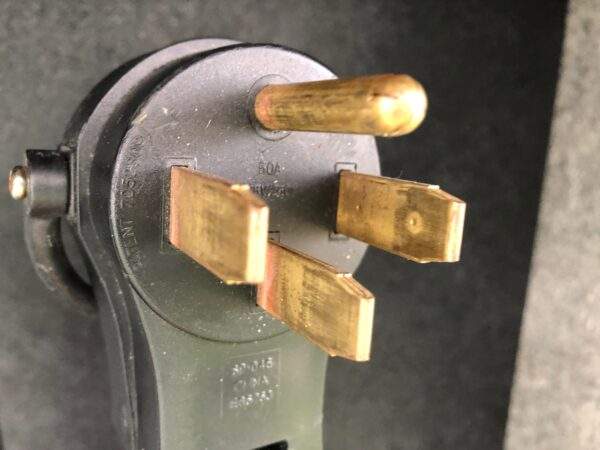
    What does a 50 amp RV plug look like? This photo show you!
    What does a 50 amp RV plug look like? Here it is!

    Now lets look at a 50 amp outlet that the plug goes into. You can see two of them at the bottom of this picture.
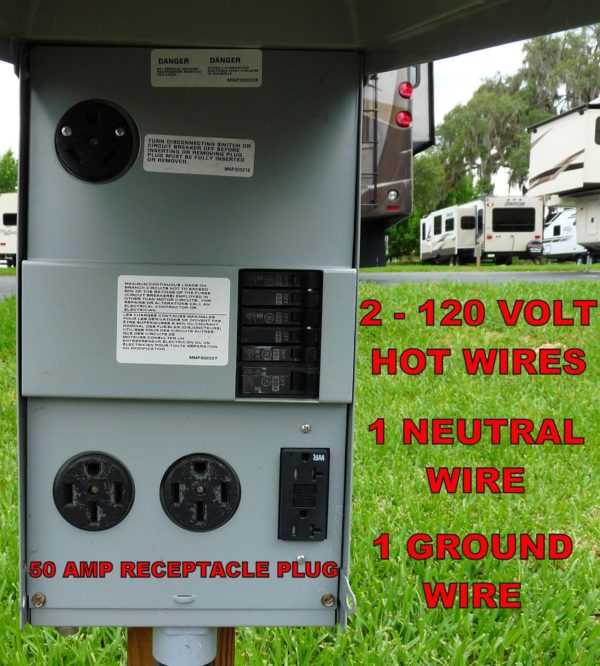
    30 amp vs 50 amp - this is a 50 amp rv receptacle
    A 50 amp RV plug has 2 – 120 volt hot wires, 1 neutral wire and 1 ground wire rated at 50 amps

    What Does It All Mean For You?

    So what we have learned is that a 30 amp RV can safely consume 3600 watts of power at one time.

    But a 50 amp RV can safely consume 12,000 watts of power simultaneously. WOW! That is a big difference.

    This means that a 50 amp RV can easily run more power hungry devices at the same time.

    For instance, 2 or more air conditioners. A television. A washer/dryer. Residential appliances, including refrigerators. As well as the microwave and wall receptacles for other devices.

    So what does all of this mean for you?

    Well, if you buy an RV with 50 amp RV wiring, expect to pay more simply because the heavier RV wiring costs more. But do you really need all of that power?

    It probably depends on your chosen lifestyle. Do you feel the need for a 40 foot diesel pusher? Or a huge fifth wheel? Or a toy hauler?

    Then you probably will also need the 50 amp RV wiring that often goes with those kind of RVs.

    But what if you are happy with a smaller RV, perhaps a Class B or C, or a travel trailer?

    Most of these RVs have only one air conditioner which is one of the major power consumers.

    And then 30 amps of power should be just fine for your needs. And you can save the extra expense of the more robust RV wiring.

    Either choice is fine. Just realize the limits of each RV electrical system, and work within those limits.

    PLEASE TAKE MY SURVEY ABOUT RV POWER

    Can You Plug A 50 Amp RV Into A 30 Amp RV Outlet?

    So what happens if you have a 50 amp RV, but your campsite only has a 30 amp RV outlet? Is it even possible to plug in to the electric service in this case?

    This is not as common a scenario these days as it has been in the past. But it does still happen. So you should be prepared for it.

    As we discussed above, a 50 amp RV can consume 12,000 watts of simultaneous power.

    But a 30 amp RV receptacle can only produce 3600 watts of power safely. So how can you make this situation work?

    The good news is that there are 30 amp to 50 amp adapters that can help out here. And it’s really simple to use.

    You can view a 30 amp to 50 amp adaptor here

    You simply insert your 50 amp plug into the female end of the adapter. And you insert the 30 amp male end of the adapter into the 30 amp plug.

    You will have power in your RV at this point. But only 3600 watts worth at one time.

    So just be careful with your power usage and you should be fine. In most cases only running one air conditioning unit will be possible.

    And just keep the usage of other high wattage devices like hair dryers and microwaves to a minimum.

    Can You Plug A 30 Amp RV Into A 50 Amp Plug?

    OK, so we covered the possibility of plugging a 50 amp RV into a 30 amp RV outlet. But can we plug a 30 amp RV into a 50 amp RV outlet?

    Let’s review the power difference again. The 30 amp RV can only safely handle 3600 watts of power at one time. Otherwise it will trip a breaker in the main RV electrical panel.

    But the 50 amp RV outlet is capable of producing 12,000 watts of power at one time safely.

    So are there adapters for plugging a 30 amp RV into a 50 amp RV receptacle?

    Yes, there are. And they work very well and are simple to use as well.

    You can view a 50 amp to 30 amp RV adapter here

    Essentially, the adapter renders one of the 120 volt lines in the 50 amp plug useless. So no power is going through it.

    The other line is still feeding power to the RV. It has a full capacity of 50 amps, but a 30 amp RV should never pull that much power. At least not without tripping the breaker in the RV itself.

    Also, in this case, there is no change needed in the use of power within the RV either. There is still only 30 amps coming into the RV, so all electrical components should function normally.

    A failsafe solution to the amperage challenge

    Now some people insist that there could be a danger of possible overload in this scenario. They argue this is the case since the 30 amp RV is still plugged into a 50 amp line.

    There are opinions on both sides online. And if you want to be absolutely safe, just buy a 30 amp EMS surge protector that I will discuss below.

    In that case you could use the 50 amp to 30 amp adapter and the 30 amp EMS surge protector together. And the surge protector would shut off the power to the RV is anything over 30 amps is detected.

    It’s your call, but many RVers use the 50 amp to 30 amp adapters without any issue at all.

    Don’t Forget To Protect Your RV Wiring

    Regardless of whether you have a 30 amp RV or a 50 amp RV, you will need electrical protection.

    That’s because power surges, spikes, and even low voltage can harm your RV’s electrical wiring. And also any sensitive and expensive equipment that you are using at that time.

    So it makes sense to protect your RV and electronics from these dangers. After all, they can affect either a 30 amp or a 50 amp RV equally.

    My recommendation is to choose an RV surge protector with EMS (electrical management system) capabilities.

    There are portable units that will monitor your electrical connection at all times. And if a dangerous electrical event begins to happen, they shut off the electricity immediately.

    Then as they monitor the situation further, they will turn the power back on when it is safe to do so.

    Here are some RV surge protectors I can recommend for 30 amp and 50 amp RVs:

    30 Amp Surge Protector with EMS

    50 Amp Surge Protector with EMS

    Disclosure: Please note this post may contain affiliate links. This means – at no additional cost to you – I earn a commission if you make a purchase using our affiliate links. I only link to products and companies I use and feel comfortable recommending. The income goes toward supporting the free content on this website

    Conclusion

    After reading this article, you should understand more about how RV wiring works.

    No doubt the information was a little surprising too. For instance, to find out what a large power difference there is in a 30 amp vs 50 amp comparison.

    Most RVers are completely unaware of how their RV electrical wiring actually works. So you are now well ahead of the game on this subject.

    Happy and safe travels my friends!

    Your RV Gas Mileage – 5 Tips To Make It Better

    If you are concerned about your RV gas mileage, you are in good company. A lot of RVers have the subject of RV fuel economy on their mind at times.

    And no wonder, since RV fuel costs take up a large chunk of our RVing budget. So how do we improve our RV MPG?

    The 5 tips I am going to share with you can apply to all RVs. This is because all RVs have an engine and tires.

    So you may need to improve your motorhome gas mileage or your travel trailer or fifth wheel gas mileage. It doesn’t matter, because these RV tips apply to them all. Now let’s get started!

    5 tips to help improve your RV gas mileage right away.
    Click on this image to follow me on Pinterest

    Disclosure: Please note this post may contain affiliate links. This means – at no additional cost to you – I earn a commission if you make a purchase using our affiliate links. I only link to products and companies I use and feel comfortable recommending. The income goes toward supporting the free content on this website.

    Better RV Gas Mileage With Proper Tire Pressure

    Maintaining the right RV tire pressure will have a big impact on your RV gas mileage. If your tire air pressure is low, the rolling resistance is greater.

    This means that it will take more energy to move your RV down the road. That means more fuel will be used to get you where you want to go.

    Of course, you don’t want to over-inflate your tires either. This makes for an extremely harsh ride and can cause safety issues as well.

    So find the manufacturer’s recommended tire pressure for your RV and maintain that pressure in your tires. You can locate a tire pressure inflation chart for your tires fairly easily. Just search for the manufacturer’s name and add “tire inflation chart” afterward.

    Usually there is also a sticker in your RV that will list the correct RV tire pressure recommended for your rig. This usually a very good place to start too.

    If you use a tow vehicle for a towable RV, make sure that you maintain the correct air pressure in its tires too. And if you want the best RV gas mileage possible, you will be checking and maintaining your tire air pressure regularly.

    Keep Your RV Weight Down

    It’s a real adjustment to move from a sticks and bricks home to an RV. And one of the things that a new RVer has to learn is how to manage their RV weight.

    This is because in our former home, weight was not an issue. So we don’t tend to think about it much when we first start RVing.

    But RV weight issues impact a lot of things. There are weight limits for every RV out there. And the closer we come to the limit for our rig, the more our RV fuel economy will drop.

    The reason for this is simple. The more weight the engine has to propel forward, the more energy will be required. Where does the energy come from? You guessed it, your RV fuel.

    Many full-time RVers make it a rule that whenever they buy anything new, something has to be removed from the RV. This is not a bad guideline to live by. It will help make sure that you discipline yourself to keep your RV weight issues under control.

    Of course, keeping our weight low is easier said than done. But the less weight we are hauling, the better our RV gas mileage will be.

    Lower RV Highway Speed = Better RV Gas Mileage

    Everyone knows that the faster you drive a vehicle on the highway, the lower your gas mileage will be. But it’s surprising to see how many people ignore that principle when they drive an RV.

    In fact, I often see rigs of all sizes exceeding the speed limit on the highway. And sometimes, they exceed it by a lot.

    Of course, this kind of speedy driving isn’t good for your RV fuel economy. But it also is more dangerous overall.

    Remember, RVing should be fun and relaxing. So if you let off on the gas pedal a little, you will no doubt be rewarded in many ways!

    Generally speaking, if you want the best RV gas mileage, you should keep your speed around 60 – 65 mph on the highway. For every 5 MPH above that limit, your RV fuel economy will drop significantly.

    RV Engine Maintenance

    If you have an RV on the road, somewhere there is an engine that is pulling it. It could be either gas or diesel, but all engines need regular maintenance.

    If the proper maintenance is not followed, many things can go wrong. But one thing that will most likely suffer for sure is RV gas mileage.

    The first place to look for guidance on RV engine maintenance is the user’s manual for that engine. If you don’t have it handy, you can usually search for it on Google and find it without much effort.

    The manufacturer’s maintenance guidelines are the best source of advice to keep your engine in good shape. But another good source of advice can be found on the online RV forums.

    Just search for “engine maintenance” related to your specific manufacturer and you should get plenty of responses. One of my favorite RV forums for this kind of information is iRV2.com.

    There are several well-seasoned full-time RVers that contribute to that forum regularly. Usually they are recognizable by the many thousands of comments they have made. And the other commenters often show them the respect they deserve.

    The point is, keep your engine in good repair and maintain it according to the manufacturer’s specifications. This means that you have to be organized and plan ahead for RV engine maintenance.

    Don’t be haphazard about it. It may cost a little for proper RV engine care. But if you keep your engine well maintained, it will pay you back in the long run.

    Maintain your RV engine for better RV gas mileage
    Maintain your RV engine for better fuel economy

    Use Synthetic Oil In your RV Engine

    This actually could be part of the last tip I mentioned above. But it is so important that I am mentioning it separately.

    This is because high-quality synthetic engine oils can do a lot of good for your RV engine. Once again, it doesn’t matter whether the engine is part of your RV or not.

    It could be an engine in your tow vehicle. High-quality synthetic oil will extend the life and performance of almost any engine. Even those found in cars and trucks.

    So generally speaking, if you want the best engine lubrication and therefore the best RV gas mileage, you should use a synthetic motor oil.

    Yes, it will cost you a little more when you change the RV engine oil. But it’s the best protection for your RV engine that you can get.

    And make sure that you follow the guidelines for changing your engine oil very closely.

    And while you are at it, don’t forget to change the engine air filter regularly too for good RV fuel economy.

    Conclusion

    So let’s recap. If you want to get the best fuel economy possible with your RV engine, here are the steps:

    • Maintain the proper tire air pressure for your rig and the weight it is carrying.
    • Keep the weight from your stored items as low as possible.
    • Drive your RV at a safe and economical speed on the highway.
    • Have a schedule for your RV engine maintenance and stick to it.
    • Use high-quality synthetic oil in your engine to improve lubrication and make your engine operate at its best level.

    If you use all 5 of these tips, you are well on your way toward getting the best RV MPG possible. Have safe and happy travels my friends!

    RV Inspection And Care For Everyone

    Duane explains what RV inspection and care is all about

    Hello everyone, and welcome to my RV Inspection and Care website. I’m Duane and I am a certified NRVIA inspector of RVs. So I want to use the knowledge that I have to help you learn more about your RV. That way you can be able to regularly inspect and also care for your RV.

    It doesn’t matter what kind of RV you have either – Class A, B, C, travel trailer, 5th wheel or even a pop-up. All RVs need regular inspection along with care and a little maintenance. This insures that they last a long time and are as trouble-free as possible.

    On this website we are going to cover it all. You will learn how to inspect and care for all the components and parts of your RV. All the way from the roof to the tires that gets you where you want to go.

    RV Inspection – do you have to be a mechanic?

    I know that many of you may be saying, hey wait, I’m not very mechanically inclined. So how can this information benefit me? Well, the simple truth is that roughly 80% of the repairs on RVs can be done by the average RV owner. They just need to be armed with a little knowledge and a few basic tools.

    Yes, that means that about 20% of RV repairs should be handled by a qualified technician or service center. But getting a quick appointment with a qualified tech or service center is getting harder and harder to do. So doesn’t it make sense to get a little advance knowledge to learn how to do the simple things yourself? That way you can save yourself a lot of money, time and frustration when things go wrong with your RV.

    So, I am looking forward to helping you learn about how your RV works and how you can keep it working the way it should. Please be sure to check back often as there will be new content on rv inspection and care every week.

    Get My FREE Camping Guide

    “The Top 5 Ways To Save Money On Campground Costs”

    Get My Newsletter

    Save on RV repairs

    Get the best RV gear

    Learn about RV life

    RV tips and tricks

    And get my free guide – The Top 5 Ways To Save Money On Campground Costs”