
RV Construction – How RVs Are Really Made

This article is going to be talking about RV construction. And specifically about conventional construction versus laminated construction in RVs.

Or if you prefer the more popular terms, “stick-and-tin versus aluminum”.

Now there’s a lot of misinformation out there about these two construction methods for RVs.

And which one is better. What you shouldn’t get, and what you should get, and so on.

Watch my video on RV construction

Table of Contents

RV Construction With Wood

For instance, there’s some out there who think that any wood framing used in an RV equals an inferior RV product.

And there’s also several who think that if you use wood for construction in an RV, that RV is just not going to last very long.

Well, here’s the truth about that. There are many great RVs out there that have been on the road for decades with wood frames.

Yes, they have wood RV building materials and they’re still going strong and doing very well.

In fact, there are still RV manufacturers even now who like to use wood framing and wood construction in some of their RVs.

And I’m going to focus on one manufacturer who does that today. Because they use both conventional and laminated building methods.

So it’s great to be able to compare one to the other that way. And the manufacturer we’re going to use for our discussion is Grand Design.

Now Grand Design makes for instance, the Transcend Xplor. And it’s made with a conventional construction method, using wood RV building materials.

The Conventional RV Construction Method

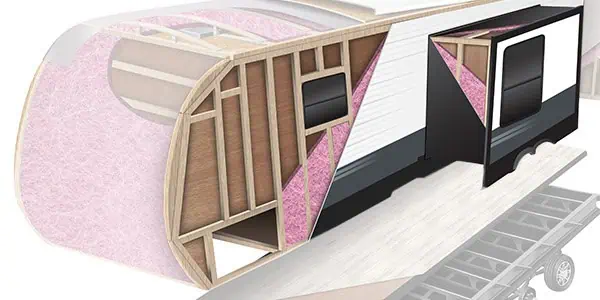
And here’s their illustration of how that method works.
The conventional RV building method

Now this illustration works for pretty much any wood framed RV that you see out there.

First of all, you’ll notice on the outside of the RV are aluminum panels. And the aluminum panels are attached to the wood frame or the wall studs.

Now in between the wall studs you’re going to see fiberglass bat insulation. And then on the other side of the wall framing is the interior wall.

So that makes up the walls of the RV. And here’s what that RV looks like on the outside.
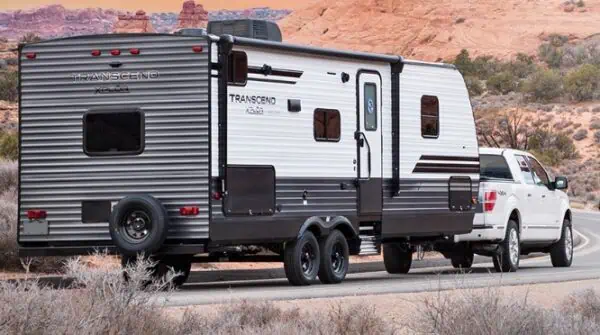
The Grand Design Transcend Xplor

Of course, this is what you normally see with conventionally constructed RVs.

It’s a kind of nook and cranny surface on the outside. With creases and crevices in the side walls. So it’s not smooth at all.

And when you see that, you know that most likely it’s a conventionally built RV. Using wood framing in the RV wall construction.

The Laminated RV Construction Method

But Grand Design doesn’t just build RVs with conventional building methods.

They also use laminate building materials too. In fact, that’s the construction method used for all the rest of their product line.

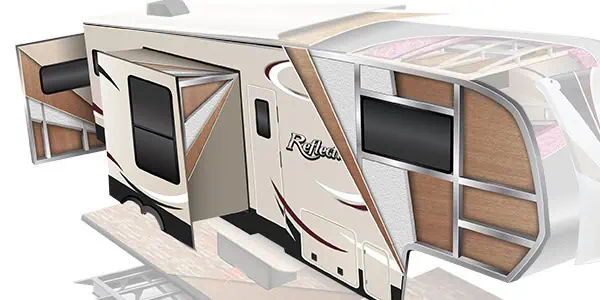
So here is their illustration of a cutaway of an RV towable that is made with the laminated construction method instead.
The laminated building method for RVs

So what you see here is the fiberglass outer skin first. Then it’s attached to a thin but rigid board inside that that goes up against the aluminum frame.

Then in between the aluminum studs is rigid foam insulation. And finally on the inside of the frame is the interior wall board.

So how does this laminated RV wall construction method work? Well, RV builders take all of these components and run them through a pinch roller. Or they vacuum bond them together as one piece.

Afterward the whole wall becomes just one big piece. And then it’s put onto the RV frame and the walls are all connected together.

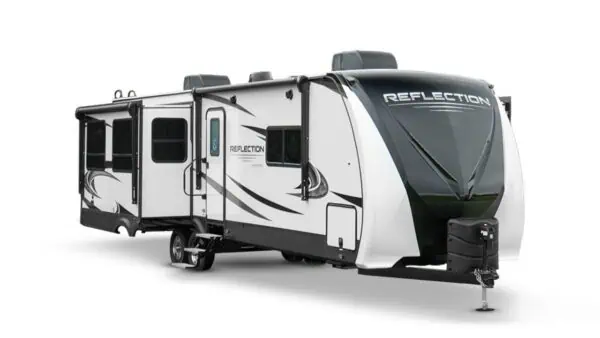
Now that’s the way that laminated RV wall construction works. And here is a picture of that kind of RV.
The Grand Design Reflection

As you can see, what we have is a smooth walled RV on the outside. And that’s the ones that you’re more used to seeing going down the road these days.

So from now on, when you see those smooth walls, you’ll know that it’s usually a laminated construction.

And most often it is going to be aluminum construction for the frame inside the RV.

Of course, that’s not always the case though. So let me make one important point here that needs to be understood.

An Important Point About Wood In RVs

And this is for those of you that just do not want any wood in your RV construction. Because you’ve been told that it’s an inferior RV building material.

And that is this. Even if the sidewalls have an aluminum frame, it’s very common that the roof and the floors use still wood framing.

Also, maybe even the interior walls will have some wood in them too.

So if you really don’t want wood in your RV’s construction, you need to ask the manufacturer about it.

Are they using wood in the roof floors, ceilings and interior walls? And that may be kind of eye-opening for you.

OK, now let’s ask two important questions. First, why are two different construction methods used by the same RV builder? And which one is best overall?

Well let’s put it to a head to head comparison between the two methods.

And let’s compare them in various areas or categories. Let’s start with cost.

Comparing The Cost Of Each Kind of RV Construction Method

And when it comes to cost, the conventional method wins hands down. That’s because the conventional method doesn’t require any specialized tools.

It’s technology that’s been used for many years in the RV industry. So it’s very common for RV building personnel to understand how to do it.

In fact, it’s more or less kind of the same sort of construction that you see in some forms of residential housing.

But aluminum costs more to begin with. And the tools to work with aluminum costs is not cheap either.

Also, the specialized methods of training for working on aluminum costs more as well.

So when it comes to cost, the conventional construction method wins the race.

Costs associated with each building method

What About The Outside Appearance of Each Method?

OK, the second area we’ll consider is appearance. And this is actually kind of subjective.

You know, it’s hard to say because people like different things. But I would have to say that most often more people will choose one method over the other.

And I think they probably like the smooth skin of the laminated method more than the wavy skin of the conventional method instead.

So we’ll give the edge here in appearance to laminated constructed RVs.

RV appearance

RV Construction – What About Insulation?

Next up let’s talk about the RV’s insulation. And on this particular point I’m going to give the nod to the conventional method instead.

Now some may disagree with that. But the reason why is that fiberglass bat insulation actually has a higher “R” factor than rigid foam insulation.

Or at least the kind of rigid foam that’s most often used in many RVs these days.

Now some people really hate the idea of fiberglass insulation being in an RV. But the reality is that it is a better insulating material overall.

RV contruction - insulation

RV Weight Considerations

Now let’s move on to our next comparison. And that’s on the weight of the RV.

In this area, laminated construction winds hands down because of the aluminum frame.

In fact, that’s the whole point of using aluminum in the build of the RV!

So definitely, when it comes to weight, laminated construction is better.

RV construction - weight

Towing Each Kind Of RV

Now let’s move on to RV towing. And in this situation, I’ve got to give the nod to the laminated method again.

But probably not for the reason you think. It’s not because it’s lighter, although we’re going to talk about that a little bit later on.

But I’m going to give the nod to lamination because of issues with wind resistance on an aluminum skinned RV.

Yes, just take a look at that wavy side of an aluminum skinned RV. All those cracks and crevices on the exterior walls.

Now all of that is more surface area to grab the wind as the RV goes down the road. So it produces drag as you’re towing them down the highway.

In view of that, when it comes to the subject of towing, we’re going to give a slight advantage to the laminated method.

What about RV towing?

RV Construction – What About Repairs?

OK, next up is the subject of RV repairs. And in this situation I’m going to firmly give the nod to the conventional method. Why?

Well let’s suppose you have a problem with the laminated sidewall of your RV.

And what if it requires a major repair? Maybe someone drove into it. Or it got hit and a hole was put in it by a branch or something.

In that case, you’re probably going to need to replace the entire wall in many cases.

Because remember that the whole wall is either vacuum bonded or pinched rolled together.

So it’s very hard to make a a localized repair on a fiberglass RV wall. Especially if you want to make it look right.

However, on a conventionally constructed RV, it’s actually kind of simple to do.

You just take off the aluminum panels where the damage is first. Then you fix the damage inside, and you put new panels back up again.

So it’s a lot cheaper, quicker and easier to repair a conventionally built RV wall. Therefore the nod goes toward the conventional method for repairs.

Repairs on each kind of building method

Cleaning The Exterior Walls

Next up is cleaning the RV’s exterior. And in this area, laminated wins big time.

That’s because of the smooth skin instead of all those nooks and crevices that you’ve got to get into in the aluminum skin of a conventional method RV.

Anybody who has cleaned the exterior skin made of aluminum knows what I’m saying.

Those crevasses attract dirt and filth and can be a challenge to clean. So laminated construction with its smooth walls wins in this area.

RV cleaning considerations

How Does Each RV Construction Method Hold Up Out To Sun Damage?

Next up in our discussion is exterior surface fade. In other words, RVs are usually out in the sun almost all the time.

So how do the exterior walls hold up in the elements? When we compare aluminum panels to fiberglass that has either gel coat or paint on it?

Well interestingly, the aluminum panels seem to handle the sun very well in most cases.

Whereas fiberglass panels often begin to chalk quickly. And need constant polishing to counter the effects of the sun’s UV rays.

So a slight advantage goes toward the conventional method in this case.

RV Construction - Exterior Fade

What About Weather, Like Hail?

All right, the next discussion is about how weather affects the exterior. And with most kinds of weather, it’s about the same in either case.

Except for hail, that is! Yes, when it comes to hail, you will really like having that laminated fiberglass skin on the outside.

And that’s because smaller hail pretty much just kind of bounces right off it. It doesn’t leave much damage in most cases.

In fact, I’ve been through a few hail storms with my RV. And we have a fiberglass outside or exterior.

Now I thought for sure damage was being done from the sound of things inside the RV. But when I went out outside afterward, sure enough it looked just fine.

However, what happens with a conventionally constructed trailer? Well, when you have hail hitting those aluminum panels, you’re usually going to see some serious denting.

So in this case I’m going to give the advantage to laminated construction.

What about weather?

How Does Each Method Conduct Outside Temperatures?

OK, the next point of discussion will be on temperature conduction. In other words, which method transfers the outside temperature to the inside more easily?

And in this area wood is a much better insulator than aluminum is. Yes, aluminum conducts temperature very easily.

So you may have insulation in between the wall studs. But the studs themselves conduct both heat and cold very easily.

So in this particular area, the conventional construction method actually works better.

Temperature Conduction in each building method

RV Features Found In Each Building Method

Now moving on to our next point of discussion. And that’s about RV features.

Remember how I mentioned that the laminated method makes the RV lighter? That’s because of the aluminum frame.

And when you use aluminum, it definitely lightens up the RV. So what do RV manufacturers do with that extra weight saved by the use of aluminum?

Very often they take that weight savings and they put extra features in the RV because of it.

So what does that mean for most laminated RVs out there? Well, you’re usually going to see a lot more features and amenities in laminated RVs.

And this is often due to the weight savings achieved by using aluminum construction. So the nod goes to laminated RVs in this case.

Now we’re going to come to a part of the discussion that is what many people argue about.

RV construction - Features

What Happens When Water Gets Into The Walls?

And that is corrosion inside the RV. Yes, some feel that if you’re using a conventional build method, the insides are just going to corrode away if you get any water intrusion.

So it all hinges on water intrusion. But in this particular area, I’m going to declare this a tie instead.

And I know there’s going to be some people who aren’t going to agree with me on that. But here is my thinking on the subject.

When you have a laminated wall frame and water gets in, you can have real damage.

That’s because very often water has been known to delaminate those walls. And you see it all the time in laminate constructed RVs.

You can see where the outside fiberglass has pulled away from the board it’s attached to.

And then there’s these big pockets or puffy areas on the side that look awful.

It’s called delamination. And they cannot be repaired easily either. So what do you have to do to try to repair it?

Most likely you’re talking about replacing the entire wall if you want it to be done right. And that a pretty serious and expensive repair!

Now if we look at the conventional build method there’s nothing to delaminate. Because the outside panels are simply attached to the frame.

So what happens if water gets in? Well, you can repair the area that is damaged much easier in many cases.

But as I said before, if water gets into a wood framed RV it can more easily break down the structural integrity of the wall too.

So when you compare these problems, they’re both serious. And therefore, in this particular area I’m going to declare it a tie.

What happens when there's water intrusion?

RV Maintenance With Either Method Of RV Construction

But let me make this point that is really important. And that is that either construction method can work just fine for many years.

As long as you as the RV owner will maintain the joints and the seals on the roof. And on the side walls too.

If you do the maintenance that you should in these areas, then you’re going to have an RV that will most likely last for many years.

And it doesn’t matter whether it’s a conventional construction or a laminated construction either!

Conclusion

So what I recommend is for you to go back over the pros and cons that I covered in this article.

Especially if you’re in a quandary. And you’re not sure whether you should buy one that is a conventional method or would it be better to get a laminated type of RV.

Just go back over these points that I’ve covered and maybe write them down.

Then you can make a comparison of the pros and cons. And decide what is best for you and your particular situation, and how you use your RV.

Just keep in mind that there’s really nothing wrong with either of these RV construction methods.

But whatever you choose, be sure that you maintain that RV the way you should.

Then it will last you for many years and many wonderful RVing adventures.

Have safe and happy travels my friends!

RV Water Filtration – Get Clean, Pure Water Wherever You Go

In this article I’m going to cover the subject of RV water filtration. And yes, you really do need good water filtration if you’re going to travel and camp in your RV. In fact, it’s essential!

Of course, when you’re home, the water that you get is usually the same water all the time.

But not when you’re going from place to place, from campground to campground.

Or maybe from water source to water source for boondocking. Then water quality can be very different from place to place.

In fact, you’ll find muddy water, rusty water, water full of sediment, and so on.

Yes, you’ll come across water that’s bad for your RV. But also, some of the water you’ll encounter can even be dangerous for you to drink.

So clearly, there’s a need to be prepared when you are traveling in your RV.

Watch my video on RV water filtration

You need to be ready for the water that you’re going to encounter wherever you go.

Now the good news is that there’s lots of options today for mobile water filtration in RVs.

And that means that you can have safe, clean and pure water on your RV travels.

Table of Contents

The Two Kinds Of Filters That are Essential

So what is the best RV water filtration system for your personal needs?

Well first of all, let’s talk about what kind of water filtration is needed. And then we can go into what’s best for your situation.

And first up, let’s talk about the two stages that you really need to have to get good water filtration.

One stage is usually made up of a carbon filter. And carbon filters are really good for filtering out odors, bad tastes and things like chlorine.

But the second stage that’s needed is a sediment filter. And it’s going to take out the particulates that’s in the water as well.

Now those two stages need to be used together to get good results. And so a lot of people combine them in inline water filters.

In other words, they’re in the line where your water is coming out of the source and going into your hose.

My Personal RV Water Filtration System

Now let’s use my personal water filter system as an example. And I’ll discuss it here so that you can see what I’m talking about.

First of all, I like to use a 20 Micron all-purpose filter coming right out of the water source. And in campgrounds that source is usually a faucet.

The Camco inline water filter

Now of course, you can see these kind of inline water filters in just about every campground. Almost everybody’s got these, right?

And Camco is the number one maker of these kind of filters these days.

The good news is that these kind of filters are fairly inexpensive too. And believe it or not, they actually work very well.

Now some people criticize this kind of water filter. You know, they think they’re just really not a good filter since they are so cheap.

But it all depends on what you need. For us, we have been using this kind of filter for many years.

And it works well as the first phase of our water filtration system. So I usually start with that filter right at the connection to the water faucet.

Then the water comes out of that filter and goes to my water softener.

Another Filter That We Use For Our RV’s Water

Now I’ll talk about that more in just a little bit. But from the softener it goes into a 5 Micron house filter.

A 5 micron house filter we use

Now remember, we started with 20 microns in the first filter at the faucet.

And microns refers to how fine the filtration is. The lower the number, the better filtration.

So now we’re down to 5 microns. And that’s much finer as far as the filtration of the water is concerned.

Now for me and for my house water situation, that’s pretty good filtration so far.

I’m using three stages of filtration at this point. First the 20 Micron water filter, the water softener, and then the five micron house filter.

Our personal external RV water filtration system

You can view the components in our RV’s external water filtration system at these links:

20 Micron Camco all purpose inline water filter that we use

Additional filter housing for 5 micron filter

On-The-Go RV water softener that we use

For us, this system produces pretty good filtration and works great for our needs. Because most of the water we use is for external purposes.

You know, for washing. And for bathrooms and showers, and things along that line.

RV Water Filtration For Drinking Water

However, when I’m going to take water inside me, I want that water filtered to the best degree that I reasonably can.

So for us, we use either a Life Straw pitcher filter or a Berkey filter for our drinking water.

Final stage RV water filtration

You can view these final stage filtration products at these links:

LifeStraw pitcher water filter that we use

Big Berkey Water Filter that we use

So in other words, we take the water out of the tap that has already been filtered well.

And then we put it through that final stage to make it good enough for safe drinking.

As I said earlier, water that is used for external purposes doesn’t have to be filtered to that degree.

But the final stage helps eliminate things like bacteria and other harmful substances.

Things that are even smaller than the other filters can remove. And it’s the final stage that makes our drinking water pure and clean.

OK, now let’s talk about what kind of RV water filtration you can use in different situations. And what can be reasonable in those situations.

Water Filtration Suitable For Weekend And Vacation RVers

So first of all, let’s talk about weekend RVing. And let’s suppose that you’re an RVer that just goes out on weekends.

Or maybe you take your RV out on a vacation or two through the year. Things along that line.

Well then you don’t really need a super duper water filter system in that case.

Not unless you’re going to be facing some really bad water somewhere.

So for most weekender’s purposes, that all-purpose blue Camco filter is probably going to do just fine.

You might want to add on another filter, like a five micron filter after that as well. And if you do, you’re going to get really good water filtration.

Since you’re not going to be using your RV for a long time, it will work well in those situations.

But now, what if you’re a part-time RVer? In other words, maybe a snowbird? And you’re out there traveling for months at a time?

Or what if you’re a full-time RVer that lives and travels in your RV all the time?

Well then, you need to take RV water filtration up a notch from what weekenders use.

That’s because you’re spending a lot of time in your RV. And you need to make sure that your water is as good as it can be.

What About Part-Time And Full-Time RVers?

So for part-timers and full-timers, I highly recommend adding a water softener. And place it somewhere in your RV water filtration system.

Why? Because we have encountered very hard water in our RV travels around the country.

And especially down around the Southwest. There’s a lot of mineral concentration in the water down there. And that’s what makes it hard.

In fact, you can even see it form around your faucets in the RV. And around the water source faucet outside as well.

The minerals in the water just keeps building up and you can actually see it as it hardens in place. So that tells you that it’s really hard water in those areas.

But there is a huge difference in water quality when you pass that water through a water softener.

Our water softener for full-time RV travel

When it comes out, it just feels so much better to your skin. It will feel better in your shower and on your hands when you wash them.

Also, your cleaners will work better with softened water. In fact, everything is better using a water softener.

So that’s why I inject a water softener into my inline RV water filtration system.

But now once again, we talked about drinking water as being a whole other thing.

So I filter it through the various filters I mentioned above and the water softener.

Then when it comes into the RV, we like to use that Berkey or Life Straw filter. And it will filter our drinking water down as fine as I need it to be.

So using this RV water filtration system, I get clean, pure RV water all the time.

Another Reason For Choosing The Last Stage of Water Filtration

Of course, what I’ve shown you here is not the only solution for drinking water filtration.

But I like to use the Life Straw or the Berkey for another reason too. And that is that over the life of their use, they are both fairly economical too.

Of course, they can be a little bit expensive to buy up front. That’s true. And especially the Berkey has a larger up front cost.

But over the life of the filter, it’s actually pretty economical to use them as they last a very long time.

The Highest Level Of RV Water Filtration You Can Get

But some RVers prefer to take water filtration to a higher level than that in their rig.

So they go to a reverse osmosis water filtration system. And that is exceptionally good water filtration for an RV.

However, it’s also very expensive too. And one reason for that is in most cases it’s going to take some kind of installation to put it in your RV.

Inline reverse osmosis water filter

You can find this reverse osmosis water filter at this link:

Reverse Osmosis Filtration system for RVs

And if you’re not really good with installing things like that, you’re going to have to pay someone to do it for you.

Now there is another solution that a lot of our RVers have gone to instead. And it works really well too.

That is to use an ultraviolet water purifier. Actually, it’s not really even a filter at that stage.

Because ultraviolet kills anything that’s alive in water. So it’s not really a water filter as much as it’s a water purifier at that point.

Inline ultraviolet water purifier

You can find this ultraviolet water purifier at this link:

UV water purifier system for RVs

And once again, it’s not going to be cheap. Also, it requires some form of installation too.

But I will say this. If you use reverse osmosis or an ultraviolet water purifier, you’re doing just about everything you can do at that point.

Everything possible to produce really clean and pure drinking water. Which is the ultimate goal, right?

You just want to make sure that whatever you take into your body is clean and pure to a reasonable degree.

What About Using Bottled Water Instead?

Now keep in mind that all of this RV water filtration we’re talking about is replacing things like bottled water.

RV water filtration can replace the cost of bottled water

So when you’re looking at the cost of these filters. And especially at reverse osmosis or water purifiers.

Well then, consider that you’re not going to really need to be buying any bottled water anymore.

And there will be a huge savings in that respect. So keep that in mind when you’re comparing the cost of RV water filtration.

Is There A Perfect Water Filtration System Everybody Should Use?

Now this question that comes up is a good one. Is there a perfect water filtration system for everybody who is an RVer?

My answer to that is, not really! Not anymore than there’s a perfect RV for everybody.

You see, we all have different needs. And different situations with different circumstances.

So whatever works best for your particular situation is just fine. But the problem is that some people get other ideas in their mind.

They feel that if they made a decision that is best for them, then it’s best for everybody. But that’s just not the case.

Instead, the thing you need to remember is the two stages that you must have for good water filtration.

And that is a charcoal filter of some type. And then a sediment filter too.

Now from there, you just add what you want to make your filtration even better.

So you can can add a water softener if you choose. Or you can add in a LifeStraw or a Berkey filter.

Or if you want the highest level of filtration possible, get a reverse osmosis or a water purifier like the ultraviolet ones.

Conclusion

But the point is, try to understand that what your needs are can be very different from what someone else’s needs are.

Also you may look at things a little differently than someone else does too. So do what you feel is reasonable for you and your situation.

Now, you’re going to hear a lot of strong opinions on this subject though. And there’s no question about that.

But do what you feel is best for you and your family. Especially considering the way that you travel and the way that you like to camp.

And if you use the tips and explanations that I’ve given you about RV water filtration, most likely you’re going to make a really good decision.

Have safe and happy RV travels!

RV Depreciation – How To Use It To Your Advantage

This article is going to be about RV depreciation. About what it is, and how you can minimize it and save money on the purchase of an RV.

So what is depreciation anyway? I mean, we hear that term used a lot. So what is it exactly?

Well, it’s simply what happens when something you buy loses value over time.

Now it often happens with vehicles, like cars and trucks. And of course with RVs as well.

So why do they depreciate so fast? Mainly because, especially with RVs, new ones are coming out every single year.

And they have new features and capabilities with every new model year.

So that means that the older ones are not quite as valuable anymore to the buying public.

Also, from year to year there’s going to be wear and tear on the RV too. And that’s going to lessen the value as well.

Watch my video on RV depreciation

So the thing I want you to keep in mind is that RVs should not be considered an investment in any way!

They’re all going to lose value somehow over time. But the question many RV owners want to know is, how fast do they lose value? And how much?

Table of Contents

RV Depreciation – How Much Does It Affect The RV’s Price?

Well, most new RVs that you buy are going to lose about 20 percent of their value within the very first year or so of your ownership.

And then after that they will lose more from year to year. But it’s not going to be nearly as much as that first couple of years.

Now here’s the good news though. Depreciation does affect the RV’s price quite a bit in the first five years.

But after five years it tends to slow down a lot in its drop in value from there on.

In fact, by year 5 most RVs have depreciated somewhere around 35 percent on the average. But by year 10 it’s only dropped to 50 or 60 percent.

How RV depreciation affects RV prices

So I think you can see that RV depreciation starts to level out a little bit between year 5 and 10.

RV Depreciation Doesn’t Affect All RVs The Same Way

But different brands and different manufacturers lose value at different rates. And why is that?

Well, that’s because some brands are better known for quality. They have a great reputation with RV buyers and so their value holds longer.

These are brands like Airstream, Casita, Newmar, Tiffin. And there’s others as well. I can’t go down the whole list here in this article.

Perceived RV quality affects RV prices a lot

But there’s quite a few high quality brands that just hold their value better than others do.

And on the other side of the equation there are the typical high production RV builders.

You know, the ones that you see everywhere at almost any dealer you visit.

And they’ve got tons and tons of models and various price ranges and so on. Typically, they are the ones that often lose their value quicker than other quality built RVs. So just keep that in mind.

Now how can you slow down this loss of value in an RV that you have bought?

Well, I’m going to share three ways that you can do that. And number one is something we’ve actually already covered.

The Number One Way To Tame RV Depreciation

That is to try your best to buy a quality RV brand from a quality RV manufacturer.

Now how can you spot quality in an RV? Or what are the brands that have the best reputation?

Well, I know it’s a challenge for many buyers! And that’s why I created several guidebooks to help you in the quest to identify quality RV brands. I’m sure they can be a big help for you in the buying process.

Download my RV guidebooks on manufacturer quality

But now let’s move along to our second point on keeping the depreciation loss as low as possible.

The Second Way You Can Keep The Value Of Your RV High

And that is to maintain your RV as well as you possibly can while you own it.

Unfortunately, this is something that I’ve got to say a lot of RV owners don’t really do very well.

Maintain your RV to keep it's value high
Maintain your RV to keep it’s value high

They buy the RV, and then they kind of treat it like a new home that will never have issues. Or at least it will be a long time before they’ve got to do anything to it.

But the truth is are that RVs constantly need maintaining. And it doesn’t take an awful lot to learn what to do. Also it’s not difficult to do for most people.

In fact, roughly 80% of the things that need to be maintained or repaired around an RV can be done by the average RV owner.

All they need is just a little guidance and know-how that is usually easy to find online.

So try to maintain your RV and keep it in really good shape. And keep a record of what you are doing as you maintain and repair it too.

Record any maintenance you do or any repairs that you make to that RV. Keep very good records of the care that you have put into it.

And let me tell you, that impresses a buyer a lot when you go to sell that RV.

Maintenance records are a great way to get more money for your RV

When you hand over the records that show exactly what you’ve been doing to keep that RV in excellent shape.

Well, automatically in the buyer’s mind, the value of that RV has increased immediately.

The Third Way To Keep High Value In Your RV

OK, let’s go to number three on our list of slowing RV depreciation loss.

And that is to keep your RV updated as you go with newer technology. Also with newer styles and appearance.

Update your RV's appearance to keep value high
Update your RV’s appearance to keep value high

Now this is important. Because a lot of times people are looking for the latest gadgets and the latest technology.

It’s the things that make RVing easier and more pleasant for them. Also, if you look at older RVs, you’re going to see colors that just aren’t anything near what we are into these days.

You will see things like carpet used everywhere all through the RV, instead of hardwood floors.

And you’ll often see things that clearly date that RV by the appearance alone.

Well, try to keep your RV updated as much as you possibly can. And then when you do, the money you put into it isn’t wasted.

Because that way the investment is not only beneficial for you and your use of the RV.

But it’s also a big plus in the mind of a prospective buyer who’s looking at purchasing that RV too.

And that’s an important point! So keeping the RV modern in appearance increases the value of the RV to them too.

When Is The Best Time To Buy An RV?

OK, so then now the question is, when is the best time to buy an RV to prevent value loss?

In other words what’s the sweet spot in depreciation loss where you should be buying an RV?

Honestly it’s somewhere between year 5 and 7 in my opinion. Because up to then, like we discussed earlier, price depreciation has been pretty rapid.

RV Depreciation Value Loss Sweet Spot

But then it just sort of starts to level out a little bit at that point. And you can get a great RV for a great price that’s depreciation stable at that point.

Should You Never Buy A New RV To Prevent The Big Depreciation Hit?

So here’s another question, should you never buy a new RV then? Because of that big depreciation hit that you take right off the bat.

Well I’m not saying that at all! There’s actually several very good reasons that people buy new RVs.

For instance, they may just want that bumper-to-bumper warranty that comes with it for the first year or so.

That way they don’t have to worry about paying for any major repairs during that time.

Also, a lot of people like new RVs because nobody’s used it before them. So they know how that RV has been treated, since it’s brand new.

That means that nobody has had it before and done some bad things to it. Especially things that may not be obvious to the next RV buyer. So they like that!

They also like the idea that there’s not been anybody who smoked in it. Or had pets in it, or things like that.

And that’s especially important to folks that have allergies to those kinds of things.

Also people like to buy new RVs for the latest features, like this article mentioned before. They just want the latest technology available.

And there is nothing wrong with any of those reasons for buying a new RV at all. But here is another important point in favor of buying new RVs.

A Major Reason Why RV Depreciation Doesn’t Always Affect New RVs

And that is if you plan on keeping your RV. And I’m talking about keeping it for many years, maybe 10 years or longer.

Well then honestly, depreciation doesn’t really factor into the equation very much at that point.

Depreciation on new RVs doesn't have to affect everyone
Depreciation on new RVs doesn’t have to affect everyone

Because during all those years of RV depreciation, you are keeping that RV instead of selling it.

But what if you think that you may sell your RV within the next few years or so?

Well then, it’s important for you to factor in the depreciation loss of value in the cost of that RV.

And then try to minimize it as much as possible in the ways I’ve covered in this article.

Well that’s it for now. Have safe and happy RV travels!