
RV Costs For Maintaining And Repairing An RV

This article is about the RV costs associated with owning, maintaining and repairing an RV.

And of course, many people buy RVs because they’re trying to save on vacation costs. So it’s often a budget thing that gets them into RVing.

And they have a budget for pretty much everything. That is, except for maintenance and repairs of the RV they intend to buy.

Many people budget in advance for  owning an RV
Many people budget in advance for owning an RV

Very often, they have figured out the monthly payments, insurance, fuel and camping costs.

But maintenance and repairs on their future RV? Well, that’s kind of nebulous and more difficult to nail down.

Watch my video on how to save on RV costs

Table of Contents

Can You Project The Costs Of Owning An RV?

But RV maintenance and repairs can be a very significant annual cost for some RVers.

And of course, I can’t give you exact figures on what it’s going to cost you personally.

Because it will depend on the quality of the RV you have. And on the number of amenities and luxuries in it.

Also, it will depend to a large degree on how you care for your RV over the years too. In fact, that’s a big one!

But there’s several other factors as well. So what we can conclude is that it’s hard to give an exact figure that fits all situations.

A Good Source For Projecting RV Costs

But Wholesale Warranties has created an infographic that can be helpful.

Because I believe that it helps folks get a feel for many of the repair costs on an RV. By showing them what those costs could be before they buy.

And why am I turning to Wholesale Warranties for this information? Well, it’s because RV repairs is what their business is really all about.

That’s because they provide service contracts for RV buyers after their factory warranty expires.

So let’s take a look at what they say about RV repair costs overall and what you could expect.

Repair And Maintenance Costs For Motorhomes

And first of all, let’s look at a graphic they made on motorhome repair costs. Just look at the image below for that information.
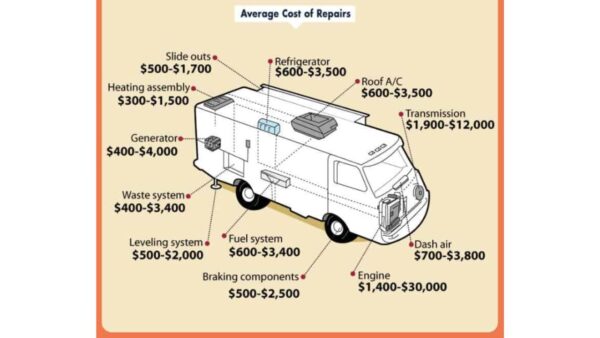
The projected costs for repairing parts of a motorhome

Now taking a look at that, let’s go up to the upper left hand side of the graphic. And we’ll cover each component by going clockwise.

So let’s start with heating first. And you can see that their projection is that expenses could be $300 to $1,500 in repairs.

Moving on to the next item, they project repair costs on slide out rooms to be $500 to $1700.

Well, honestly I feel like that could even be a little low in some cases. But next up is refrigerators at $600 to $3500 for repair costs.

Then roof AC’s are about the same amount at $600 to $3500. But then we get to the transmission in a motorhome. And that can be significant!

In fact, repairs there can run $1,900 to $12,000 depending on the kind of motorhome you have.

Then the dash air conditioning in a motorhome could be $700 to $3,800.

More RV Costs Associated With Owning A Motorhome

And now, just take a look at engine repair costs. Once again this is a biggie!

And that is especially true if it’s a big diesel engine. In fact, repairs could range from $1,400 to $30,000. That could be a huge expense for anyone!

Next up is the braking components on a motorhome. And that could be $500 to $2500 to repair.

The repairs on the fuel system can range from $600 to $3400. And the leveling system repairs can go from $500 to $2,000.

Then there’s the waste system that can cost $400 to $3,400 to repair.

And finally, what if you have an installed generator in your motorhome? Well, that could run anywhere from $400 to $4,000 for repairs.

Is This All The Possible Repairs You May Have To Make?

Now one thing I want to mention here is that this is a very good overall layout for the general components of an RV motorhome.

But keep in mind that this is not all of your possible expenses on a motorhome.

Because there could be also expenses for water leak repairs. Or for replacing your tires regularly.

Or for replacing awnings, and so on. So what we have covered are just some of the major expenses that an RV motorhome can incur.

But I do feel that the graphic provides a pretty good breakdown on the major RV components.

Also notice that there’s a wide range of costs found for each listed component.

That’s because you can’t really nail down something specific for each situation.

There is a lot of variance in repair costs depending on what went wrong.

However I do feel that this graphic is useful. Because it helps you compare repair costs from one component of the RV to another.

So it could be a good idea to use the lower figures they’re giving here as a base for RV repairs.

Or you might choose to use a mid-range of figures in this graphic instead to produce your budget.

And then spread those costs over the years you plan on owning your RV.

RV Costs Associated With Owning A Towable RV

OK, let’s move along to towable RVs like fifth wheels and travel trailers now.

And of course they do not include the engine and drivetrain that motorhomes have.

So let’s take a look at the Wholesale Warranties graphic for those kind of RVs now. Just view the image below for that information.
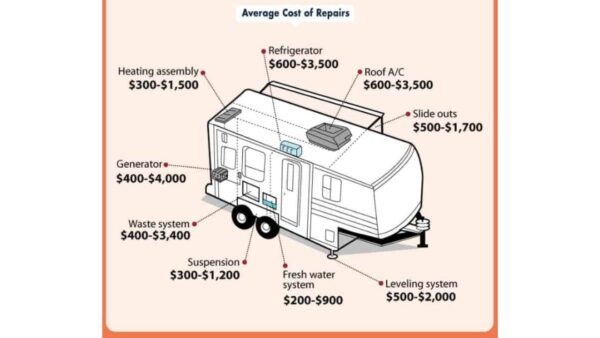
RV costs for repairing and maintaining a towable RV

So when you look at this graphic you’re going to notice something right away.

And that is that the costs associated with the house or the RV part of the towable is very similar to the costs of the house part of a motorhome.

That’s because they are similar in makeup. However what you don’t see in this graphic is the engine and drivetrain costs.

But that doesn’t mean that they aren’t still there. And why is that?

Where Are The Engine And Drivetrain Costs With Towable RVs?

Simply because those costs are transferred to the tow vehicle for a towable RV. And that’s often a truck of some type.

Now some feel that towable RVs are less expensive to maintain and repair than motorhomes.

However, you can see that often doesn’t take into account the cost of the tow vehicle’s repairs and maintenance as well.

So you need to add the tow vehicle’s costs in along with your towable RV.

And when you do, the repair and maintenance costs are pretty similar to motorhomes.

But there are a couple of factors that impact maintenance and repair costs.

And these factors are under your control. So let’s talk about that now.

A Huge Factor In Managing RV Costs

One of them is the size of RV that you choose. Because the bigger the RV you have, generally the more expense there’s going to be to care for it.

And the more luxury items and amenities in it, the more there is to go wrong.

For instance, the more slides you have, or the bigger slides you have, the more expense to repair them.

Also, what if you have an RV that has a lot of advanced technology in it?

Well, if a lot of things are controlled digitally in your RV, you may not be able to repair it yourself.

Instead, it may cost you to have someone who’s experienced and knowledgeable to make that repair.

So let me give you a few words of wisdom to remember here about RV costs.

And that is, generally speaking, usually the simpler and the smaller the RV is, the less costs you’re going to have to repair and maintain it.

The Costs Of Owning A Large RV

Now the most expensive RVs are often Class A diesel pushers like I own.

In fact, I made a video on that subject a little while back. And I showed how that I had made a projected budget for my repair costs.

However, I found that my projected budget was seriously low. It didn’t really match the actual RV costs that I encountered.

So I feel that it would be good for you view that video and see how that turned out. And you can view it by clicking here or on the image below.
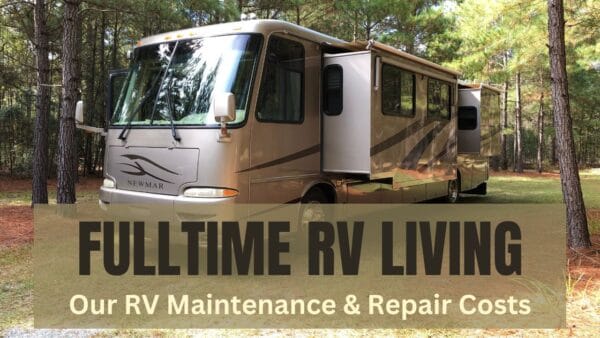
The expenses associated with repairing and maintaining my personal Class A diesel pusher

Now the least expensive RVs cost-wise are usually small travel trailers. Ones with just the camping basics built into them.
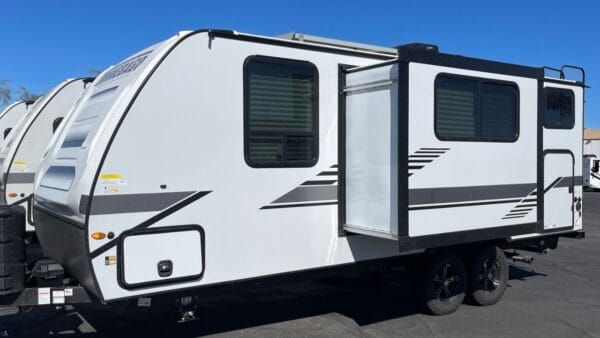
Smaller travel trailers are usually the least expensive RV to own

So if RV costs could be a problem for your budget, decide what size RV will fit your budget. And maybe a smaller one will be best for you.

OK, now let’s talk a little bit about how to keep RV repair and maintenance costs down as much as possible.

The Best Way To Keep RV Repair Costs Low

And the number one thing you can do here is to learn how to repair most things on an RV yourself.

Now here’s the good news. Roughly 80% of things that go wrong on RVs can be fixed by the average owner with a little bit of knowledge.

And that kind of RV repair knowledge can often be found on YouTube these days.

If you do that, it can save you the big expensive hourly rates for labor that an RV facility is going to charge you on those repairs.

How You Can Prevent Many Large RV Repair Bills

Next up is to do your RV maintenance tasks on schedule. Don’t let them slide, or procrastinate them!

By doing that, you will help prevent many major RV problems that could be costly.

OK, let’s move on to number three on the list of ways to keep RV costs low.

How To Manage RV Costs With A Service Contract

And that is, if you want to manage your RV repair costs, you might consider getting a service contract for your RV.

This is also what some people refer to as an extended warranty. And that will help you cover the major repair costs that could come up.

Now personally, I think this makes most sense for those who own more complex and bigger RVs.

And that’s for the simple reason that they have more things to go wrong that could be expensive to repair.

So here I am going to recommend Wholesale Warranties as a good place to start.

I recommend Wholesale Warranties for RV service contracts

And a good reason for that is they have a great reputation among the full-time RVing community.

A Word About Saving Money At RV Repair Facilities

But I also recommend that you choose a highly rated repair facility that’s nearby.

First of all, make sure you can trust them. Then establish a relationship and try to do your business with them exclusively.

Because that way they get to know you, and you get to know them well too. So it eventually becomes a working relationship.

And over the course of time, that kind of thing can lead to their saving you money on RV repairs and maintenance.

Conclusion

Well I hope these tips that I’ve given you will be helpful in managing your RV costs.

And I hope they will help you keep your repair and maintenance costs on your RV as low as possible.

Have safe and happy RV travels!
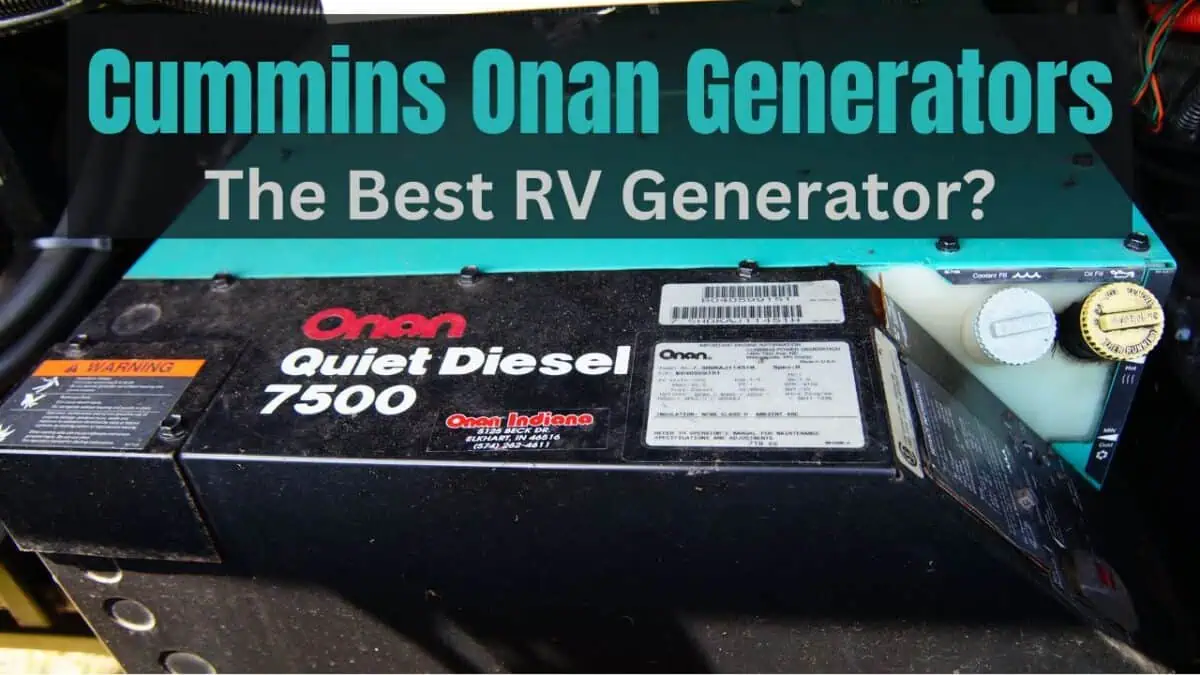
Cummins Onan RV Generators – Are They The Best You Can Buy?

This article is about Cummins Onan RV generators. Are they really as good as so many people claim?

And if you have one, how do you take care of it and maintain it to make it last?

Watch my video on Cummins Onan RV generators

Table of Contents

Why A Generator Is A Good Thing To Have

Now if you do a lot of boondocking, a generator is often considered to be essential equipment in your RV.

A generator is a great piece of equipment to have when boondocking

And that’s true even if you have a lot of solar equipment installed. Especially on some of the hotter days in the summertime.

That’s when you’re going to be very happy that you can run your roof air conditioners to stay comfortable.

And when you do, you’re going to need a generator to run them for any length of time.

Because there are periods where you could go days without much sunshine.

And when that happens the effectiveness of your solar power system is really diminished.

Do You Really Need A Generator In RV Parks?

But even if you mostly stay in RV parks and campgrounds, a generator can still be very helpful.

Cummins Onan RV generators can even be useful in RV parks too

Especially in those times when the power goes out in the park or campground you are in.

In fact, we’ve had that happen a lot to us in our travels. And when it did, we were happy that we had a generator on hand.

Also, maybe you’re just traveling somewhere and you decide to stop and stay overnight. And you choose a spot that’s not in a park or campground.

Well then, a generator will make that so much more pleasant and comfortable.

What Size Generator Should You Have For Your RV?

Now for many RVers, if you have a 30 amp service in your RV, a portable inverter generator will work just fine for you.

Many 30 amp RVs can be served well by a portable inverter generator

But what about larger RVs? What about RVs like diesel pusher motorhomes? Or a Super C, or larger fifth wheels and so on?

Well, many of them have 50 amp electrical services installed in their RV.

So what happens if you want to run everything in that RV? Like you do when you’re hooked up to shore power?

In that case, you’re probably going to need a larger generator. One that’s capable of supplying the needs of a 50 amp RV.

Larger RVs are often served best by a larger Cummins Onan diesel generator

And that is where Cummins Onan RV generators really shine.

What You Should Know About Cummins Onan RV Generators

So now let’s talk just a little bit about the company itself. Onan has been making generators since 1926.

And that means that they’re coming up on a hundred years of making generators.

Cummins bought them in 1986. So they have had ownership for almost 40 years now.

And at this point, Cummins Onan has 85 percent or so of the market share of generators in RVs. Wow, that is really an impressive statistic!

And these days, if you buy a new motorhome or a larger fifth wheel, the chances are that you’re going to find a Cummins Onan RV generator in it.

So the question is, why are they so popular? And why do manufacturers like them so much?

Well, let’s find out about the pros of Cummins Onan RV generators first.

Cummins Onan Generators – Pro #1

And the first pro is that they are relatively quiet. So what do I mean by relatively quiet?

Well honestly, smaller inverter generators may be quieter decibel wise.

However, when you run a Cummins Onan generator, you’ll notice that the tone that it puts out is very low.

So an inverter generator may have fewer decibels with the overall sound it creates.

But the sound that comes from the Cummins generator may not be as noticeable to most people.

So that’s why they are what I call relatively quiet.

Cummins Onan Pro #2

Now the second pro is about maintaining your Cummins Onan RV Generator.

And if you do, they are super reliable, and they will last an incredibly long time.

In fact, a Cummins Onan generator will probably outlast the RV that they are installed in. And that’s an amazing thing to be able to say!

Cummins Onan Pro #3 – What About Repairs?

Now the third pro is that if you have to work on them, parts are usually readily available.

Also, you can find repair facilities and technicians almost anywhere in the country.

Of course, there’s lots of Cummins facilities that you could use for service and repairs.

But there’s also quite a few independent facilities and repair techs that can work on Cummins Onan generators too.

So if you need a repair on your Cummins Onan generator, it shouldn’t be a major problem to find a service tech who can handle the job.

Cummins Onan Diesel Generators Pro #4 and 5

OK, our next pro is that they’re very flexible. They can come in diesel versions, gasoline versions, and even LP versions.

Cummins Onan RV generators come in a variety of sizes and versions

And that leads us into pro number five. That it is that they make it very convenient for you as an RV owner.

Because often, they have a remote start. And that means that you don’t have to go out and start the generator manually when you need power.

Especially like you very often have to do with many portable inverter generators.

Also, they’re usually able to run off the fuel that you already have in your RV.

So for instance, we have a diesel pusher motorhome. And our Cummins Onan generator runs off the diesel that’s in our fuel tank.

And as long as we’re above a quarter tank of fuel, it just keeps running along nicely.

So I don’t have to even think about carrying fuel for the generator. Not unless my motorhome’s fuel tank gets down to that quarter tank mark.

And that’s very convenient as many RVers struggle to find space for generator fuel.

Well, those are all good things about Cummins Onan RV generators.

Cummins Onan Diesel Generators Con #1

Now what about the cons? Well, the number one con of a Cummins Onan generator is that they are big. And they are also very heavy.

So that means that they can’t be moved around like a portable inverter generator.

And so, that is something you have to plan for if your generator was not installed at the factory.

Cummins Onan Con #2

Now the number two con is they usually need lots of space in your RV.

A Cummins Onan RV generator can be very large and require a lot of space

Now we all know that space and weight is at a premium in most any RV.

So you’ve got to find somewhere to put that Cummins Onan RV generator.

A spot where it will be in its permanent location from then on. And that can be a challenge in some rigs.

Cummins Onan RV Generator Con #3

OK, the third con is that they have to be exercised regularly. Yes, if you’re going to get good service out of them you need to use them.

And that is especially true of the diesel and gas versions that you often see in RVs.

Cummins Onan Con #4 – What About Cost?

OK, the final con we’re going to talk about is that they can be costly to replace.

Oh yes, even the smaller Cummins Onan RV generators will start around $3000.

And they can go up to almost $15,000 for the bigger units. For the 12,000 watt generators and so on.

But there is a flip side of that too. Because remember I said that usually they outlast the RV they’re installed in.

So you don’t have to replace them very often. However, if you do need to replace one, you definitely will have a serious expense then.

The Results Of My List Of Pros And Cons

Well, that’s my list of both the advantages and disadvantages of Cummins Onan generators.

So I invite you to just compare the pros and the cons that we’ve covered in this article.

And if you do, I think you’ll agree that Cummins Onan generators really are a great choice for many RVers.

There’s a lot of really good points on the positive side of this subject.

And I would say, there are more pros than there are cons for most RVers. Especially if you have a larger RV with lots of power hungry equipment.

Cummins Onan RV Generators Maintenance

OK, now let’s talk a little bit about maintenance. So how do you keep these big generators going?

And the number one thing I talked about earlier is to exercise them. And that means you have to use them regularly to keep them in good shape.

A Cummins Onan diesel generator will need to be exercised regularly

In fact, about once a month you need to crank up that generator and run it.

In addition to that, you need to put it under an electrical load too. So what do I mean by that?

Well, you need an electrical draw that’s pulling a lot of power to exercise them properly. And that will make the generator really work.

Now to do that, you could turn on an air conditioner or two in the RV.

And if you do that, you’ll definitely get that generator working. But you could also use the electric element in your water heater too.

Or electric hair dryers. You know, things along that line that pull a lot of electrical current.

Yes, you need to get that generator up and really humming along to exercise it properly.

And if you do that for a couple of hours or so, then you can turn those items off and let it cool down.

Once again, this should be done about once a month when you’re not using the generator regularly.

Cummins Onan Maintenance Schedule

Now the next thing you need to do to maintain them is watch the maintenance schedules.

Especially for things like oil filters, air filters and spark arrestors. All of those need to be given attention fairly regularly.

So whatever your manual from Cummins Onan tells you to do for your generator, follow that very carefully.

And then there are also some items that need to be taken care of on a basis that’s a little bit longer.

Things like flushing the coolant and changing your fuel filter, and so on. You need to be religious about caring for those things on time.

Do not neglect a Cummins Onan RV generator. Instead, make sure that you take care of it throughout its life of service.

And replace the items that need to be replaced as they come up. Also, keep a record of what you’ve done and stay on schedule.

If you maintain your generator properly, you can expect it to work well for many years.

Who Should Maintain Your Cummins Onan Generator?

Now some of the tasks that you can do on Cummins Onan generators can actually be done by do-it-yourselfers.

And that means all of you guys out there that know your way around engines.

So if you love tools and working on things, well there’s nothing super difficult about maintaining a Cummins Onan Generator for you.

But for the vast majority of the rest of us? Probably, maintaining and repairing your Cummins Onan generator is best done by qualified repair techs instead.

Ones that are familiar with Cummins Onan repair and maintenance needs.

In fact, there’s a few things that even I don’t try to tackle when it comes to my RV.

Now I’ll do a lot of the things that have to be done for maintenance. But when it comes to the chassis and the generator, I’m going to let the pros do it instead.

Of course, that’s just my personal decision about performing maintenance on my generator. But it’s up to you to decide how you want to do it.

Conclusion

OK, here’s my final statement on Cummins Onan RV generators.

Personally, I love our 7500 watt diesel generator. It has worked so well and it has been so reliable for us in our travels.

In fact, we haven’t had the first problem with it in our ownership of the RV.

So for me, I personally believe that Cummins Onan generators really are just as good as so many people claim they are.

And I highly recommend them to others who need a plentiful and reliable source of power for their RV.

As always, have safe and happy travels my friends!

An RV Water Softener System – Why You Really Need One

In this article I’ll be discussing an RV water softener system, and why you might need one.

First of all, let’s get into the subject of what a water softener actually does. Because it seems like an odd name. After all, how do you soften water?

Disclosure: Please note this post may contain affiliate links. This means โ€“ at no additional cost to you โ€“ I earn a commission if you make a purchase using our affiliate links. I only link to products and companies I use and feel comfortable recommending. The income goes toward supporting the free content on this website

Watch my video about RV water softeners

Table of Contents

How Does An RV Water Softener System Work?

Well, the way a water softener works is that the water from the faucet goes in one side of the water softener.

And then in the body of the softener there’s resin particles that attract the hard water minerals out of the water.

In other words, they grab these minerals away from the water as it flows through the water softener.

Then the water flows right on up and out the other side of the softener and into your RV.

Now without a water softener there’s hard minerals in the water like calcium, magnesium, iron and so on.

And these minerals just keep building up in your RV water system. They build up in your RV pipes, in your faucets, in your appliances, and so on.

This buildup of mineral deposits just goes on for quite some time. And eventually it creates problems!

What Happens Without An RV Water Softener System?

Now there are several bad results that can come out of hard water. And number one is bad taste.

Bad tasting water is certainly something you can tell right away. But hard water also causes odors and rust stains.

Yes, if there’s iron in the water you’ll start to notice rust stains in your sinks and on your kitchen appliances.

Also, believe it or not you can actually have dry skin from hard water too.

So all of this building up in your appliances and your faucets is not good. It will shorten the life of your appliances and you just keep having problems over and over with them.

So it’s something that really does need attention. It’s not an imaginary problem at all!

And interestingly, nearly 85% of homes in the US are dealing with hard water.

So again, it’s not a a problem that happens every now and then. Or is an issue in only a few places here and there. It’s a very prevalent problem!

Do You Need An RV Water Softener System?

So what I recommend is to find out if it’s something you need to address in your RV travels.

To do that, you could get a test kit for your RV water and then see what it tells you about your water hardness.

I think that most likely you’ll be surprised. That’s because usually you’re going to find that you’re dealing with some hard water issues in many RV parks and campgrounds.

You know, campground water to begin with has all sorts of issues. And we have found that it can be very suspect as you travel from park to park.

You just never know what you’re going to get for water when you are in a campground.

And that’s why a lot of RV owners have water filters. And of course, water filtration is a very good thing to have in your RV.

It can get rid of the larger particulates in the water and things like that. But water filters do not soften the water.

And that’s the last necessary step to make sure that you are enjoying the best quality water possible.

So you need to remove those hard water minerals that can cause so many problems for you and your RV.

The Benefits Of An RV Water Softener System

And I feel strongly that once you have a water softener you’ll notice a real difference in your water quality!

It’s hard to explain, but just the feel of the water is different. You’ll begin to notice that your soaps and your cleansers suds up more. Your shampoos just work better and so on.

And your shower nozzles don’t get clogged easily anymore. And your appliances will be cleaner inside and they will function better and last a lot longer.

So there’s a lot of good things that come from having soft water for use in your entire RV.

Now let me describe how we use our own water softener system here in our RV.

A Little Bit About RV Water Filtration

First of all though, I made a video a while back about the water filtration system that we use in our RV.

And you can go watch that if you like first. Because what I explain in that video is that I actually use two different methods of filtration for our RV water.

Click here to watch my video on RV water filtration

This is for the water that we use in the sinks and shower and things like that.

The first filter is a blue water filter that almost everybody recognizes. It is a very common type of RV water filter that you often see many RVers using.

And we actually like this kind of filter as the first stage of water filtration for our RV.

Then the second water filter I use is in our water bay in the RV. And it’s very similar to a house water filter.

It’s also a higher quality filter than just the blue one that we use at the water faucet in campgrounds.

But between the blue filter and the house filter we get really good filtration for our RV’s water.

Where The Water Softener Fits In With Water Filtration

So then, what I like to do is put the water softener in between these two filters. That way there is a little filtration first out of the the blue filter before the water goes into the water softener.

Then the water goes into the house filter before it goes inside the RV.

I have to say that we find that this system works very well for us and really handles our water needs well.

Now of course, you can set it up any way that you want for your RV and your needs.

And really, as long as the water is softened before it goes into the RV, it’ll work just fine.

But we find that this arrangement actually makes the water softener last longer before you have to do a little maintenance to it.

Maintenance For An RV Water Softener System

Now let’s talk a little bit about maintenance for your RV water softener system.

That’s because there is a little bit of maintenance that goes with water softeners. And you need to know about that in advance too.

But the good news is that it’s not a lot of work, and it’s so cheap and easy to do.

Remember those resin beads that are inside the water softener that we talked about?

I mentioned above in this article how they attract all the hard minerals out of the water that passes through the softener.

Well, there comes a point that they get kind of saturated. You know, they have grabbed all these minerals out of the water for a while.

And those mineral deposits keep building up until finally there comes a point that there’s just not enough resin to keep softening the water.

So there has to be a way to get those minerals loosened off of the resin and then get them out of the water softener.

That way the resin in the softener can work like it should again.

Recharging Your RV Water Softener

And the way to do that is with regular old table salt. It will do the job just fine.

So first of all, go ahead and take the top off of the water softener. This is the very top. Not the where the hoses connect to the softener, but the very top cap.

The next step is that you get your box of regular table salt ready. And again, let me emphasize that there’s nothing special about this salt. And it’s very cheap to buy!

Now you pour it into the water softener. Just empty the entire box of salt into the softener through the top.

Once you do that, then you can turn on the water faucet and allow the water to start going in through the water softener again.

But don’t use too much water pressure at first. You just want it moving through at a nice little flow that’s barely coming out the other side of the softener.

What’s happening is that table salt is now rinsing those hard water minerals off of the resin beads.

And then those minerals are being taken right out of the water softener as the water flows out the other side.

How To Know When Your RV Water Softener Is Recharged

So rinse the water softener at a very low pressure setting for about 15 minutes. Then you can turn the flow of water up much higher to fast rinse for another five minutes or so.

After that is finished, test the water coming out of the softener with your test kit. This will help you know whether the softener is working correctly again or not.

You could also take a little cup and drink some of the water to see if you still have some salt taste left in it.

If the salt taste is gone, and if the water is soft that’s coming out the other side, you’re all set!

At this point you have regenerated your water softener and it’s ready for another period of solid service.

So once it’s regenerated, make sure that the top is back on really good and go ahead and reattach the outlet hoses.

Then it’s right back in the system and ready for use for another few weeks or so.

Conclusion

Now let me say that we love our water softener! In fact, everything that uses water in our RV benefits from the water softener and just works better.

Click here to view the RV water softener system that we use on our rig

We just love the feel of the water that comes out of our RV faucets whether it’s in the kitchen, or bathroom.

In fact, I would say that overall, our RV water softener system has been one of the best purchases that we have made.

And therefore we feel very confident that we can recommend water softening as a an important part of RV life.

After using it on a daily basis, we feel it will make a real difference for you just like it has for us!

Get My FREE Camping Guide

“The Top 5 Ways To Save Money On Campground Costs”

Get My Newsletter

Save on RV repairs

Get the best RV gear

Learn about RV life

RV tips and tricks

And get my free guide – The Top 5 Ways To Save Money On Campground Costs”