Motorhomes vs Towables – RV Inspection And Care Podcast #1
Hello everyone and welcome to the RV inspection and Care podcast.
Yes, in addition to all my YouTube videos I’m going to add a weekly podcast to the mix as well.
We’re going to talk about all kinds of subjects about RVing. You know, about RVs themselves, the RV lifestyle, RV camping, towing, and all kinds of things.
And there’s going to be a lot of information here on this podcast. So what I invite you to do is please subscribe to the podcast.
And that way you won’t miss anything as I go along.
Now for those of you that are watching this on video right now, you can go down to the description below the video.
And there’ll be a link to my podcast where you can subscribe there.
But I’m not only going to just talk to you myself. Today of course, it’s just going to be me on the podcast.
However I’m also going to try to involve other RVers, you know, that we really could learn from.
There’s a lot of our RVers out there, and there’s a lot of RVers that have opinions.
But that’s really not what we want to focus on.What we want to do is find RVers that we can learn from.
You know, they have something to teach us, something to share that we can benefit from.
And I’m going to work hard to try to involve folks that I find along the way that will be beneficial not only to me but to you as well.
And I’m sure we’ll enjoy listening to them. So let’s go ahead and get started now and talk about one of the biggest decisions for newer RVers that they can face.
Motorhomes VS Towables – Which To Buy?
And that is, should I buy a motor home or should I buy a towable RV?
Now, that was a very big decision for me. And I really kind of struggled with this for a long time.
No doubt several of you have too. And even if you have a motorhome or a towable, you are probably kind of going over in your mind “Hey, I wonder what it would be like to have one of the other kind”.
So we’ll talk about that today. And the first thing we want to get into is the fact that actually there’s a lot that they have in common.
You know ,you can focus on the differences. But there’s a lot of commonalities as well.
Motorhomes VS Towables – Points In Common
For instance, when you’re talking about motorhomes or towables, they’re going to require some hookup at some point. If you use a tow vehicle with your motorhome.
So you either have to hook it up, or if you’re a towable, you’ve got to hook the tow vehicle to your RV.
And the truth is that it’s about the same amount of time either way you go. So that’s really kind of a wash as far as I’m concerned.
The next thing is that both of them are going to require a certain amount of set up and a certain amount of tear down at the campsite.
And it’s going to be similar. It’s not going to be a lot different from motorhomes to towables.
The next point is, as far as costs are concerned, insurance and fuel costs to me are kind of a wash.
You know, you might have a little bit difference between one part of the rig or the other part of the rig.
But when you take them both as a whole, well insurance and fuel costs are probably going to be pretty close to a wash.
motorhomes vs towables – motorhome pros
But now there are differences. There are things that would make either kind of RV more attractive to certain RVers. And let’s talk about that.
Now first of all, let’s talk about the pros, or the advantages, of having a motorhome.
Motorhomes Pro #1 – Weight Considerations
And the number one thing, and this was the thing that really kind of got me about motorhomes when I first was starting out RVing.
That is that all of your weight considerations are already done for you. And that was big for me.
You know, what happens is that RV manufacturers usually buy their chassis from someone. Then they build their RV on it.
And at that point, they establish the gross vehicle weight rating, the gross axle weight rating, the gross combined weight rating, and all of that.
So will you buy that motor home you’ve got it all worked out for you.I
You don’t need to have to figure out “okay, well I’ve got this tow vehicle. Now what kind of RV can you put with that?”
Or “I’m going to buy this RV, now what kind of tow vehicle can I use to pull that?”
None of those considerations are needed. It’s all taken care of for you. And that’s a big pro when you’re starting out .
Motorhomes Pro #2 – Kitchens & Bathrooms
Now the next point is that bathrooms and kitchens are available while you’re going down the road.
And boy is that nice! You know, I’ve got to tell you that when you’re traveling down the road, your on a long trip, and somebody needs to go to the bathroom, well you need to have a motorhome.
Because that’s going to make it really easy to take care of that situation. So if that’s an issue for you, well then, motorhomes are going to be a good buy!
Motorhomes pro #3 – small towed vehicle
The other point is that when you have a motorhome, and you’re towing a vehicle behind it, to run around town in, you can have a smaller vehicle.
You can have a very fuel-efficient, small kind of a passenger vehicle. And so that means that when you’re running around town you’re not burning all that fuel that a bigger tow vehicle would be burning up if you’re towing an RV.
So that’s a real kind of an advantage right there.
motorhome pro #4 – may not need towed vehicle
Now the fourth advantage I want to mention is that if you want to go really light, and you are in a motorhome, you can buy a small Class C. Or you could buy a small Class B and you don’t even need a tow vehicle.
You can actually use the RV for traveling around town. And so you’ve got all of your usable RV and over-the-road vehicle right there in one vehicle. You don’t need anything else.
Now that’s only true of smaller motorhomes. But it is an advantage that they have.
motorhome pro #5 – more storage space
Now the next point is there’s generally more storage space in motorhomes as opposed to towables.
Now I know that’s not always the truth. But it is especially when you get up into the bigger motor homes.
The diesel pushers especially. oh my goodness, you’ve got storage space! And that’s really nice to have.
motorhome pro #6 – campsite maneuvering
And then the next point is that you can more easily maneuver motorhomes in my opinion into campsites, than you can with towables.
Now that doesn’t mean the towables aren’t easy to do. But again, think about it, you only have one vehicle to get into the campsite.
So it’s pretty much like backing in a car or truck. It’s just bigger as opposed to having two vehicles that you’ve got to maneuver into a campsite instead.
So for some people, they find that backing-in procedure to be really valuable to them. So we’ll give that advantage to motorhomes!
motorhomes vs towables – towable pros
All right now, we’ve been talking about all the advantages for motorhomes. But there’s tons of the advantages for towables too.
towable pro #1 – usually less expensive
And one of the things that people really like about towables is that, number one, they are generally less for the cost of the entire rig.
And you know, that’s kind of interesting. Because a lot of people think that motorhomes are less expensive.
But pretty much, if you look at the length of almost any rig. And you check into the cost of a motorhome, or buying a motorhome for that length.
Or instead doing the tow vehicle with a towable, usually you’re going to find that the towable rig all together will be less expensive.
So that’s a big point! And it’s especially a big point for newer RVers who want to get started in RVing and like to keep their costs down.
towable pro #2 – may not need a tow vehicle
Now the next point is that in some cases with towables you don’t even need to buy another vehicle to tow it with.
If you get a small enough travel trailer. In fact, many little small travel trailers can be pulled with SUVs or even minivans, things along that line.
So you may very well have a vehicle that you already own that can tow a smaller travel trailer.
And if you do, you’re all set to go. You don’t have to make that extra expense in that case. So that’s an advantage!
towable pro #3 – easy to repair tow vehicles
The next advantage is that there are more places to repair the engine and the components of the tow vehicle then there is for motorhomes.
My point is this, if it’s a towed vehicle, it’s probably going to be some kind of regular passenger truck or something along that line.
Or some sort of SUV or minivan. And all of these can be repaired almost anywhere.
You can find mechanics to work on them very easily. Motorhomes though, are not as easy.
And especially when you get up into those diesel pushers. Things get tough because the bigger the rig the more difficult it is to find places that they can fit into be repaired.
And even mechanics that can work on them too, so in general there’s more places to repair the engine, and so on. On the the components of a tow vehicle.
towable pro #4 – costs less to repair tow vehicles
Now the next point is closely related and that is that they’re usually less to repair. Let me tell you, when you have a diesel pusher motorhome, almost everything you have done to it is going to be expensive.
The parts are more expensive. The labor is more expensive and so on.
So when you have a towable, and you’re towing it with a tow vehicle, that passenger vehicle again has so many places that it can be worked on.
The competition is out there, and you can usually repair them a lot for a lot less money than motorhomes.
towable pro #5 – better safety features
The next point is that while you are going down the highway, there’s better safety features in towables.
You know, when it’s a passenger vehicle, they are are pretty much forced to have the very best safety features in them.
And so, all of your passengers, and you, and everybody in that vehicle, has good safety features.
Unfortunately, motorhomes are very often not quite up to that standard.
Some are better than others. But some are really not very safe, especially for your passengers, if you have kids and so on. So it can be a consideration between the two.
towable pro #6 – keep tow vehicle when changing RVs
And finally, if you decide to make a change in the RV part of your rig, if you have a towable, all you’ve got to do is just change out the RV.
You don’t have to change the tow vehicle most of the time. And if that’s the case, all the maintenance you been doing on that tow vehicle, all the effort and the money you spent on it over the years, well you still get the rewards from it.
But in a motorhome, when you make a change, you change everything. And all the work you’ve done on the engine, and your suspension, and everything else on that chassis, well it’s going to go right along with it in the sale.
So that is a little bit of an advantage for towables as well.
motorhomes vs towables – overview
So as you can see there are some advantages either way. But let me make this point- it does not matter which one you choose as far as RVing is concerned.
You may have certain preferences though. You know, what I recommend is as we are going over the list here, determine what are the things that are most important to you.
What’s most valuable in your opinion, your priorities. And that will lead you toward either a motorhome or a towable.
But just understand that you’re not going to make such a big mistake that you can’t recover from it.
Both of those kinds of RVs will take you anywhere you want to go in your RV adventures. And allow you to have great fun and enjoy your time there.
motorhomes vs towables – conclusion
So what I’ve covered today hopefully will be beneficial for you. It will help you in trying to make the decision between the two.
But either way, you’re going to be able to get out there and go RVing and have fun RV camping.
Well that’s it for now. Have safe and happy travels my friends and thanks for listening to my first podcast.
In this Thousand Trails review I’m going to be talking about Thousand Trails campground memberships.
Specifically, we’re going to be talking about the pros and the cons of using Thousand Trails campgrounds.
And I’ll cover the various ways to become a Thousand Trails member and use their program.
Also, we will provide information about our experiences with Thousand Trails overall. And whether or not it has saved us money.
Now when you go online, you are going to find that there are some RVing subjects that are controversial.
Well this is one of those subjects. There’s lots of Thousand Trails complaints to be found online.
About whether they provide the kind of value that you would hope and expect.
Thousand Trails Hidden Cove in AL
Especially for the money that you invest in one of their memberships.
But even if Thousand Trails campgrounds do save money on camping costs, there are still some other questions that have to be answered.
For instance, do they provide all the amenities you are hoping for? And are they a good value for the money that you invest into a membership?
Those are very good questions that I will answer in this article. But before I do, you need to see the Thousand Trails memberships explained first.
Because you can’t really understand the pros and cons of Thousand Trails membership levels without knowing what they are. So let’s get started.
2025 UPDATENOTICE – This article has been updated to include the latest Thousand Trails memberships. And a LOT has changed just recently in what Thousand Trails offers, so be sure to find out about the new changes as I explain them in this article.
I can’t tell you how many times I have heard Thousand Trails memberships explained by some as a time share.
But that is not a very good explanation of how Thousand Trails works. And I know because I have owned time shares myself.
In a typical time share, you buy a week or weeks at a resort. And you are only entitled to stay for the week(s) you bought at that particular resort.
Of course, if you join an exchange program you can trade your week(s) to stay elsewhere. But you still only have the week(s) you bought to trade.
Thousand Trails memberships don’t work like that at all. Instead, you can use a membership to stay at qualifying campgrounds any time of the year.
And you don’t have to exchange anything. You can use the same membership in RV parks all across the country.
And Thousand Trails has a lot of campgrounds in their program.
So you can travel throughout the U.S. and use your Thousand Trails membership as often as you like.
Or as often as the Thousand Trails rules allow for the membership you bought.
OK, now that you know how it works, let’s make sure that the Thousand Trails memberships are explained clearly.
Watch my video explaining the Thousand Trails membership levels and new 2025 changes
Huge Changes In Thousand Trails Memberships For 2025
The first thing I need to cover here is important for anyone who has considered Thousand Trails before now.
Because what you may be used to seeing with Thousand Trails has changed a lot.
So here are the big changes from their past memberships to the ones they are offering now:
No more lifetime memberships. I know that’s hard to imagine. But now all upgraded memberships are only available for a 2 year term or a 4 year term.
At the end of your term, you have a choice to make. (1) you can buy another term of the level that you currently have, (2) you can upgrade or downgrade your membership level and term, (3) or you can stop your membership in Thousand Trails altogether.
You cannot resell the new memberships. Since they only last for 2 or 4 years, you can’t resell them to someone else on the used market.
The upgraded memberships are all-inclusive. That means there are no added yearly dues in the cost of the membership. And the Trails Collection of Encore resorts is included in the cost of each upgraded membership too.
So those are big changes in the way that Thousand Trails offers their memberships.
But no Thousand Trails review is complete without discussing their various membership options in detail. So here we go.
Thousand Trails Review Of The Regional Camping Pass
The most basic Thousand Trails membership level is the Regional Camping Pass.
It used to be called the Thousand Trails Zone Pass, but they have changed the name.
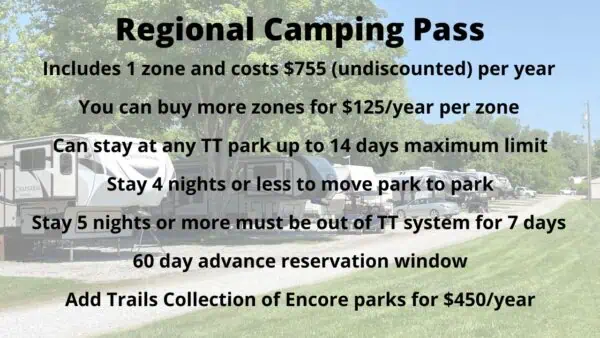
As of 2025, the Thousand Trails Regional Camping Pass costs $755 for a whole year of camping.
But that figure assumes that no discounts have been applied. And there are ways to get this membership for less.
But I’ll discuss that later in this Thousand Trails review.
Thousand Trails Regional Camping Pass Rules
So what are the Thousand Trails Regional Camping Pass rules? Well, here they are:
You can stay at any Thousand Trails campground for up to 14 nights at a time. And it will cost you $0/night to do so in most cases.
You may only stay at Thousand Trails parks that are within a region (or defined area). And you get to choose the region you want from 5 areas in the US.
If you only stay 4 nights or less, you can move from one Thousand Trails campground to another. And there would be no need for time spent outside the system.
If you stay 5 nights or longer in one campground, you must be outside the system for 7 days. After that, you can stay again at another Thousand Trails campground.
You can make reservations for a stay at any Thousand Trails campground up to 60 days in advance.
You can add the Trails Collection of Encore RV resorts for $450/year undiscounted.
Thousand Trails Regional Camping Pass benefits and rules
Who Should Get A Thousand Trails Regional Camping Pass?
If you are not familiar with Thousand Trails memberships at all, this is a good place to start. In fact, this is where we started with Thousand Trails.
One of the great things is it allows you to learn how the system works. And you don’t have to invest a lot of money to do that.
It works very well for RV campers who like to camp on weekends or vacations. And it can also work well for some part-time RV campers too.
According to the latest figures, most RVers use their RV for a total of about 30 days a year.
So even if you get a Camping Pass at full price with no discounts, that averages out to about $25/night. That’s a pretty good value these days!
And the cost will of course be less if you get a discount on the Camping Pass. And I’ll explain how to do that later in this article.
So what happens if you decide that you don’t care for the Thousand Trails system though? Well in that case, just cancel your Camping Pass renewal. It’s that simple.
However, if you want to use it again for another year, it will automatically renew.
Where Can You Use Your Regional Camping Pass?
There are 5 defined zones of Thousand Trails campgrounds in the US.
They are the Northeast, Southeast, Midwest, Southwest, and Northwest zones. And you can view them here on this Thousand Trails Zones Map.
Thousand Trails Zones Map
As you can see, most of the campgrounds in the system are closer to the US coasts. There is not a lot of them available in the middle of the country.
But if you live in or plan to vacation a lot in any of the five zones, a Regional Camping Pass could be a very good choice for you.
Now, only one zone is included when you get your Thousand Trails Camping Pass though. However, you can add zones for $125 per zone.
So if you lived in North Carolina, you could get the Southeast zone included in your Camping Pass membership.
But you might want to add on the Northeast zone too for another $125.
By adding zones, it extends your camping possibilities within the Thousand Trails network.
And lets you have more opportunity to use your Camping Pass in more places.
But remember that the number of parks you have access to can be increased by a lot in a different way.
And that’s by adding the Trails Collection to the Regional Camping Pass. So let’s talk about what the Trails Collection is.
Our Thousand Trails Review Of The Trails Collection
The Trails Collection is an add-on that can enhance the Regional Camping Pass. And give you more RV parks to stay in each night.
It is a group of RV resorts managed by Thousand Trails Encore. There are 110+ resorts that can be added to the 80+ Thousand Trails parks.
And these Encore parks are spread all across the country. The only downside is that they are again located mainly on the US coastal areas.
But that means that by adding the Trails Collection package, you could have nearly 200 resorts and RV parks for camping. And that is pretty impressive.
Just look at the map below to see the Thousand Trails Encore resorts across the country.
The Thousand Trails Trails Collection Map
The Rules And Benefits Of The Trails Collection
So here are the rules and benefits of adding the Trails Collection to a Regional Camping Pass.
You can stay up to 14 nights at a Trails Collection park
You must then exit the Encore resort system for 7 days
After the 7 days are up you can stay at another Encore resort for up to 14 days
You can however move from an Encore resort directly to a Thousand Trails park without exiting the system and vice versa
Most Encore resort campsites can be reserved at $0/night. But some charge up to $20/night extra
There are a small number of resorts in the Trails Collection that are age qualified at 55 years of age
The longest reservation window for these resorts is 60 days in advance
How Much Does The Thousand Trails Trails Collection Cost?
So how much does it cost to add on the Thousand Trails Trails Collection to the Regional Camping Pass?
As of 2025, the annual cost of this add-on is $450.
So for $450 you can increase your number of available parks by more than double the amount in the Thousand Trails membership system alone.
An important thing to keep in mind is that all the memberships I will discuss from here forward will include the Trails Collection.
There will not be any extra fee charged for adding it to the upgraded memberships. Because it’s already included in the price for each one.
Thousand Trails Journey Membership
OK, let’s suppose that you have used your Regional Camping Pass for a while, and you like what you see.
And you have decided to camp in your RV even more often throughout the year as you travel.
If so, you can think about upgrading your Thousand Trails membership level. And the next one in line is the Journey membership.
And here are the Thousand Trails Journey membership benefits and rules:
You can stay in any Thousand Trails park for up to 21 days without moving.
You can then transfer directly to another Thousand Trails park. And you don’t have to spend any time outside the system to do so.
You also can now stay at all 80+ campgrounds in the network. So there is no more need for zones to stay in. You have the whole country included in your membership.
You can extend any stay for an extra week after 21 days two times per year for $29 each time.
Your window for making reservations extends to 120 days (4 months). And that’s a great improvement over the Regional Camping Pass.
The Trails Collection of Encore parks is included in the cost of the Journey membership.
Thousand Trails Journey membership benefits and rules
How Much Does A Thousand Trails Journey Membership Cost?
If you have a Regional Camping Pass already, you can upgrade at any time to the Journey membership.
And as of 2025, the cost of this membership level is $2,000 per year for a 2 year term. And $1800 per year for a 4 year term.
But those figures, like all of the costs I give you in this article, is undiscounted.
So you may be able to get it for less. And I will discuss that later in this Thousand Trails review article.
Of course, you may be able to get a discount for the remaining time left on your Regional Camping Pass too.
And you can pay for the membership in cash. But you can also finance it through Thousand Trails too.
Typically financing your membership upgrade requires a minimum 10% down payment. And there’s no interest applied to the remaining balance.
And the option to finance an upgraded membership applies to all of them.
This is a great option for many RVers. And maybe it’s something that could help you afford an upgraded membership as well.
Keep in mind that unlike past upgraded memberships, no additional yearly fees are added.
So there will be no dues to pay, and the Trails Collection is included in the cost of the Journey membership.
Who Should Get A Thousand Trails Journey Membership?
Well, now we are getting into the area where full-time and part-time RVers benefit most.
Obviously, the membership cost is more up front. But if you travel and camp a lot, it may be a very good choice to control your camping costs.
And as camping nightly fees keep rising in the years ahead, this is a way to lock in lower costs for future years.
Thousand Trails Hershey PA
Thousand Trails Explore Membership
Next in the membership upgrade path is the Thousand Trails Explore membership level.
And here are the benefits and rules for that membership upgrade:
You can stay in any Thousand Trails park for up to 21 days without moving.
You can then transfer directly to another Thousand Trails park. And you don’t have to spend any time outside the system to do so.
You also can now stay at all 80+ campgrounds in the network. You have the whole country included in your membership.
You can extend any stay for an extra week after 21 days two times per year for $29 each time.
Your window for making reservations extends to 150 days (5 months).
The Trails Collection is included in the cost of the Explore membership.
Thousand Trails Elite Connections membership benefits and rules
Obviously, the big draw of this membership is the 150 day camping reservation window.
This allows you to reserve campsites a month earlier than the Journey members.
And as more people come into the RV lifestyle, that benefit will only get better over time.
Otherwise, this membership is pretty much the same as the Journey.
But it also comes with some perks that include added annual cabin stays in the Thousand Trails system. And some family perks as well.
Also, you can use the no-interest financing option for this upgraded membership too.
How Much Does A Thousand Trails Explore Membership Cost?
As of 2025, the Thousand Trails Explore membership costs $3,000 per year for a 2 year term. And $2,700 per year for a 4 year term.
But later on in this Thousand Trails review, I’ll show you how you can get this membership for less.
Who Should Get A Thousand Trails Explore Membership Upgrade?
Once again, full-time and part-time RVers benefit most from this membership.
Especially since the upgrade cost has increased at this point. And that puts it farther out of the reach of many weekend and vacation RV travelers.
But it also works well for those that travel a lot and like to have flexibility in their travel plans.
And it’s helpful if you like to stay at Thousand Trails and Encore parks that are popular. That’s because you have an extra 30 day reservation window.
Thousand Trails Adventure Membership
So now we get to the top of the upgrade path. And that is the Thousand Trails Adventure Membership level.
And here are the membership benefits and rules for this upgrade:
You can stay in any Thousand Trails park for up to 21 days without moving.
You can then transfer directly to another Thousand Trails park. And you don’t have to spend any time outside the system to do so.
You also can now stay at all 80+ campgrounds in the network. So there is no more need for zones to stay in. You have the whole country included in your membership.
You can extend any stay for an extra week after 21 days four times per year during off-peak times for $29 each time. And two times annually during on-peak times for $99 each time.
Your window for making reservations extends to 180 days (6 months).
You have special privileges at RV resorts in the Thousand Trails Trails Collection Plus.
Thousand Trails Adventure membership benefits and rules
So as you can see, the main benefits of the Adventure membership is pretty much the same as the Journey and Explore memberships.
But there is a big difference. And that has to do with the Thousand Trails Trails Collection Plus.
And that is a group of Encore RV Resorts that are also available for camping reservations.
In the Thousand Trails Adventure membership you get special privileges in those parks.
Just skip farther down in this article and I will explain what those privileges are.
But there are also more benefits in the form of extra annual cabin stays too. And additional family perks as well.
How Much Does A Thousand Trails Adventure Membership Cost?
As of 2025, the cost for this top level membership is $4,000 per year for a 2 year term. And $3,600 per year for a 4 year term.
These are undiscounted costs. But look farther down in this Thousand Trails review to find out about savings on this membership.
Clearly, that is a bigger investment for many RVers. But as I said above, the main attraction is the addition of the special privileges at the parks in the Trails Collection Plus.
But there are no added yearly dues to pay. And no additional cost for the Trails Collection Plus either.
And once again, the cost of this membership can be financed with a no-interest payment.
Who Should Get The Thousand Trails Adventure Membership?
Obviously, the cost of this membership is higher. And that means that most weekend and vacation RVers would not benefit from it.
But if you are a full or part-time RV traveler, it could be well be worth it. Especially if you like to have the largest reservation window possible.
It also appeals to those who want an extensive list of RV resorts and campgrounds to choose from.
And you will see why that is true in the next section. So let’s explain the benefits of the Trails Collection Plus that is included in the Adventure.
Our Thousand Trails Review Of The Trails Collection Plus
Remember I said that the Thousand Trails Adventure members get special privileges in the Trails Collection?
Well, it’s called the Trails Collection Plus. And here are the benefits, rules and costs of the program:
You can stay up to 21 nights in the Encore park system
You can move from one Encore park directly to another without staying outside the system at all
Your reservation window for campsites extends to 90 days in advance
This add-on is only available with an Adventure membership. And it’s included in the cost of the membership.
Thousand Trails Trails Collection Plus benefits and rules
What’s The Main Benefits Of The Trails Collection Plus?
Of course, the ability to stay longer at each Encore resort is a big plus.
Your stay moves from a 14 day maximum with other memberships to a 21 day maximum instead.
And for many, being able to move seamlessly from Encore to Encore park and back without any time outside the system is huge!
I know that as full-time RVers, we lobbied for this kind of benefit regularly.
Monte Vista Encore Resort in AZ
Remember though, that the Trails Collection Plus is only available to Thousand Trails Adventure membership owners.
So you can’t access its benefits on any other Thousand Trails membership at any price.
How To Save On Thousand Trails Memberships
OK, it’s time to explain how you can save money on Thousand Trails membership levels. That should be part of a Thousand Trails review too.
Of course, if you call Thousand Trails directly you can get a membership anytime you want.
But you won’t usually get any really good bargains that way. And you’re not really sure who you will be working with.
However, when we decided to upgrade our Thousand Trails membership, we learned about a way to save money on our purchase.
Other full-time RVers in Thousand Trails explained it to us. And I will share that insight with you now. Here is what I recommend:
Another con is that it does require somewhat of an investment to get one of the upgraded Thousand Trails memberships.
These are the ones that allow you to travel from park to park across the country. And I covered the membership options earlier in this article.
Generally speaking, on the used market you’re probably going to need to invest around at least $4,500 or so.
That is, as of the time of this writing in 2025. And who knows how much the used memberships will go up in the future.
Especially since they will now become more and more scarce and difficult to find.
Of course, if you are buying a new upgraded membership from Thousand Trails in 2025 it starts around $2000 per year for a 2 year term now.
However, keep in mind that there are no-interest financing options that can be available to you.
But the cost of Thousand Trails memberships keep going up. So who knows how much they will be in the years ahead.
And for some people, that is just too much money to come up with for a camping membership. So for them it’s a big con.
Thousand Trails Cons #6 – Confusing Options
And there is one more con, or disadvantage, we want to talk about. That is that there are lots of confusing options in Thousand Trails membership programs.
When you speak with the company’s membership sales this becomes very apparent.
Because with each different add-on there are also restrictions that come with it.
After a while, it actually becomes very confusing. This is because there are just so many details that have to be understood and remembered.
I explained the major benefits and rules of each Thousand Trails membership above in this article.
But there are lots of smaller rules with each membership that are not so obvious.
I didn’t get into those details because I find that in most cases it just confuses people.
And it’s the big benefits that are the most important anyway. So that’s where your focus needs to be in my opinion.
But considering a membership is not simple, and I fully understand the irritation that many RVers feel about this.
And I agree that the system should be much simpler. It should be easier for folks to be able to decide what kind of membership they want.
And it should be very clear what they’re getting. But that’s not always the case.
So having someone who is helpful and personable guide you through the purchase process is important.
For that, just check my recommendations for personal assistance earlier in this article. They are:
Or you can call them at 631-921-1674 or 352-396-6835.
And they will be able to make the whole comparison process much easier.
But the complexity of Thousand Trails memberships is an unfortunate con to be aware of.
Who Should Get A Thousand Trails Membership?
So now let’s talk about what kind of RVer or camper best fits into the Thousand Trails system.
And this is an important part of a Thousand Trails review.
First, number one and foremost, are full-time RVers who are on a budget.
In other words, they need to keep their camping costs under control. And Thousand Trails is designed to do that really well.
Now maybe you have a lot of money. And it really doesn’t matter to you what you spend on camping costs.
Well, someone like that doesn’t necessarily have to think about getting a Thousand Trails membership.
But if you don’t fit that criteria, then it’s really good for full-timers that need to be on a budget.
It helps them watch their camping costs and keep them reasonable.
Thousand Trails Chesapeake Bay in MD
Other RVers That Benefit From Thousand Trails Too
Yet another kind of person that’s really good for a Thousand Trails membership are RVers who camp a lot on weekends or vacations.
They can get a Thousand Trails Regional Camping Pass for the year for $755 in 2025.
And for them it’s a great way to sample the system and see how it works. And it will usually save them money on camping costs too.
So even these kind of campers get benefits from Thousand Trails at the Regional Camping Pass level.
Another Point – What Kind Of Campsite Do You Prefer?
Another person that benefits from Thousand Trails is people who like rustic campgrounds. You know, they like to be in nature.
They don’t really want to be around big cities and things like that as much. In that is you, then you are going to really like Thousand Trails.
But a Thousand Trails membership is not going to benefit folks that want the best of everything in their campground membership.
And maybe you are the type of person that really wants the best luxuries and amenities. You want to go first-class.
And if you are not really flexible with not always having the best, Thousand Trails is probably not for you.
That’s because you have to be flexible and adjustable in the Thousand Trails system to be happy in it.
So you need to consider that when trying to determine your RV camping needs and wants.
Then you can decide whether they line up with what Thousand Trails actually provides or not.
Our Thousand Trails Review About Our Experience In The System
Now, Cheri and I really like Thousand Trails. It works great for us. It’s saved us a lot of money.
And our Thousand Trails review reflects that we are satisfied overall with our camping membership.
We have liked most Thousand Trails and Encore parks almost everywhere we have gone.
But we’re the kind of folks that are fairly easy to get along with on most things. And we easily adjust to most situations.
We don’t always expect the best, and we’re flexible as a result of that. So it has worked well for us.
But Thousand Trails does not work for everyone.
So we all need to be honest with ourselves about what we expect from RV campgrounds in our travels.
And that will help you make the best decision about whether a Thousand Trails membership works for you, or not.
But there is one more very important thing to explain in detail in this article.
And that is the history we have had since becoming Thousand Trails members.
Our Thousand Trails Review – How Has It worked Out For Us So Far?
OK, from here on I’ll be covering our personal experience in the Thousand Trails system.
And give you the facts and figures of our journey with them so far.
Watch my video that answers the question – Is Thousand Trails Worth it?
So to start with, we have been Thousand Trails members for over 5 years now.
And we didn’t want to write about this subject until we had fully experienced the Thousand Trails system.
But now we’ve been out there and we’ve camped in their system for a while.
And we have the dollars-and-cents figures worked out. So now we want to share that with you.
And by the way, these are not just opinions on what the facts and figures are. But rather, the cold hard facts on how they worked out for us.
Just keep in mind that we bought one of the older lifetime memberships in 2019.
But as I mentioned above, there are still great savings to be had with the new 2025 Thousand Trails memberships too.
So let’s go ahead and get started using our first year’s camping costs on our cross-country RVing trips.
The First Year Of Our Thousand Trails Membership
First of all, we started our trip in Arizona. Then we traveled across the bottom of the country until we got close to the east coast.
After that, we made a big turn and went right up into the Northeast. So from Arizona to our destination in New Hampshire, it was a 3300 mile trip.
We did it in one hundred days. So it took us a long time. Why? Well, we are not one of those RVers that just wants to be on the go all the time.
In fact, we think that the destination is not the only part of the journey you should enjoy.
So we like to stop and get to know the areas we’re in for a while.
And we enjoy getting out on some day trips and enjoying the culture in each part of the country.
So because of how we travel, it took us 100 days to go 3300 miles.
Now during that 100 days, we only spent 11 nights outside the Thousand Trails system.
The only reason why we went outside is because there wasn’t a Thousand Trails park in that particular area.
So now we want to look for a benchmark figure that we can use per night to know what Thousand Trails saved us on this first trip.
Our first trip costs
So on that first trip across the country, those 11 nights outside Thousand Trails averaged out to cost us between $35 and $40 a night.
That is how much it cost us to stay at conventional campgrounds on that trip a few years ago.
Of course, camping costs are even higher now in 2025. But let’s still use the lower figures from a couple of years ago that reflects our experiences then.
And keep in mind that any higher nightly cost now would make the savings even greater at this point.
So let’s use the lower average cost of $35 a night that was useful back when we first got started in Thousand Trails.
Then let’s apply it to the nights that we were in Thousand Trails instead of conventional campgrounds.
So in total, we stayed 89 nights in Thousand Trails. And if we multiply that out (89 nights times $35/night), Thousand Trails saved us $3,115 on that trip.
In other words, that’s what those nights in conventional RV parks would have cost us for 89 nights.
Because we stayed in Thousand Trails for $0/night. And that’s pretty impressive!!!!!!
Our stay in the northeast
But then we arrived in the Northeast. And we were there for about 60 days.
Out of that 60 days, we spent only 7 nights outside of Thousand Trails.
So let’s use that same benchmark figure of $35 a night for conventional campgrounds.
And that means that during the other 53 nights we stayed in Thousand Trails parks in New England, it saved us $1,855!!
Now we need to make one point here about being in the Northeast in the summertime with an RV.
And that is that if you have done that, you know that $35/night is not going to be sufficient for nightly camping. Not by a long shot!
You might find some places like that. But the reality is that it was honestly more like $50 or even close to $60 a night on average at conventional campgrounds.
And of course, these days that nightly figure for camping is even more.
But we are are still going to use that $35 a night benchmark average for campgrounds across the country. Even in New England in the summer.
As it will help explain how much our Thousand Trails membership saved us.
And it will make sure that the savings I’m covering here, if anything, are lower than what they really were.
Encore Resort Tuxbury Pond in NH
Our second trip costs
Now after being in New England for a couple of months we left for Florida.
And our Florida trip was a 39 day trip altogether. During that time, we stayed seven nights out of the Thousand Trails system.
So once again, we will use the $35/night benchmark for the other 32 nights that was in Thousand Trails.
And if we do that, Thousand Trails saved us another $1,120. Because Thousand Trails only cost us $0/night!
So as you can see, the savings are really adding up now.
Our third trip costs
Then after being in Florida for a brief time, we headed back to Arizona for the winter months. And that was a 45 day journey.
And on that trip we stayed a total of 10 nights outside of Thousand Trails campgrounds.
So then the remaining 35 days on that trip we were in Thousand Trails campgrounds.
And if we again use that benchmark of $35 a night, a total of $1,225 was saved on that trip.
All right, now I’ve gone through a whole lot of facts and figures here about our travels a few years ago. So let’s get to the bottom line.
Our Thousand Trails Review About The Total Savings Using Thousand Trails
And that is that we made three long trips across the country that year. The first year that we used our Thousand Trails upgraded membership.
And the total saved is $7,315 on trips that took us just eight months to complete. Now why do I say that?
Because that still left 4 more months to go in the year. But in just 8 months we had saved over $7,000.
Now, I always knew the savings were pretty good. But going over the facts and figures again, I have to say that is really impressive!
Of course, I know what some are going to say though. Wait a minute Duane, you’re not being fair!
What About Weekly And Monthly Rate Savings At Other RV Parks?
Because you could have gotten some weekly rates, or perhaps monthly rates along the way.
You’re right, conventional RV parks do offer better rates for those time periods. But here’s the thing I have found.
Weekly rates at RV parks save you some money. But that’s not where the real savings is. It’s in the monthly rate.
And we are not doing this to be spending a month or more in a campground in any one location.
As you can see, we are traveling quite a bit. We’re not doing it fast, but we’re definitely moving along.
So monthly rates were really out of the question for us.
So then we get back down to that $35 a night average for most RV parks, in that year.
And I feel it’s reasonable to use an even higher figure as a benchmark for camping costs now.
Clearly then, there is definitely savings in using Thousand Trails. Because our nightly stay in their system was only $0/night.
Mesa Spirit Encore Resort in AZ
Our Thousand Trails Review – Adding In Our Yearly Dues
Of course, that’s not counting our dues or what we paid for our Thousand Trails membership either.
We are just talking about the nightly stay which is $0/night.
But as I showed earlier in this article, the cost of dues spread out over a year is less than $4 night.
And that’s including all of our extra expenses for using our membership that year.
So the savings are still very real in Thousand Trails!
Now let me make another couple of points here. On all of these trips where we stayed at Thousand Trails campgrounds, we had full hookups.
None was without full hookups which included 50 amp electric, water, and sewer. And that’s an important point to me as well.
And we also never had a reservation refused. That’s also very important.
Because I often hear RVers talk about how they just can’t seem to get reservations at campgrounds.
Well, we never had one refused, and have never had a single problem reserving a spot. And that continues to this day!
Of course, we planned our trips out well in advance. We like to do it that way, and by doing that, it no doubt helped us.
But we had no refusals for a reservation at any Thousand Trails Park. It all went very well.
Our Thousand Trails Review – Adding In Our Membership Costs
Of course, we have to say in all fairness that we have an upgraded older lifetime membership. So we have to consider the cost of that too.
But you know what? By adding it all up this way, Cheri and I came to some important conclusions.
We figure that in these first three trips alone we have saved over $7000 in nightly camping costs.
And that more than covers the cost of our upgraded Elite membership that we bought in 2019. And that is in the first eight months alone of that year.
So that’s not even considering the savings we accumulated during the other four months of the year.
And going forward, that original membership cost doesn’t apply from year to year any more.
Especially if you cover the cost of it in the first year’s savings.
What About The Cost Of The Trails Collection?
And what about the Trails Collection? It’s true that it does cost us a little bit more yearly than just the Thousand Trails parks alone.
Of course, it’s already included in the new 2025 memberships. But what I’m covering here is just our experience with our own membership.
And we like the Trails Collection because it gives us a lot more parks to choose from.
And that’s a big help if you are a full-time RVer like us who likes to travel the country a lot.
Now so far, we have considered the real world savings that Thousand Trails has allowed us on RV camping.
And I honestly don’t know how we could have gotten our camping costs any lower than with Thousand Trails.
Not and have full hookups which include 50 amp electric, water, and sewer all on-site.
What About The Savings You Get With Boondocking?
Of course, some will say that the cost of camping can be cut down quite a bit with boondocking, or dry camping, though.
But there’s a lot of extra effort that goes with boondocking. And I’ve made that point in other articles.
For instance, it means you have to bring your power with you. And you’re going to have to bring your water with you too.
You’re also going to have to manage all of your waste tanks and so on. Whereas in Thousand Trails all of that is taken care of for you.
The other thing is that boondocking can only be done easily in certain parts of the country.
For instance, most boondocking spots are located in the western part of the US. That’s where you find a lot of BLM (Bureau of Land Management) land.
But in the Eastern US, places to boondock become more and more scarce as you go. And that’s another real consideration.
A 2025 Thousand Trails Review Update
There is a lot to consider when reading through this Thousand Trails review.
And if you are still with me here, I appreciate your patience and perseverance!
But some may wonder whether things have changed for us since this was first published.
But I can say confidently that we have come to appreciate and value our decision to buy a Thousand Trails membership even more now.
The costs for staying at the average US campground has increased a lot over the past couple of years. And that makes our membership value even better.
Also, Thousand Trails has been expanding the number of available campsites.
And they are actively upgrading many of the older parks in their system too.
And the value of our membership on the used market has gone up as well.
To the point that we could easily get the vast majority of the amount we paid for it back if we chose to sell it.
How To Get The Best Membership Deal In 2025
So if you want to get all of your questions answered and get the best deal possible on a Thousand Trails membership, here’s what you should do:
In this article I’m going to be talking about our five best full time RV living lessons that we can share with you.
These come from our first full year of full time RVing on the road. And you know, a lot of them we learned the hard way.
So they really come from real world experience. And hopefully what we share with you will help make your RV travels a little easier.
So maybe you’ve been considering part-time RVing or full-time RVing or just taking a long extended trip in an RV.
And if so, this article is definitely for you. We’re going to share with you the the best wisdom that we have learned over the last year of travel.
(Watch my video on this subject by clicking on the image above)
Disclosure: Please note this post may contain affiliate links. This means – at no additional cost to you – I earn a commission if you make a purchase using our affiliate links. I only link to products and companies I use and feel comfortable recommending. The income goes toward supporting the free content on this website
Now let’s go ahead and get started with lesson number one. And that is slow down and enjoy where you are.
It seems that everybody agrees that when they get on the road it seems like they get itchy feet syndrome.
You know, you feel like you have to be traveling, going here or there all the time. This can happen even though you know that it’s not a good thing to do.
And yes, we certainly fell into that trap ourselves. What happens is you get a little weary after a while, but you don’t notice it right away.
But over the course of time you get progressively more tired and that takes away from your enjoyment of RV travel.
And then your anxiety level increases and it’s just not good for enjoying your time out on the road.
So there is a need to kind of regulate what you’re doing and watch it carefully.
Ultimately, the point we want to make to all of you is that the fun of RVing is really not in the travel.
Of course, it can be enjoyable too, but that’s not where the real fun and enjoyment is.
Instead, the really enjoyable experiences are what you do and where you go and the things you see because of your RV travel.
So don’t get the cart before the horse and think that traveling is what you need to always be doing.
No, travel is just a means to an end. And the end is enjoying where you are at right now.
Our Plan To Enjoy RVing More
So going forward we plan that when we know we’re going to an area, we’re going to just get on the road and get there.
And then, when we get there we’re going to plan to be there for at least a couple of weeks, maybe longer.
And that’s because we want to get to know the area well before we move on. We want to see it and take it in and really enjoy it while we are there.
So you can use your passenger vehicle and do day trips at that point. Just get out there and see the sights, and experience the joy of that area.
That way you’re not just rushing around all the time and it will really will lower the anxiety and stress level of RVing.
So once again, lesson number one is slow down and enjoy where you are. Don’t always be thinking about where you’re going next.
Full Time RV Living Lesson #2
Now, lesson number two is about managing camping costs. This is because you’ve always got to have some place to park your rig.
And since camping costs are the number one expense for most RVers, how can you control that?
Well, what we found is that you can easily control your camping costs through campground memberships.
And the number one camping membership that has really worked for us this past year is Thousand Trails.
Now I know that some are going to roll their eyes at that statement. Because maybe they’ve heard bad things about Thousand Trails or whatever.
But our experience has been very positive. In fact, we have had good experiences all across the country in Thousand Trails parks. So we can highly recommend it.
Learn more about a Thousand Trails membership by clicking the image above
But not only did we enjoy staying in Thousand Trails campgrounds, but the savings were also fantastic.
We have already saved thousands of dollars over the last year, and going forward it’s going to get even better.
Thousand Trails Videos To Watch
Now, I’ve made two videos on Thousand Trails memberships already and I’m going to put the links to those videos in this article now.
And in the videos I will give you the facts and the figures of what it actually cost us and what we’re saving with our Thousand Trails membership.
(For more information on new Thousand Trails camping memberships contact Jim and Brandy Reneau by email at [email protected] Or call them at (770) 622-4188 or (717) 585-6137 . Be sure to tell them that Duane at RV Inspection And Care referred you to get the best deal and the lowest prices on Thousand Trails memberships. OR Contact Kimberly at https://www.campgroundmembershipoutlet.com/ for information on resale Thousand Trails memberships.)
Another RV Camping Membership To Consider
Now the second RV camping membership that’s worked really well for us this year is Passport America.
You know, when you’re out on the road, there may not be a Thousand Trails campground anywhere near you. So you’ve got to choose other campgrounds to stay in.
Well, in many cases they will accept Passport America and give you 50% off from the normal camping costs for the night. And that’s really a great savings!
It’s worked well for us where we have camped all across the country. But we’ve even found that it often works when we’re staying for a week or so at a time.
So Passport America is a really good membership to have.
The Third RV Camping Membership That Has Worked Well For Us
Now, the third membership that has saved us money this year was Boondockers Welcome.
And this was a surprise to us because we aren’t really boondockers. We like staying overnight mostly in campgrounds.
But it was recommended to us by a friend we met in our RV travels. So we decided to give it a try.
And now we really enjoy that program because we can stay overnight on the road for zero dollars a night.
Boy do I love that figure of zero dollar a night camping. And we have stayed at some very nice facilities across the US through our Boondocker’s Welcome membership.
Once again, I made a video about Boondockers Welcome and I’ll put the link here in the article. And that way you can learn more about their program if you like.
So lesson number two is that if you want to save a lot of money, consider campground memberships.
Of course, maybe you’ve got plenty of money and you’re not budgeting anything because you don’t have to.
In that case, campground memberships are really not all that important. But if you do have to budget while traveling, the campground memberships I’ve mentioned can be a big help.
Full Time RV Living Lesson #3
Now it’s time for lesson number three. And that is about staying connected on the internet while you’re traveling.
You know, maintaining internet connectivity while traveling around the country can be a challenge at times.
And over the course of this last year it’s gotten even more challenging, mainly because of Covid restrictions.
This is because many people have been staying home and using their devices to access the internet. Through their phones, their tablets and laptops.
Well, cellular bandwidth for the carriers has really been eaten up as a result of this. So this has caused a lot of upheaval in the cellular internet industry.
And many folks that are RVing often use cell carriers for their access to the internet.
So once again, I made a video that gives you some very practical advice on how to maintain internet connections on the road.
Of course, we learned these things the hard way. We went through some real trial and error and some expense too.
But in the video I explain what carriers you need to focus on and the data plans that are are good for RVing.
I also cover the equipment that you need and the strategies necessary to keep connected while traveling.
So be sure to access that mobile internet connectivity video at the link that I provide here below:
But one other point i want to make about planning ahead is about the maintenance that needs to be done on RVs.
You know, if you don’t keep up your RV maintenance, you’re going to regret it. Most likely, it’s going to come back and bite you somehow in the end.
And it’s probably going to cost you a lot more than if you would just keep up the maintenance as you go.
So when you’re traveling for a while, try to plan to be in an area where your maintenance can be done.
For instance, where you know that there’s an RV tech or an RV service center that can be trusted and reliable.
Then plan ahead to be there for a little while and let them catch you up on your RV maintenance.
As a result, you’ll have a lot better and more safe trips. And you won’t have as much going wrong with your RV while you’re out there on the road.
So once again, it’s a good idea to plan ahead for those things.
Full Time RV Living Lesson #5
Now lesson number five is that if you’re going to be out there traveling a lot, get a fuel discount card or program and use it.
This is the second best way that we have found to save money on full time RV living costs.
In fact, being part of a fuel program really worked well for us. Recently, we added it all up and we saved over seven hundred dollars last year in just fuel costs alone.
Now, that’s some real savings. So we encourage you to look into fuel discount programs if you’re going to be out traveling for a while.
It’s definitely going to save you money that you can use for other things that is going to be more enjoyable.
And I did also make a video about this too and you can find the link for that video here below:
Well, those are the five best lessons that we learned about full time RV living that we wanted to share with you.
And lots of full time RVers that we know have learned these lessons already. So we are sure that these tips will benefit you in your RV travels as well.
And by the way, if you have suggestions about other ideas that’s really worked well for you, please leave them in the comments below.
That way we all benefit from each other’s RVing experiences.
Have safe and happy travels my friends!
Get My FREE Camping Guide
“The Top 5 Ways To Save Money On Campground Costs”
Get My Newsletter
Save on RV repairs
Get the best RV gear
Learn about RV life
RV tips and tricks
And get my free guide – “The Top 5 Ways To Save Money On Campground Costs”