
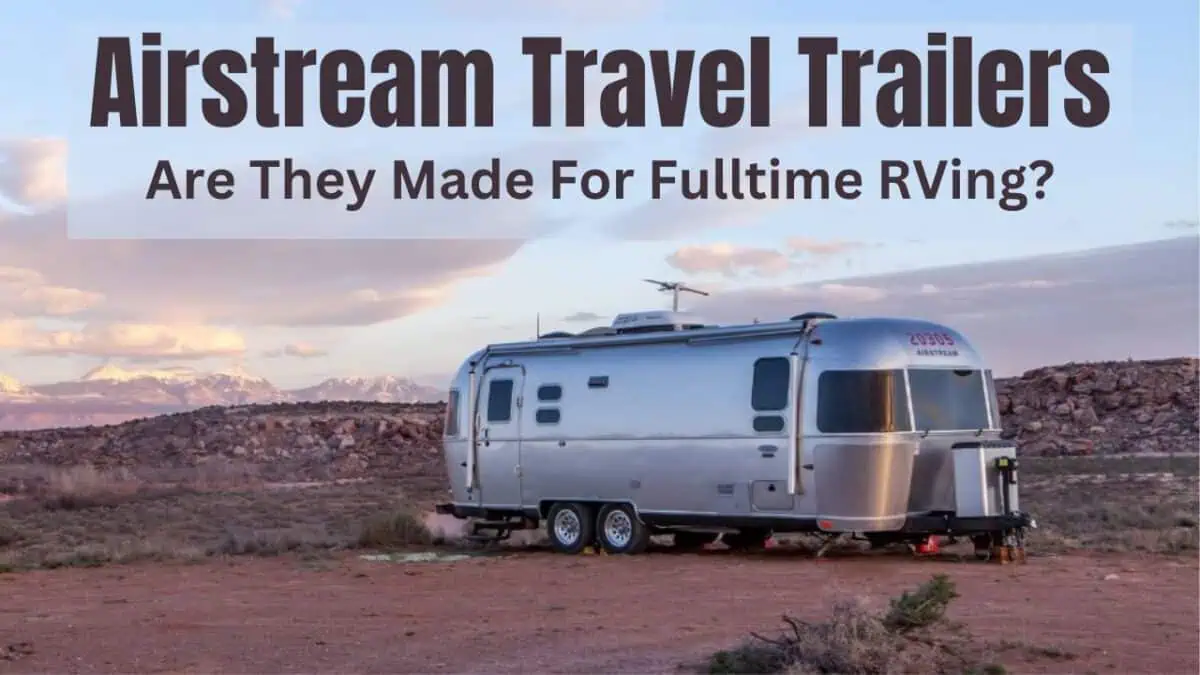
Airstream Travel Trailers – Are They Good For Full-Time RVing?

This article is about Airstream travel trailers. And whether you should choose one for full-time RV travel and camping, or not.

Of course, just say the word Airstream and pretty much everybody knows what you’re talking about.

They get this picture in their mind of a shiny aluminum rounded travel trailer. Because you see pretty much see them everywhere.

Airstream travel trailers are well known for their appearance and shape

So there’s no question that Airstream travel trailers are very popular. But are they a really good choice for full-time RVing though?

Watch my video about Airstream travel trailers

Table of Contents

Are Travel Trailers A Good Choice For Full-Time RVing?

Well, the vast majority of travel trailers that are sold today are actually only made and designed to be used occasionally.

Mainly just for a few weekends each year and vacations spent in good weather.

And as long as you use them that way, they’re going to be just fine.

Most travel trailers are not made for fulltime RV living

But full-time RV living puts lots of extra stress on RVs. Stress that can wear them out very quickly if they aren’t designed for it.

So the number one requirement for full-time RVs is being built well. Built with quality.

Are Airstream Travel Trailers Built With Quality?

So then are Airstream travel trailers built well enough for full-time travel and camping?

Well, I made a video just a little while back about Airstream travel trailers. And about how well they are actually made.

Just click on the image below to watch that video.

Watch my video about how Airstream travel trailers are made

In that video I said that both high quality building materials and construction methods are being used by Airstream.

For instance, Airstream says that they put in 350 hours for the average travel trailer to be produced.

And you can compare that with only 50 hours of construction time for most other brands of travel trailers.

So clearly, a lot of extra time and effort is being put into Airstream travel trailers when they are made.

And that’s why roughly 70 percent of all Airstreams ever made are still being used today. At least that’s according to Airstream’s website.

Airstream has a deserved reputation for longevity and quality

And that’s really an impressive figure! In fact, what other travel trailer manufacturer can make anything close to that claim?

So then Airstream travel trailers are built well enough to withstand full-time use.

Is Quality Construction All You Need To Consider?

But just because you have a well-built RV that doesn’t mean that it’s going to fit you personally for full-time travel.

Because there are very practical day-to-day considerations that also apply that you need to consider as well.

So let’s talk about that. Let’s talk about the pros and cons of Airstream travel trailers.

Airstream Travel Trailers – Pro #1

And on a day-to-day basis for practicality, number one on the pro list is that they’re built light.

In fact, that’s one of the main reasons for that aluminum shell that everyone knows about.

It helps to keep the total weight of the RV down because the shell doesn’t weigh much.

And that means that if you have to buy a tow vehicle, it often will not have to be a diesel powered one.

The chances are that it can probably have a gasoline engine in it instead. And that’s a big plus for many people.

Take for instance, the middle range Airstreams like the Flying Cloud. Or the International or Globetrotter.

The iconic Airstream Flying Cloud

All of those models top out under 9,000 pounds! And even if you go to the Classic, the biggest model Airstream makes, it tops out at 10,000 pounds.

So that’s well within the capability of some modern gas powered trucks that are on the market today.

And if a diesel powered truck is needed, often a 3/4 ton unit will do the job nicely.

And that’s a big savings for folks that are trying to get into full-time RV living and travel.

Pro #2 of Airstream Travel Trailers

Now let’s move on to number two on the pro list. And the second pro is that Airstreams fit in campsites very easily.

The reason for this is that there are several models they make that are under 30 feet in length. And under that’s an important advantage.

Because 30 feet or less gets you in almost any state park or national park in the country. As well as the vast majority of RV parks as well.

So that’s really good for full-timers who want to travel and go pretty much anywhere!

Pro #3 That Makes An Airstream Very Livable

Now the next pro to consider is that there’s lots of floor plans to choose from in Airstream travel trailers.

But they’re also well thought out for livability too. In fact, it’s clear that Airstream has put a lot of effort into this.

They try and make sure that their layouts make sense. That they’re reasonable. And that everything is where it really should be.

And that can make a big difference in day-to-day livability for most people. Especially when you’re living in the RV on a full-time basis.

Pro #4 Is A Big Advantage Over Motorhomes

OK, the next pro is that there is no drivetrain to have to deal with in travel trailers.

Of course, this is one of the big problems with motorhome RVs. And that is that the drivetrain and the RV itself is all in one unit.

So when you have a problem with either one of them, they very well could go in the shop together. And that can be a big headache for RV owners!

Especially if the repairs are going to take a while and require a repair facility to handle it.

But because an Airstream is a travel trailer, there’s no drivetrain built into it. Instead, the drivetrain is your tow vehicle.

Travel trailers have some advantages over motorhomes when it's repair time
Travel trailers have some advantages over motorhomes when it’s repair time

So that means that the RV itself has very little that can go majorly wrong with it and strand you. And that’s a big pro for full-time RVers!

The #1 Con For Airstream Travel Trailers

OK, let’s move along to the cons of Airstream travel trailers too. And the number one con for Airstreams is that they are expensive!

Yes, there’s no doubt about it. Airstream travel trailers are not cheap!

Take for instance those mid-size models that I talked about earlier. Either the Flying Cloud, the International, or the Globetrotter.

They’re going to start at $90,000+ and go up from there. And the Airstream Classic can be close to $190,000.

So clearly, that’s a lot to swallow for many RVers out there who want to travel full-time.

And as a result, it’s going to eliminate many of them from being able to even afford an Airstream. So that can be a disadvantage for sure!

What About Living Space? – Con #2

Now the second con about Airstreams is there are no slide rooms in them.

Of course, there was a time when Airstream tried to build slides into their RVs.

But they stopped it several years back, and they don’t do it anymore.

So how much room do you have if you get a 25 foot Airstream? With about eight feet or so of interior space from side to side?

Well, you only have about 200 square feet of total living area in that size RV.

In a 30-foot Airstream, you get about 250 square feet of living area. And that’s not very much!

So that kind of living area can get very tight for some. It can even feel claustrophobic for many.

So it’s something you need to consider before you think about buying an Airstream.

Con #3 For Full-time RVers

Now moving on, the third con is they’re not really made for extreme temperatures.

Of course, they’re just fine really for four seasons weather in many parts of the country.

But when you get to extreme temperatures, you’re going to have some issues.

And one of the reasons for that is the aluminum shell that Airstream is so well known for.

Unfortunately, it transfers temperatures from the outside to the inside easily.

In fact, much easier than the materials that most travel trailers are made out of.

So it means that if you have an Airstream, you really should try to stay in temperate areas.

And follow good weather as much as possible to stay comfortable in your travels.

Con #4 For Airstream Owners

Now the next con is that generally you’re going to find pretty small kitchens and refrigerators in Airstream travel trailers.

Airstream travel trailers often have very small kitchens

So if you are a cook, and you like to make big meals, you’re going to have a real challenge on your hands with an Airstream.

So be sure to look over the kitchen area carefully before you buy. And try to decide whether you can adjust to the small size or not.

Con #5 For Airstream Travel Trailers

OK, it’s time for the last con I want to talk about in this article. That there’s really not very much storage in the travel trailer itself.

So that means that when you buy a tow vehicle, you need to be sure it has plenty of room for storage.

Because you’re going to need room in that vehicle to store a lot of the things that probably many other RVers might put in their RV.

Now it’s not a huge issue. It’s not the end of the world. But it is something to consider before you buy an Airstream!

OK, those are the pros and cons I wanted to cover with you in this article. And they come from real life experiences with full-time RVing.

What You Should Do Before You Buy An Airstream

So what if you’re on the fence about some of the disadvantages or cons in this article?

Well, here’s my recommendation. Go rent an Airstream first and try it out before you buy one.

You need to make sure that you feel it’s livable for you first. Don’t just go out and buy one if you’re unsure about some of these things.

A Word Of Caution About Buying RVs

Also take note that quality control issues have affected Airstream during the Covid pandemic years.

Just like pretty much all other RV manufacturers experienced during that time.

And all RVs are made by hand too. Which means that consistent quality is always a challenge in the construction process.

So if you’re buying a new Airstream, be sure that you get it inspected before the purchase.

Hire a certified RV inspector before you buy any Airstream RV

And that way, you can find all the issues that have come out of the factory right away.

And you can get them fixed before you take ownership of the RV and take it home.

To help in doing that, I’ve created a guidebook for buying new RVs of any kind. And it would be helpful for buying new Airstreams as well.

I highly recommend using the guidebook in the buying process. It will help you find the right RV for your needs and get it at the right price too.

Also, I will be personally available to help you throughout the buying process if you get my guidebook.

So if you think that could help you, just click on this link to find out more about it.

Download my guide for buying new RVs before you get an Airstream

Conclusion

Well, there’s lots of pros for full-time RVing in Airstream travel trailers. There’s no doubt about that.

But there are some cons too. Some things you need to think about as well before you buy an Airstream.

Hopefully what I’ve covered here in this article will help you be able to make a good decision.

A decision that will work best for you and the way that you like to travel and camp.

Have safe and happy travels my friends!
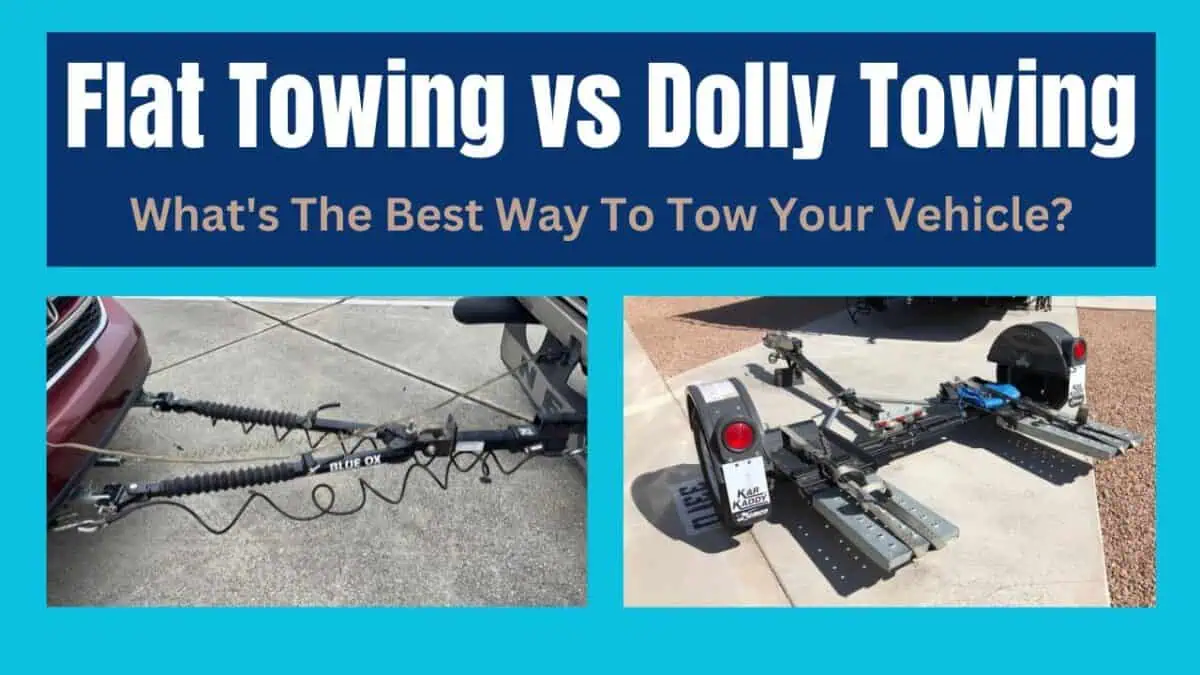
Dolly Towing vs Flat Towing – Which Is Best?

This article is about dolly towing vs flat towing. So which towing method is best for you?

And we might ask, who needs to even consider towing another vehicle along with them on their RV travels?

Watch my video on dolly towing vs flat towing

Table of Contents

Who Should Consider Towing Another Vehicle Behind Their RV?

Usually not anyone who has a towable RV, like a travel trailer or a fifth wheel.

And that’s because you have a tow vehicle that’s pulling it down the road.

So when you get to where you’re going, you unhook the RV. And then the tow vehicle becomes your daily driver that you use.

But if you have a motorhome, you might want to consider towing another vehicle with you. To be able to use it as your daily driver instead.

Of course, not all motorhomes require towing an extra vehicle though.

Do All Motorhome Owners Need To Tow Another Vehicle?

For instance, smaller RVs like Class Bs, some Class B pluses, and some smaller Class C’s may not require you to tow another vehicle.

Smaller motorhome owners may not need to tow another vehicle

That’s because they’re small enough that you can use that RV for both camping and as your daily driver.

But if you do that, there is a procedure you will have to go through every time you leave the campsite.

And that is that if you’re in an RV park or campground, you’re going to have to unhook each time you leave.

You’ll need to disconnect your electric line, your water hose and your sewer hose every time.

Then you can go make your errand or trip in your RV. Afterward, you then come back and re-hook it all back up again. Every single time.

Now as long as you’re okay with those inconveniences, it works just fine. And you don’t need to take another vehicle with you.

What About Larger Motorhomes?

But what about when we’re talking about larger motorhomes like large Class Cs? Or Class A and Super C RVs?

Larger motorhome owners should consider towing another vehicle along with them

In that case, you really should consider taking another vehicle along with you.

Because using those big RVs as your daily driver is very cumbersome. It’s really difficult to get around in tight areas with an RV that large.

And it costs you more fuel wise as well. So the larger your motorhome is, the more you really should consider having a towed vehicle.

Two Main Choices For Towing Another Vehicle

So what kind of towing is best then? Well, there’s two main kinds of towing equipment that you’ll see out there being used by RVers.

The first is dolly towing. And that’s where the front wheels of your tow vehicle rests on a dolly as it’s towed.

The second popular method is flat towing. And that’s where the towed vehicle has all four tires on the ground for towing.

Dolly towing vs flat towing - the two main choices you have
Dolly towing vs flat towing – the two main choices you have

Now let me mention something before we get into the pros and cons of each towing method.

Three Things You Need To Tow A Vehicle Successfully

And that is that there’s three things you’re going to need for any form of towing.

#1- you have to have the method itself, either dolly towing or flat towing.

#2- you’ve got to have a braking system for the towed vehicle. Because you can’t expect all that weight to be put on your motorhome’s brakes every time that you go to stop. It’s just not safe to do that!

#3- you’re going to need a lighting system for that vehicle as well. In order to be legal in all states that you’ll travel in.

To learn more about these three things you need, click here to watch my video on the subject.

OK, having considered all that, let’s now get to the pros and the cons of each towing method.

Dolly Towing vs Flat Towing – The Pros Of Flat Towing

And the number one pro of flat towing is that it’s so easy to connect and then disconnect your RV.

Yes, there’s really not a lot to it. There’s not a lot of time involved in that process.

A typical flat towing setup

Just a few connections and you’re off. And when you connect back up, it’s very simple and easy. So that’s a huge advantage for flat towing!

The second pro is there’s very little physical work that’s required to set up a flat tow vehicle. In fact, it’ something that almost anyone could do.

So if you have some physical challenges, flat towing may be your best solution.

Now the next pro is there’s very little storage required for the equipment you use for flat towing.

The tow bar stores out of the way very easily

In fact, most of it can fit in a small box. And then you just store it away until you need to take the next trip.

Flat towing equipment doesn't take up much room
Flat towing equipment doesn’t take up much room

Then you bring it out and set it up before you leave. And in between, not much storage space is used in your RV at all.

Then the last pro we’re going to talk about is that flat towing works kind of like a dream. Yes, it just tracks so well behind an RV.

And that’s because it has the same turning radius as the RV. So it really follows along well when you’re going around corners.

And you will really appreciate that because you don’t have to worry so much about it cutting off a corner on you as you turn.

Dolly Towing vs Flat Towing – The Flat Towing Cons

OK, those are all pros of flat towing. But there are cons too!

And the number one con to flat towing is the expense. Because it can be expensive to get set up for flat towing a vehicle. Much more so than tow dollies.

Of course, it all depends on how you get your equipment for flat towing.

If you choose to buy used equipment, you can save quite a bit that way. Just be sure the equipment you buy is still in workable shape.

Also, the cost will depend on how you set up the braking and lighting system for the towed vehicle too.

Flat tow braking choices can vary widely in the cost involved

If you hardwire those systems into the tow vehicle, your expense really goes up at that point. Mainly for the installation of those systems.

Now of course, it’s very convenient to have all of that equipment hardwired into the vehicle.

Because it makes hooking up and unhooking the vehicle go much quicker. And it’s easier as well.

But the expense of installing it that way can get costly very quick. Especially if you pay a qualified mechanic to install it for you.

In fact, these days you can expect to spend somewhere between $3000 to $5000 to set up a vehicle for flat towing that way.

And obviously spending that kind of money can a real issue for some RVers!

A Common Problem With Flat Towing A Vehicle

Now the next con is that you are limited in tow vehicles that can be flat towed. At least the ones that have that capability from the factory.

That means that you can’t just take any vehicle and pull it on all four tires behind your motorhome.

Instead, they have to be designed from the factory to be able to be flat towed.

And that is especially true of the transmission. Otherwise, you’ll just tear it up as you go down the road!

So that really limits the selection of vehicles that you can use for towing. Because the number of flat towable vehicles gets smaller every year.

Battery Concerns When Flat Towing

OK, the next con has to do with battery concerns for flat towed vehicles.

And that’s because when you have all four wheels on the ground, the front wheels need to be able to turn as you go down the road.

To do that, the steering wheel must be unlocked. And to do that, you often have to put the key in the ignition and turn it to the on position.

So then you’re going down the road towing with the ignition on the whole way. And obviously, that can be a real drain on your battery.

Of course, there’s ways of getting around that. And it’s not the end of the world to resolve that issue. But it is another consideration.

What About When It’s Time To Sell Your Flat Towed Vehicle?

Now the last con for flat towed vehicles we’ll consider has to do with selling that vehicle.

Because very often you’ll have hard decisions to make at that point.

Especially about the braking and the lighting systems on the towed vehicle.

Now if you’re using auxiliary brakes and lighting, the choice is easier. Because they aren’t hard-wired into the tow vehicle.

Auxiliary vs hardwired lighting systems

And in that case, you just transfer them to the next vehicle without much difficulty.

But if those systems are hard-wired instead, You have a major decision to make.

Are you going to let that big expense just go along when you sell that vehicle?

Or are you going to go to the time and effort it takes to remove it all instead?

Because if you remove the hard-wired components, you’ll need to do it right.

To make sure that the vehicle you sell functions correctly without them.

Also, when you sell a flat towed tow vehicle, it must have a faceplate that connects to your tow bar.

And that faceplate is made for that specific vehicle too. So when you sell that vehicle, you pretty much have to let the baseplate just go with it.

Then when you buy another tow vehicle you have to also buy another faceplate that matches it.

So as you can see, there are some cons when it comes to selling tow vehicles you have been using for flat towing.

Dolly Towing vs Flat Towing – The Pros Of Tow Dollies

OK, now let’s move on to dolly towing a tow vehicle instead. And let’s talk about the pros and cons involved with that too.

Dolly towing vs flat towing - A typical tow dolly setup
Dolly towing vs flat towing – A typical tow dolly setup

So the number one pro on the list is the cost of setting up for dolly towing.

Because it’s often about half the cost of flat towing. And that’s huge for a lot of RVers. Especially those just getting started.

In fact, many tow dollies can be found for $1500 – $2000 or less for everything needed. And that is a real savings over flat towing!

Now the next pro is that there’s a wide range of vehicles that you can choose from for dolly towing.

It’s nowhere near as limited as the choices you have for flat towing.

So that makes it easy to choose a vehicle that you want and like for taking along with you.

The third pro is there are no battery concerns with dolly towing. In fact, you want the towed vehicle’s wheels to be as stationary as possible.

So they must be locked in place on the tow dolly. That means there’s no ignition key left on or any of that involved. And that is a nice thing!

The last pro we’ll talk about is that you can change the towed vehicle very easily.

And that’s because you really haven’t made any major alterations to that vehicle.

So you can just back it off the dolly, sell it, get your next vehicle and pull it onto the dolly. It’s really that simple in most cases!

And that means no big hard decisions that have to be made in that case when selling your towed vehicle.

Dolly Towing vs Flat Towing – Tow Dolly Cons

OK, now let’s talk about the cons of tow dollies. And the number one con is the time and effort it takes to set up and disconnect it from your RV.

Honestly, it really is a lot more time and effort than hooking and unhooking when flat towing.

It’s not the end of the world, but it does involve more time and effort overall.

Now the next con is that it not only requires extra time and effort. But it also calls for physical strength to set up and remove a vehicle from the dolly.

And that’s because first of all you have to move the tow dolly around to hook it up to the RV.

And tow dollies are not necessarily always lightweight. So it will require some real effort to move it around.

Then when you pull the vehicle up onto the tow dolly you’ve got to ratchet down those front wheels. And you need to really tie them down well.

Dolly towing vs flat towing - it takes physical effort to tighten the tow dolly straps
Dolly towing vs flat towing – it takes physical effort to tighten the tow dolly straps

So that while you’re going down the road it doesn’t loosen up and come off the dolly. That’s certainly the last thing you want to see happen!

And in order to do that it takes a certain amount of physical effort and strength.

So if you have some physical issues, tow dolly towing may not be your best choice.

What About Storing Your Tow Dolly When Not In Use?

Now the final con we’re going to talk about with tow dollies happens every time you stop to camp.

When you do, you’re going to need to find a spot for the tow dolly. And in some campgrounds and parks you’re kind of limited.

Storing your tow dolly at the campsite can be a challenge sometimes

Because the space or the campsite you get may not be big enough to handle the size of the tow dolly.

At least not after you have parked your RV and vehicle on the site as well.

And in that case, you have to get very creative with places to store the tow dolly while you’re there.

Of course, this isn’t a super big problem though. You’ll see a lot of tow dolly users that have figured out very unique ways of storing their dolly. But it is another consideration.

OK, those are the pros and the cons of flat towing versus tow dollies.

Conclusion

So now let me condense it all down into a couple of short statements.

Number one – flat towing is easy. But it can be expensive.

Tow dollies are much cheaper, but they have some real challenges too.

So that’s really what it all boils down to. But let me say this as well.

Either method is fine. They both work very well to take other vehicles along with you.

And you’re going to see a lot of people going down the road that are flat towing their vehicle behind them and are very happy with it.

But you’re going to see a lot of other people going down the road with a tow dolly too. And they’re very happy with it as well.

So either way works fine. And what I recommend is go back and review the pros and the cons that I’ve covered in this article

Then choose the one that you feel fits your situation best.

Have safe and happy RV towing travels!

What Is The Best RV Surge Protector For Your RV?

This article is about the best RV surge protector that you can get for your rig. And how to choose the right one for your RV.

So how much electrical protection do you really need for your rig? And we could also ask, do you even need electrical protection at all for your RV?

Well to answer that question, let’s ask a few more questions for you to think about.

Watch my video on RV surge protectors

Table of Contents

How Do You Know Whether You Need An RV Surge Protector?

For instance, do you travel frequently in your RV? And do you find yourself staying at different RV parks and campgrounds as you go?

If you do, would you say that some of those parks and campgrounds could be considered a little old and dated?

Some campgrounds are older and outdated

Also, do you find yourself camping in high lightning strike areas sometimes? Where thunderstorms frequently happen?

Or do you camp in RV parks during high usage seasons where there’s lots of other campers around? When you’re all using the electrical grid at the same time?

Staying at RV parks during the high season of camping

And finally, do you have expensive electronic equipment in your RV that you really want to protect?

You know, things like computers, laptops, cell phones, TVs and things along that line?

RVers often have sensitive electronics along with them while camping

Well, if you answered yes to any of those questions, you really should have an RV surge protector!

What Does The Best RV Surge Protector Do Anyway?

So what do surge protectors really do? Well, they protect the appliances, electronics and wiring in your RV from harm.

From things that could cause harm from power spikes and irregularities in the electrical line leading into your RV.

Now the point of this article is to discuss two different kinds of RV surge protectors that you usually encounter.

And to help you understand the differences between them. That way you can identify the best RV surge protector for your RV.

Now I see a lot of people making mistakes and buying the wrong kind of surge protector for their rig.

So this will be very important information for you to understand to avoid making the wrong choice.

The First Kind Of Surge Protector And What It Does

OK, the first kind of surge protector we’re going to talk about today is a very basic one.

And what it does is it prevents electrical spikes from doing damage to your RV.

A basic RV surge protector

In other words, it watches for power surges on the electrical line that is providing power to your RV.

After all, that’s what a surge protector is supposed to do, right?

And when it detects a dangerous surge of electricity, it shuts the electrical power off to the RV.

Now essentially, this basic kind of surge protector is just a bigger version of those home surge protector strips that many people like to use.

A home version of a basic kind of surge protector

Of course, it also may warn you of other electrical issues when you plug it in at the power pedestal.

For instance, it may tell you that there is reverse polarity at the power pole. Or maybe an open ground or open neutral situation.

But it won’t prevent you from going ahead and plugging in at the pedestal anyway.

It only really takes action on one thing. And that is a sudden surge of electricity on the power line going into your RV.

The Best RV Surge Protector And What It Does

Now the second kind of surge protector for RVs is often called an electrical management system or EMS for short.

And this kind of surge protector protects against more electrical threats than the basic one.

EMS- the best RV surge protector

Also, the key point is that it takes action on the electrical dangers that it finds.

Yes, it certainly does handle surges of electricity, just like the basic kind does.

But it also monitors for low voltage on the power line just as it does for high voltage.

Electricity At RV Parks And Campgrounds Is Not Consistent

And a lot of RVers really don’t understand this concept. They think that all electricity is the same when they plug into it at the RV park power pole.

But it’s not! And that is especially true from campground to campground as you travel.

In fact, electricity can fluctuate widely at times. From 90 volts all the way up to 180 volts.

But the electrical management system (EMS) surge protectors are constantly monitoring the electrical line. And the power that’s coming into your RV.

If there is a problem, the EMS will shut off the power too. Not only if there’s a surge in electricity. But also if it drops into low voltage territory.

And that’s because either one of those extremes can do real damage to your RV. And to the electrical components using power in your RV.

So for instance, if the power drops down to say 103 volts, it cuts off the power at that point. Then if it goes above 130 volts, it’ll cut it off in that case as well.

And that way your RV and all of the things in it are always protected.

So it keeps items like air conditioners, microwaves and sensitive electronics, as well as your appliances safe.

It’s constantly protecting them from overload on the one hand, and from not enough power on the other hand.

And both of those things are very important!

Other Power Problems That The Best RV Surge Protector Prevents

Now at the same time, an EMS surge protector will be looking for those other problems we mentioned earlier too.

Like reverse polarity, open ground, open neutral, and so on.

But the difference is how it handles those issues when you plug the EMS surge protector into the power pole.

Because if it senses those issues, it will not allow you to connect to the RV. Not until those dangerous situations are fixed.

Also, let’s say you that you plug in and everything is fine at first. But at some point while you’re camping things change in that power pedestal.

Well. in that case it will shut off the power until those things are fixed. And it happens automatically and fast enough to protect your RV.

What Happens When The Surge Protector Senses Dangerous Electricity?

OK, now let’s talk about what it does once it shuts power off to protect your RV.

Does that mean that you have to go out there and keep fiddling with it to figure out when things return to normal? Not at all!

Because again, after it shuts the power off to your RV, it continues to monitor the line.

And when it senses that the power situation has stabilized, after a minute or two it will restart and reconnect to the RV.

All of this happens without your having to work with it at all.

So it really takes a lot of the work out of electrical management for you. And makes protecting your RV at all times a very simple thing.

What Brands Make The Best RV Surge Protector?

Now there’s lots of brands of surge protectors out there on the market.

And many of them may be just fine. But I’m going to suggest three brands that I have either personally used or know quite a bit about.

And these brands are- Hughes Autoformers, Progressive Industries, and Southwire.

Now let me show you some examples of basic surge protectors made by these three companies.

Different Versions of EMS Surge Protectors

And you’ll note that they come in either 30 amp or 50 amp versions.

So what that means is that when you buy a surge protector you need to match it to your RV.

If you have a 30 amp service RV, you need a 30 amp RV surge protector. And if it’s 50 amp RV, you need a 50 amp protector.

How Much Do Surge Protectors Cost?

But when we look at these basic surge protectors notice that the cost is very inexpensive. Usually somewhere between $80 – $110 or so.

The cost of basic RV surge protectors from the best brands

And that’s what you can expect to pay for a good quality basic surge protector.

But now let’s take a look at examples of 30 to 50 EMS surge protectors instead.

And all from these come from the same three well-known companies.

And when we do, notice that the price changes. It goes to somewhere between $200 – $275 dollars instead.

The of the best RV surge protector from the best brands

At least, these are the latest prices on Amazon at the point this article is being written.

And of course, you can get more expensive EMS surge protectors.

But usually when you’re paying more, it’s just for extra features. It’s not really for better actual protection itself. So what do we learn by all of this?

Well, what we learn is that an EMS surge protector is probably going to cost you 2 1/2 – 3 times what you would pay for a basic surge protector.

One that just prevents electrical spikes and doesn’t really do much else.

But in my opinion, the extra cost is well worth the added protection that they offer.

Two Different Kinds Of Surge Protectors

And there is another thing you need to know about EMS surge protectors too.

And that is that they can come in two different kinds. They come in portable versions. And they come in hardwired versions too.

Pros And Cons Of Portable Surge Protectors

Now the portable version simply means that you can take it with you wherever you go.

So you just plug it into the power pedestal when you set up at each campsite. And then you plug your RV’s power cord into it.

The best RV surge protector in the portable version

That makes the portable kind very easy to use. It’s just plug it in and go.

Also it can be moved to other RVs if you like. And that’s a big advantage. Because you can use it with any RV at any time.

But the disadvantage is that because it is portable, it is also easily stolen.

So it’s a good idea to have a way to secure a portable surge protector when it’s in use.

Pros And Cons Of Permanent Surge Protectors

Now the hardwired version makes plugging in at campgrounds super simple.

In fact, you don’t even have to think about it. Because it’s just part of the RV’s electrical system.

The best RV surge protector - permanent version
The best RV surge protector – permanent version

But to get that convenience, you have to install it on a permanent basis in your RV.

And you need to do it right so that you don’t do harm to your RV when you install it.

Also if you move to a different RV for some reason it can be difficult to move the surge protector as well.

Conclusion

So then, let’s ask this question. Are RV surge protectors really worth the money that you spend on them?

Well let me say this. Just one major electrical incident can cost you very dearly.

In terms of appliances, electrical wiring, your electronic gadgets and so on.

Yes, just one major incident can cost you several times the cost of an RV surge protector.

Of course, we wish that everywhere we went electricity was the same. And that it was always safe to use.

But when you’re an RVer, that is just not the way things really are.

So ultimately whether you choose to use a surge protector or not, and what kind of surge protector you choose to use, is really totally up to you.

But hopefully this article has helped you be able to make a more educated decision on the subject.

On what you feel will be best for you and your RV.

Have safe and happy RV travels!

Get My FREE Camping Guide

“The Top 5 Ways To Save Money On Campground Costs”

Get My Newsletter

Save on RV repairs

Get the best RV gear

Learn about RV life

RV tips and tricks

And get my free guide – The Top 5 Ways To Save Money On Campground Costs”