The Best Portable RV Air Compressors

This article is about the best portable RV air compressors to use for travel and camping.

Yes, a good air compressor is an essential piece of equipment for RVers.

Watch my video about the best portable RV air compressors

Table of Contents

Why Have A Portable Air Compressor For Your RV?

And the most important job that an air compressor has around an RV is to keep your tires inflated properly.

That’s critical because it’s a life safety issue. But having a good air compressor handy is also great for inflating other items.

Like kids toys, a temporary bed, or things like that. And believe me, it’ll save a lot of time time and effort over trying to blow them up manually.

Air compressors are great for inflating lots of things around an RV

Also, having an air compressor with a tank attached to it can be good for running air tools.

So for you DIY RVers who like to use air tools in your projects, that could be very useful too.

An air compressor can also do double duty for DIY RVers

And with the right adapter, an air compressor can also be used to blow all the water out of your plumbing lines.

And that comes in handy at the end of the RVing season when you’re winterizing your RV.

So I think you can see there’s a lot of good uses for an air compressor around an RV.

An Important Point About The Best Portable RV Compressors

But the question is, what kind of air compressor specifications should you be looking for?

Well personally, I think you need to decide first of all whether it will have a tank or not.
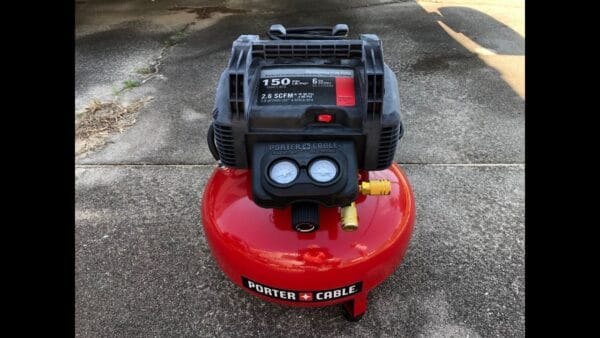
An air compressor that comes with a tank

Because if you’re going to be doing DIY projects around the RV, then it can come in handy by doing double duty for you.

But the truth is that if you’re just using an air compressor for inflating tires and other items, there’s really no need for a tank.

In fact, the tank just takes up very precious space and weight that’s not necessary.

What Size Will You Need To Inflate Your RV’s Tires?

Now the other thing you need to know is, what are the maximum PSI ratings for the tires on your rig?

And what kind of tire pressure are they going to require? The answer to that will tell you what size air compressor you’re going to need.

Of course, travel trailers generally only use about 60 to 80 psi in their tires.
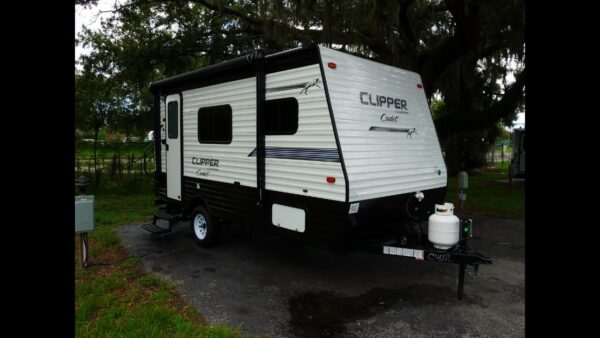
Smaller travel trailers don't require tires with a high PSI rating
Smaller travel trailers don’t require tires with a high PSI rating

But a Class A motorhome could require up to 120 PSI in those big 22 1/2 inch tires.
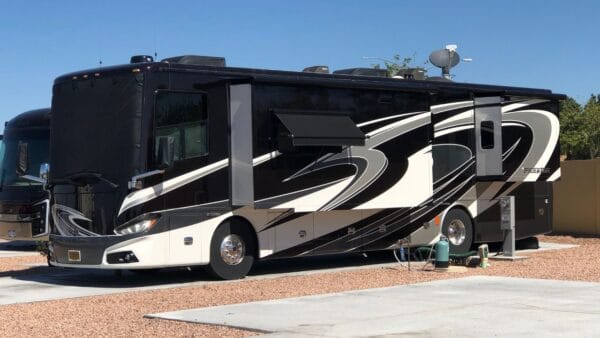
Some diesel pusher motorhomes may require 120 PSI in their tires

So my recommendation is, it’s best usually to get an air compressor that’s actually more than your current needs.

Because if you decide to upgrade your RV later on down the line to a bigger one, you don’t have to go and get another air compressor.

Instead, you can just take the one you have with you now and it should do the job just fine.

But another thing you need to know is, how much cubic feet per minute an air compressor will be able to put out.

And that’s simply the amount of air that it’s pushing out at one time. The higher the number, the faster the inflation rate.

And that means you get done with your job of tire inflation faster and easier.

Air Compressors That Run On 120 Volt Power

Also, keep in mind that most tankless air compressors are going to run on 12 volt battery power.

However, air compressors with tanks are usually going to require 120 volt AC power instead.

And that means that you’re going to need an outlet to plug into for AC power.

Also, the outlet needs to be useable even when you’re not necessarily connected to shore power.

Because you may need to use your air compressor for tire inflation when no shore power is available.

The Best Portable RV Air Compressors That Run On 12 Volt Power

But what about 12 volt air compressors that run on battery power instead of a wall outlet?

Well, usually they plug into the cigarette lighter. Or they may attach to your battery directly instead.
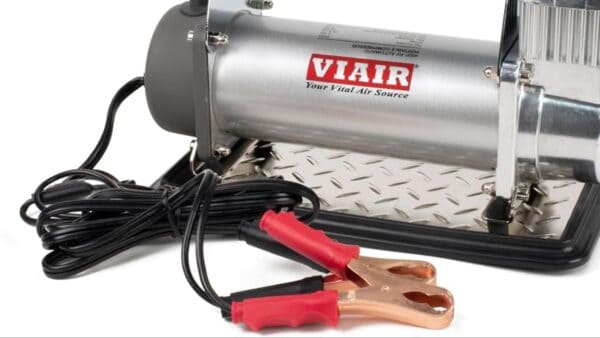
Some of the best portable RV air compressors run directly off of a battery

And when they do, they’re kind of stationary at that point. They can’t be moved around very far away from the 12 volt battery source.

So the other thing you’re going to need is a long enough air hose that can reach the entire RV.

And I recommend that the hose should be somewhere between 30 and 60 feet in length. Of course, it all depends on the length of your RV.

Also, you should probably get one that’s kind of wound up tightly and can expand out as you need.

That way it doesn’t take up nearly as much room in your storage compartment.

What Is A Duty Cycle And Why Is It Important?

Now the next thing you want to consider with an air compressor is its duty cycle. So what is a duty cycle?

That’s simply how long that air compressor can run continuously without having to shut off and cool down.

Now some air compressors can only run for about 15 minutes and then they have to shut off for a while. But others can run for an hour or so.

And the duty cycle is usually represented in the specifications for an air compressor as a percentage.

So if you see a 100% duty cycle it means it can go a full hour without shutting off.

If you see 50%, that means about 30 minutes. And 33 means 20 minutes, and so on.

With all that said, let’s get to the point of what brands of air compressors you should consider. And here are my recommendations:

#1 On My List Of The Best Portable RV Air Compressors

First of all, let’s consider an air compressor that has a tank. And in that case, I’m going to recommend the Dewalt 6 gallon air compressor.
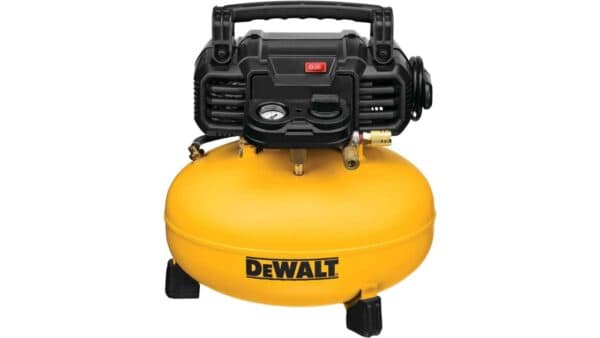
One of the best portable RV air compressors is made by Dewalt

It can inflate up to 165 PSI. And that means it can handle pretty much anything an RV can throw at it.

Also it’s very good for using with air tools too. So the DIYers will be happy with it. And the cost is going to be around $190.

Of course, there are other air compressors with tanks available. But I chose Dewalt because the name is known for reliability and quality.

#2 – A Great Inexpensive Tankless RV Air Compressor

OK, next up we’re going to talk about two tankless air compressors. And the first one is the Viair 88P.
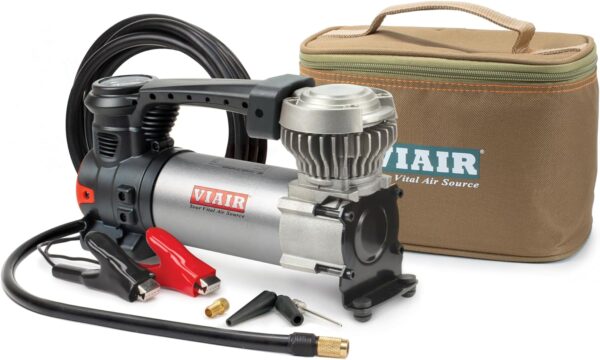
A great inexpensive RV air compressor is the ViAir 88P

It can inflate up to 120 PSI, and that’s very good. Also, the duty cycle is around 25 minutes at 30 PSI.

So if you’re inflating at a higher PSI than that, it could be less. And the cubic feet per minute is around 1.4.

Now the average for these kind of air compressors is around 2.0. So it’s a little low on that particular spec.

And it means that it’s going to take you longer to inflate things. But the good news is the price. Because it comes comes in at only $90.

So it’s a very good air compressor to choose for travel trailers and smaller motorhomes.

#3 – The Best Air Compressor I Can Recommend For You

Next up is the best that I can recommend for you. And that is the Viair 400P-RV. And I think you can tell from the name that it’s made for RVs.
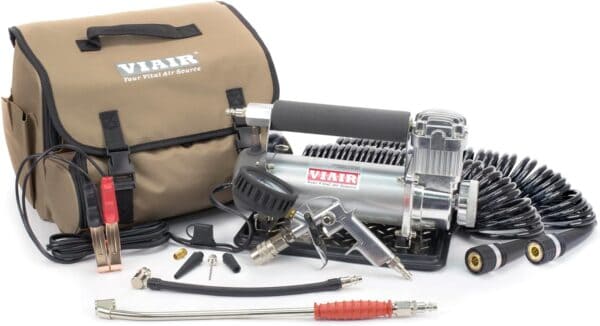
One of the best portable RV air compressors you can buy is the ViAir 450P-RV

It can inflate up to 150 psi for those larger motorhome tires. And it has a 100% duty cycle.

So it can go a full hour running flat out with no problem. And the cubic feet per minute rating is 2.3.

So that’s considerably more than the 88P, and should get things inflated quicker for you.

Now the downside though is the cost, since it comes in at $350. And that’s a lot to spend on air compressor for your RV.

But let me say that this particular air compressor is a “buy it and forget it” type of product.

It can last you through any RV change you’re going to make and still be useful. So it really should be considered for that reason alone.

An Important Word About Quality

Now I guess you’ve noticed that I only recommended Viair for tankless air compressors. And there’s a reason for that.

It’s because Viair is well known in the RV industry. It’s known for its reliability and for its quality.

And if you look on Amazon there are thousands of reviews for Viair air compressors.

And they are all coming in around a 4.7 out of 5 rating. So that pretty much tells you that you’re buying a good product.

But any of the air compressors that I mentioned here will work well. Just follow the links I have provided in the article to learn more about them.

That way you can go check them out and see if there’s something that will work for your situation.

Conclusion

Well, hopefully this article about the best portable RV air compressors will help you choose the right air compressor for your needs and budget.

And that will help you enjoy safe and happy travels on your RV adventures!

The Best 30 Amp RV Generators

This article is about the best 30 amp RV generators that you can buy for your RV.

Of course, if you’re always plugged into shore power at a campground, you may not even need a generator at all.

If you are always hooked up to shore power, maybe you don't need a generator
If you are always hooked up to shore power, maybe you don’t need a generator

Instead, you might just have it as a backup in case there’s a power outage.

But if you like to boondock at all in your 30 amp RV, then having a portable generator can be very handy and very much appreciated!

And this is true even if you have solar power for your RV. That’s because you can sometimes go days without the sun even appearing.

And after several cloudy days, your solar power system often just can’t keep up.

So that’s where having a generator can be very helpful to fill in the gaps in your power needs.

Watch my video about the best 30 amp RV generators

Table of Contents

Why Do You Need A Generator For A 30 Amp RV?

But what does a generator do for your 30 amp RV? And for that matter, what is a 30 amp RV anyway? What does it all mean?

Well, I made a video a while back on 30 amp and 50 amp RV electrical services in RVs. And it explains the differences between them.

There’s a lot of information there that even many experienced RVers don’t really know or understand.

So it would be a good idea to watch the video to learn more about RV electrical services.

And you can click the image below or click here watch that video.

Watch my video about the difference between 30 amp and 50 amp electrical RV services

But for this article, let’s just simply say that a 30 amp RV can handle 3600 watts of simultaneous power.

That’s the most that it can handle at one time without tripping breakers and becoming unsafe.

What Takes The Most Power To Run In Your RV?

And the biggest draw in most RVs is the air conditioner. In fact, it takes a lot of power to get an air conditioner up and running initially.

In many cases it may require up to 3000 watts to just start up. But then it settles down and runs on a continuous 1,800 to 2,000 watts of power.

Now obviously, that’s a huge chunk of your 3600 total watts of available power!

And it’s also why most 30 amp RVs only have one air conditioner. Because two air conditioners would just overload the electrical system.

So many of the generators I’m going to talk about here have a 30 amp plug built right into them.

And that way you can just plug the cord from your RV right into the generator.

When you do, they can provide 80% – 90% of the power you’d get if you were hooked up to a campsite power pole.

How Much Electrical Power Do These Generators Produce?

So these generators are going to have an output somewhere between 3,000 and 3400 watts of continuous power.

And that will power most of the electrical needs you’ll have, including your air conditioner.

But here’s one of the drawbacks on these generators. They are not lightweight at all!

In fact, most of them are going to weigh around 100 lb. So you’re going to need to find a place to put the generator in your rig.

And a lot of people put it in their tow vehicle or pickup’s bed. Which works well for a lot of RVers.

But wherever you put it, it has to have good ventilation to disperse the fumes it puts off.

And most of these generators are also gasoline powered. So very often, it means you’ve got to take another power source, gasoline, along with you.

And the gasoline has to be stored safely in an appropriate container when not used.

Also, you’re going to need to refill the generator with fuel from time to time. Because its tank is going to go empty after running for a while.

The Best 30 Amp RV Generators – The Quiet Ones

Now one last point about these generators I am going to recommend in this article. And that is, they are what are called inverter generators.

Now what that means is that they are the quietest generators that you can buy.

And believe me, that’s going to be really important to your RVing neighbors.

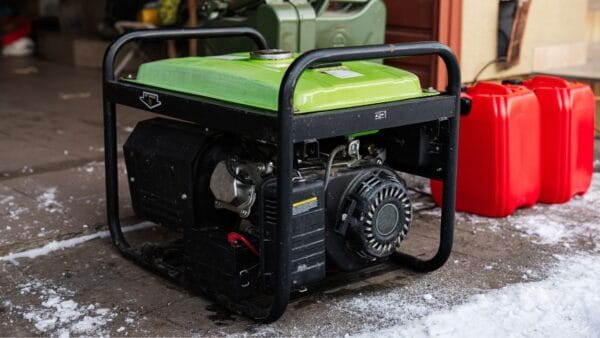
In fact, I never recommend using a construction type of generator for your RV. You know, the ones that are on a frame and are very loud.

The best 30 amp RV generators are never the construction type

Their sound is very obnoxious, and you’re going to make enemies really fast. Especially if there’s any other RVers anywhere nearby.

So all the ones I’m going to show you here are inverter generators. And they are designed to be as quiet as possible.

OK, so let’s go over my list now for 30 amp RV generators that I can recommend for you.

And all the links to each one will be listed below so you can check them out for yourself. Just click on the images to learn more.

#1 On My List Of The Best 30 Amp RV Generators

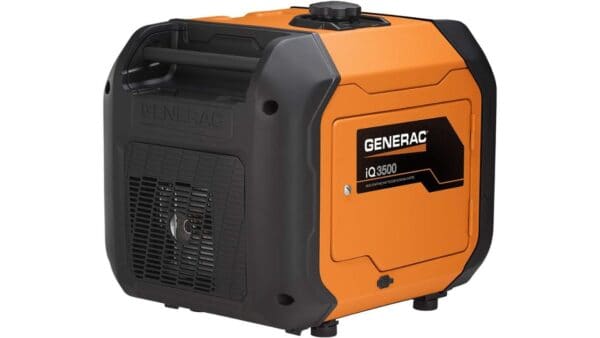
Let’s start off with number one, that’s from Generac. It’s the IQ 3500 model.

The Generac IQ 3500 inverter generator. Click the image to view it.

Generac has a solid reputation among many people for great quality and great reliability.

However this particular generator is not very light to handle. It weighs in at 109 lbs, and that’s quite a bit to move around.

It puts out 3500 watts of starting power and 3,000 watts of continuous running power.

And that’s pretty useful for most RVers with a 30 amp RV. And another good thing is its noise level which many reviewers say is very low.

It also offers an electric start, so it’s pretty easy to operate for almost anyone.

And the price on this inverter generator is very affordable at just over $1,000. But it’s also the most expensive one on my list here.

My #2 Choice For An Inverter Generator For Your RV

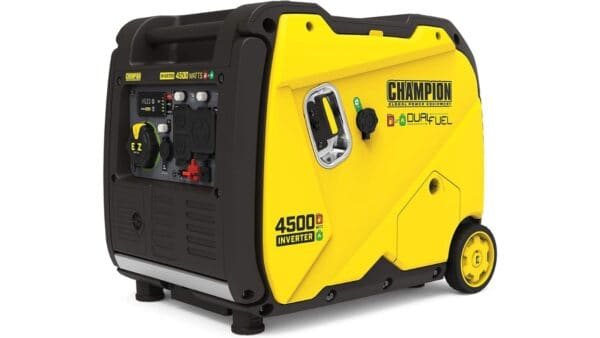
Next up on my list is the Champion 4500 watt generator. And yes, it’s 4500 watts of peak power, but it runs continuously at only 3150 watts.

The dual fuel Champion 4500 deserves to be on any list of the best 30 amp RV generators

The noise level is said by Champion to be at about 61 decibels of sound.

And to understand that, just know that normal conversations are usually held around 57 decibels.

Now it’s also the lightest generator in the bunch here, at 99 lbs. of weight.

But its claim to fame is that it’s a dual fuel generator. And what that means is you can run it not only on gasoline, but another fuel source as well.

In fact, you can actually run this generator very well on propane too.

So you may not even need to bring another power source with you on your RV travels.

You can just run it on the propane that’s already in your RV LP tanks. And a lot of people like that!

Now the cost is right around $900, and that a pretty affordable inverter generator solution.

The #3 Generator That I Can Recommend

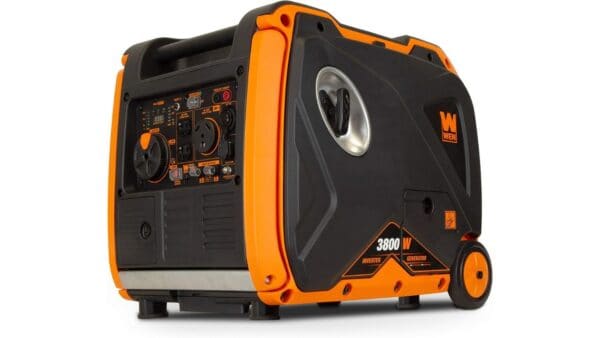
Next up on my list is the Wen 3800 watt generator. Yes, 3800 watts of peak power, but it runs continuously at 3400 watts.

The Wen 3800 watt inverter generator

And it comes in right around 100 lb for weight. Also, it’s quiet. It’s 57 decibels in loudness, about the same as all the others in this article.

And it has an electric start feature that makes it super easy to use by almost anyone.

Plus, it’s the least expensive generator on my list here at only $850. And that’s a real deal!

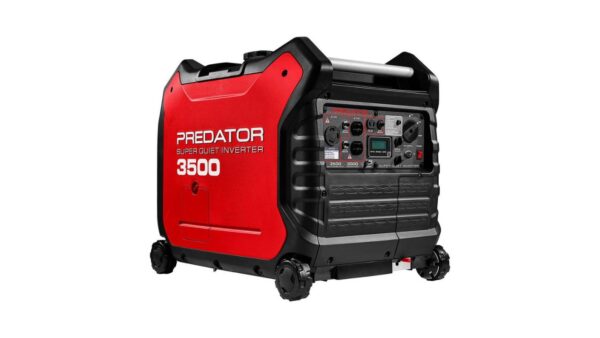
Last up on my list is a generator that comes from Harbor Freight. And Harbor Freight has made generators for a few years now.

They produce the the Predator line of generators. And actually RVers of all kinds like them because there’s a lot to like, for not a lot of money.

So the Predator 3500 watt generator is 3500 watts of peak power and 3,000 watts continuous running power.

One of the best 30 amp RV generators is the Harbor Freight Predator 3500

It comes in at 102 lb. for weight and it’s quiet at 56 decibels of sound. Plus, it’s very affordable at only $800.

OK, so there’s my list of generators that I think you should consider if you have a 30 amp RV.

And you should be able to find something that you need in there somewhere.

This Makes Using These Generators Simple And Easy

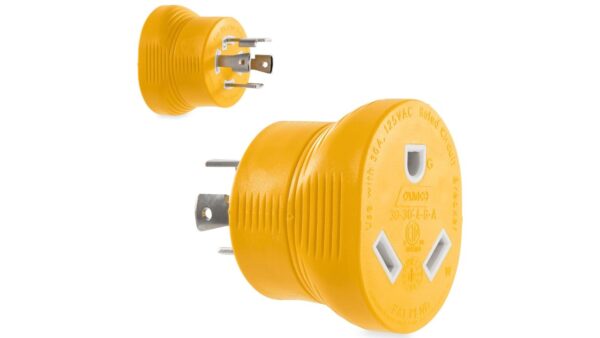
But let me mention this too. As I said before, all the best 30 amp RV generators have a built-in 30 amp RV plug.

So you can plug your electric cord from your RV direct into the generator.

Of course, some have the actual RV plug that works with your power cord. And you just plug it into the generator.

But in others, you’re going to need a small adapter that’s very cheap to make the connection.

A 30 amp adapter for your RV's power cord to plug into the generator
A 30 amp adapter for your RV’s power cord to plug into the generator

And in that case, you just put the adapter on the generator and then plug the cord directly into the adapter.

Just check the instructions for each generator to see how the RV cord attaches to it.

Either way, you can plug right into the generator though, and that makes everything super easy and simple.

Conclusion

Well, I’m very confident that with this list I’ve given you, you can find a generator that’s going to work for your 30 amp RV needs.

And hopefully, it will fit not only your needs but also your budget at the same time.

Have safe and happy RV travels!

The Top 10 Tips For Stationary RV Living

This article is about my 10 best tips for full-time RV stationary living. Whether it’s temporary or permanent.

Yes, RV living can be done in lots of various ways. And you don’t always have to be traveling to enjoy the RV life.

In fact, there’s lots of RVers that actually spend quite a bit of time in their RV in just one spot. And there’s various reasons for that.

Watch my video about stationary RV living

Table of Contents

Reasons Why You May Want To Be Stationary In An RV

For instance, it could be that they just want to save money on travel costs.

And therefore, staying in one spot for a while can help them save the costs of traveling around.

Or maybe they really enjoy the climate in one area of the country. And they want to stay a while and enjoy it. Like snowbirds, for instance.

Or it could be that they just like the area itself and want to explore it. And staying in one spot for a while makes that possible.

Or maybe they have family nearby that they want to spend a while visiting. That’s a big reason that many RVers become stationary for a while.

Finally, if they’re like us, full-timers may also really want to have a permanent home base.

They want a stationary place to be able to go if unexpected things come up out on the road. A place they can always come back to.

So clearly, there’s a lot of reasons why you may want to be stationary in your RV for a while.

And therefore, here are my best tips for successful stationary RV living. Let’s start with number one on my list.

The #1 Tip For Stationary RV Living

And that is, if you’re going to be permanently living for a while in an RV, then a towable RV is probably your best bet for that.

Towable RVs are best for long-term stationary RV living

At least, it’s probably a better choice overall than choosing a motorhome. Why?

Mainly because the motorhome has an engine and a drivetrain. And if you’re stationary, it’s just sitting there doing nothing for prolonged periods of time.

But that doesn’t mean that you don’t have to keep maintaining those mechanical parts.

Because mechanical things like engines, transmissions, etc., need to be used to stay in good shape.

So for that reason alone, a towable RV lends itself to stationary living better than a motorhome.

And that brings us to the question of which towable RV is best for stationary RV living?

#2 – Which Kind Of RV Is Best?

That means we’re talking about comparing travel trailers and fifth wheels then. Which kind of RV would be best in this case?

Well probably. if you can make it a fifth wheel that’s a little better. Because first of all, it’s usually built with a little better quality overall.

In addition to that, fifth wheels are often larger as well. And that leads us into another point about stationary RV living.

Which is that larger RVs lend themselves better to long-term stationary living in general. Why would I say that?

Larger RVs like a fifth wheels are great for long-term stays

Because RVs don’t have a lot of living space to begin with. You’re probably looking at between 200 and a little over over 300 square ft. in most cases.

So the more living space you can get, the better for long-term living.

That’s because sometimes RV walls can kind of close in on you. It can start to feel claustrophobic for many people.

So if you plan on staying a long time in an RV, having more living space is a good thing. Now for number three on my list.

#3 – Don’t Forget About RV Maintenance

And that is, while you are stationary don’t forget to keep up the maintenance on your RV. No matter what kind of RV it is.

I see this as a problem all the time. Many RVers get stationary, and they forget about a lot of maintenance tasks that still need to be done.

Especially on the outside, or the exterior of the RV. But remember, you still need to be checking joints and seals all over your RV regularly.

Maintaining your RV's joints and seals while stationary is critical
Maintaining your RV’s joints and seals while stationary is critical

This is the only way to prevent water intrusion that can begin to seriously damage your RV.

Also, you need to be washing and waxing that RV on a regular basis too.

That helps prevent fading and oxidation on the outside walls caused by the sun and other elements.

And if you have a generator, you will need to run it on a regular basis. Usually at least every month or so.

By doing that, you will help keep it in good working shape and ready for when you need it.

Now that leads us along to another tip that’s very important. It’s number four on my list.

#4 – Stationary RV Living In A Motorhome

And that is, let’s suppose that you have a motorhome that you’re staying in for a prolonged period.

If so, don’t forget to exercise that engine and drivetrain regularly. Of course, when you’re not using it, it can be out of sight and out of mind.

But it needs to be used regularly. And once again, I recommend exercising them at least on a monthly basis.

Which means that at the very least you should start the engine up and run it for a while. Make sure it’s being lubricated well in the process.

However, if you want to exercise these components properly, you really should do more.

You really need to unhook the motorhome and take it out on the road for a drive. It’s especially good if you can take it on the highway.

Drive your motorhome regularly to keep it working like it should

Just run it for a while and get everything working. This will help the transmission, the brakes, the suspension, and pretty much everything.

By doing this on a regular basis, it will keep things in good working shape while you’re stationary. OK, let’s move on to number five on the list.

#5 – What About The RV Park Or Campground?

And that has to do with choosing the RV park where you will be staying for a while. Make sure that you choose it carefully, especially for security.

Unfortunately, a lot of folks don’t think about that when choosing an RV park or campground. Many just think about choosing by price alone.

Don't forget about security when choosing an RV park or campground
Don’t forget about security when choosing an RV park or campground

But then they move into the park they have chosen and find out that there’s problems in that park.

However, now they’re kind of committed in many cases. So before you do that, read the online reviews for that park or campground.

Read them very carefully. And if you start to read about security issues, maybe it’s better to choose someplace else.

Or you could also ask around in the area and get some suggestions from people that are local.

Because that often gives you a lot of good information you need to know before you choose your park or campground.

#6 – How To Keep Your Camping Costs Low

OK, moving on to number six on the list. And that is, if you’re going to be in a park, try to get the lowest rates possible for your stay there.

And that means that you don’t want to be paying daily rates for an extended stay. Even weekly rates can be too much.

So look for annual, quarterly or semiannual rates instead. That way you can get the cost of your stay as low as possible.

Long-term rates are best for stationary RV living

But here’s something to keep in mind about longer term rates at most RV parks.

And that is, you may find that they don’t include the cost of electricity in those rates. Instead, you will be billed for that separately.

So try to find out what the electric cost for an RV tends to be on average before you commit.

And that way, you can budget the cost of the campsite for the entire time of your stationary stay.

#7 – How To Increase Your RV Living Area

OK, now moving along to number seven on the list. And that is, it’s good to have an outdoors area for extra living space and comfort.

Once again, that gets back to living space being an issue in an RV for long-term stays. In fact, over time it can get very tight for some people.

So it’s nice to have a little outdoor area where you can go out and enjoy the outside. And do so in comfort too.

So here’s a recommendation if you’re going to be in the area for a while. Or in one campsite spot for a while.

And that is, you might choose to set up a pergola or a gazebo on your campsite.

Because they are great for having a really nice enjoyable area outside and have shade at the same time.

Having a comfortable outside area makes staying in an RV more enjoyable

Of course, if you’re not going to be there for a permanent stay, then maybe a popup canopy would be fine for your needs.

In fact, we’ve done that ourselves. Because they generally don’t weigh an awful lot, or take up a lot of space either.

And you can even store the canopy in the RV and use it as you go from place to place too. So it can be good for all of your RV travels.

Whatever you do though, just consider the idea of setting up a nice little area outside your RV while you’re stationary.

It extends your living area to the outside and let’s you feel more comfortable.

#8 – What Stationary RV Living Does To Your Tires

OK, that brings us to number eight on the list. And that has to do with your tires.

Because if you’re sitting in one spot for a while. it’s so easy for tires to get pounded by the ultraviolet rays of the sun.

If so, they’re going to dry out and crack very quickly and easily while you’re just sitting. And that makes them age very fast.

So if your RV is stationary, make sure that you have the tires covered and protected. And that will be a great way to make them last longer.

Get tire covers for your RV tires when you are staying in one place for a while

#9 – What About Extreme Weather?

Now moving on to number nine on the list. And that has to do with weather considerations.

So, what if you’re going to be in an area where extreme weather could happen before you leave?

Then get prepared for that in advance. For instance, what if you’re going to be in a more northern area where colder weather is going to come?

If very low temperatures will start to happen before you leave, get ready for it. And to do that, you may want to skirt the bottom of your RV.

That really increases the ability of the RV to maintain warmer temperatures inside. And it helps protect your RV plumbing as well.

Also, you probably want to increase the insulation in your RV too. By maybe covering the windows with an insulated material.

Also, stuffing some soft material up into the roof vents to provide better insulation is a good idea.

Insulate your RV well when to prepare for extreme weather

Of course, if you’re staying in the south for a while, the opposite kind of weather could happen.

How To Get Your RV Ready For Hot Temperature Extremes

And this is often what snowbirds do. As they often are going to be in areas like maybe Texas or Arizona.

These are areas where you could be facing 100° or more for a prolonged period of time.

So once again, try to insulate as much as you can to stay comfortable in that kind of weather.

And here’s another consideration for really hot temperatures in the southwest. It has to do with your air conditioning units.

Because they may not be able to keep up in that kind of an environment. So what can you do if that is the situation?

Well, you actually might want to think about installing a mini-split in your RV.

Especially if you’re going to be staying in one spot for a prolonged period in high heat.

These days, mini-split air conditioners seem to be catching on pretty well. Even in the RVing community.

Mini-split air conditioners are becoming popular in the RVing community

And a lot of people are using them in extremely hot temperatures. Because they help make up for the deficiencies of RV air conditioners.

#10 – Your Internet Options While You’re Stationary

OK, let’s move along to number 10 on the list. And that is your internet needs while you are stationary in one spot.

Now, when you’re traveling around, you probably have a mobile internet solution already. One that helps you stay up with your internet needs.

But when you’re in one spot, you may find that it’s actually cheaper and faster to just connect up to a local cable company instead.

Local internet solutions can be much better for long-term stays
Local internet solutions can be much better for stationary RV living

Especially when you are going to be in one area for several months. So give that some thought as well.

Conclusion

OK, those are my 10 tips for stationary RV living. And clearly, being in one spot for a while in an RV can have its challenges.

But it can also have its rewards too. Especially if you think ahead and prepare well.

And hopefully the tips I’ve shared with you in this article will help make your RV stays in one place more enjoyable and more successful.

Have safe and happy RV travels!

Get My FREE Camping Guide

“The Top 5 Ways To Save Money On Campground Costs”

Get My Newsletter

Save on RV repairs

Get the best RV gear

Learn about RV life

RV tips and tricks

And get my free guide – The Top 5 Ways To Save Money On Campground Costs”