What causes RV accidents and how can you avoid them?
Most people buy an RV because they want to travel, enjoy new adventures, and make good memories with family and friends. Nobody starts an RV trip expecting to be involved in an accident.
However, driving a motorhome or towing a travel trailer or fifth wheel is very different from driving an ordinary passenger vehicle. RVs are longer, wider, taller, and much heavier, so they require more planning and attention from the driver.
The good news is that many RV accidents can be prevented. When you understand the most common causes of RV accidents, you can take practical steps to reduce your risk and travel with greater confidence.
So let’s look at six common causes of RV accidents and what you can do to avoid them.
Why Driving an RV Requires More Attention
Modern vehicles are comfortable and easy to drive, so it can be tempting to approach RV travel the same way you would an ordinary road trip. But the additional size and weight of an RV change almost everything.
For instance, an RV usually needs more room to stop, more space to turn, and more time to merge into traffic. A motorhome may also have large blind spots, while a towable RV introduces additional concerns involving hitch equipment, trailer sway, and weight distribution.
Conditions that seem minor in a car can become serious when you are driving a large motorhome or towing a heavy trailer. That is why good preparation and conservative driving habits are so important.
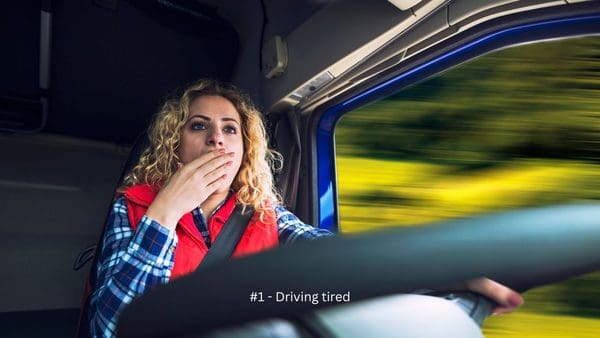
1. Driving an RV While Tired
Driving a motorhome or towing an RV requires concentration. You must constantly monitor traffic, road conditions, mirrors, clearances, and the movement of the RV itself.
Unfortunately, fatigue develops gradually. You may not realize how tired you are until your concentration and reaction time have already started to decline.
Stop Before You Feel Exhausted
One of the best ways to prevent fatigue-related RV accidents is to stop regularly. Get out of the vehicle, walk around, stretch, and get your blood circulating again.
A short break can make a noticeable difference in how alert you feel. It also gives you an opportunity to walk around the RV and look for tire, hitch, cargo, or exterior problems.
Do not wait until you are struggling to keep your eyes open. By that point, you should have already been off the road.
Use a Conservative RV Travel Schedule
I use a personal travel guideline that I call the 3-3-300 rule. I try to arrive at my destination by 3:00 in the afternoon, travel no more than about 300 miles in one day, and avoid driving for more than three consecutive days without taking a longer rest.
That schedule helps me stay relatively fresh while traveling. It also allows time to deal with traffic delays, fuel stops, bad weather, or unexpected problems without feeling pressured.
Of course, you can adjust the rule to fit your needs. Some RVers may be more comfortable with a 2-2-200 approach or another schedule that reduces their daily driving time.
The particular numbers are not as important as the principle: plan your trip around your ability to remain alert, not around the maximum distance you could possibly cover.
2. Driving an RV Too Fast
RV travel is not a race, although you would never know that from watching some RVers on the highway.
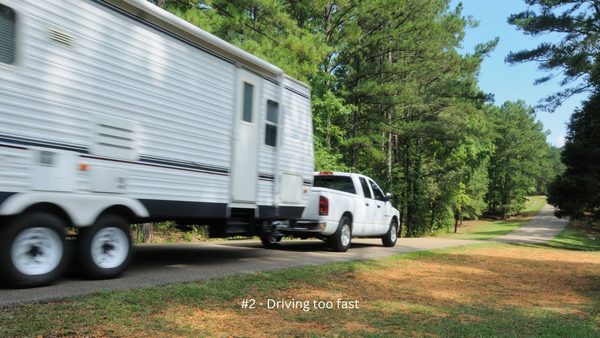
The faster you travel, the less time you have to react to changing conditions. Speed also increases the distance needed to slow or stop a heavy RV.
A passenger vehicle may be able to make a sudden lane change or stop quickly when traffic backs up. A large motorhome or a truck towing a heavy trailer cannot always respond as easily.
Find a Comfortable and Controllable Speed
Many RVs travel comfortably in the 60-to-65-mph range under good conditions. However, the correct speed always depends on the road, traffic, weather, your RV, your tires, and your level of experience.
Posted speed limits represent the maximum legal speed under favorable conditions. They are not a requirement to travel that fast when conditions are poor.
So if traffic is heavy, visibility is limited, or the road is wet or winding, slow down even further. Give yourself enough time and space to respond smoothly instead of making sudden corrections.
Increase Your Following Distance
Because an RV takes longer to stop, leave more room between your rig and the vehicle ahead. This space becomes especially important when traveling downhill or on wet pavement.
Other drivers will occasionally move into the opening you created. That can be frustrating, but simply back off again and restore a comfortable following distance.
A few extra minutes on the road is a very small price to pay for having more time to avoid RV accidents.
3. Tire Blowouts and Tire Failures
An RV tire blowout can be frightening, especially when it happens at highway speed. Depending on which tire fails, it may also make the RV much more difficult to control.
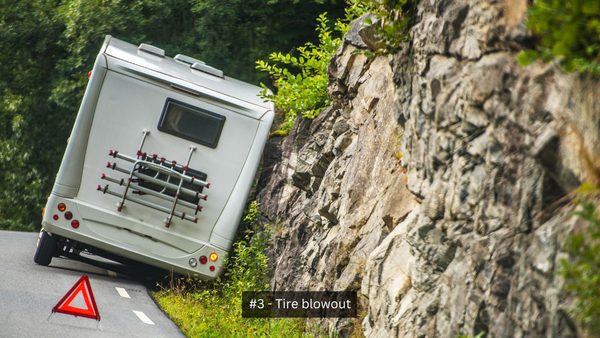
Some tire failures are caused by damage or manufacturing defects. However, failures can also result from age, improper inflation, excess heat, overloading, or a combination of these factors.
That means RV owners should pay close attention to both tire condition and the actual weight of their RV.
Know Your RV’s GVWR
Every RV has a Gross Vehicle Weight Rating, usually abbreviated as GVWR. This is the maximum allowable weight of the fully loaded RV.
You should find the GVWR on the RV’s certification or vehicle identification label. However, that number does not tell you what your RV currently weighs.
The only reliable way to determine the loaded weight is to take the RV to a certified public scale. A CAT Scale is a convenient option for many RV owners.
Load the RV as you normally would for travel before weighing it. Include passengers, water, fuel, food, clothing, camping gear, tools, and anything else you routinely carry.
Remember that an RV can exceed its weight rating before its storage compartments appear full. If you want to learn more about this subject, my article on the biggest travel trailer buying mistakes explains why actual loaded weights matter so much.
Check More Than the Total Weight
The total weight is important, but weight distribution matters too. Ideally, the RV should be weighed in a way that reveals how much weight is being carried by each axle.
If possible, obtaining individual wheel-position weights provides even better information. An RV can be under its overall GVWR and still overload one axle or one tire position.
Towable RV owners must also consider tongue weight or pin weight, the tow vehicle’s payload capacity, its Gross Combined Weight Rating, and the ratings of the hitch and other towing equipment.
Use the Correct Tire Pressure
Tire pressure should be checked when the tires are cold and before beginning a travel day. The correct pressure depends on the RV, the tires, and the load they are carrying.
Do not determine pressure solely by looking at a tire. A tire can be dangerously underinflated without appearing flat.
For a more detailed explanation, see my guide to correct RV tire pressures.
Install a Tire Pressure Monitoring System
I also highly recommend using a tire pressure monitoring system, commonly called a TPMS.
A good TPMS monitors tire pressure while you travel, and most systems also monitor tire temperature. It can warn you when a tire is losing pressure or becoming unusually hot before the problem turns into a catastrophic failure.
A TPMS cannot prevent every blowout, but it can provide valuable advance warning. I have personally benefited from traveling with one, and I consider it an important piece of RV equipment.
Finally, inspect your tires regularly for cracking, bulges, cuts, uneven wear, and other damage. RV tires frequently age out before they wear out, so tread depth should never be your only consideration.
You can find additional guidance in my article on how to make RV tires last longer.
4. Driving an RV in Heavy Wind
Motorhomes, travel trailers, and fifth wheels have large sidewalls that can catch the wind like a sail. As a result, strong crosswinds can push an RV sideways or make it difficult to remain centered in the lane.
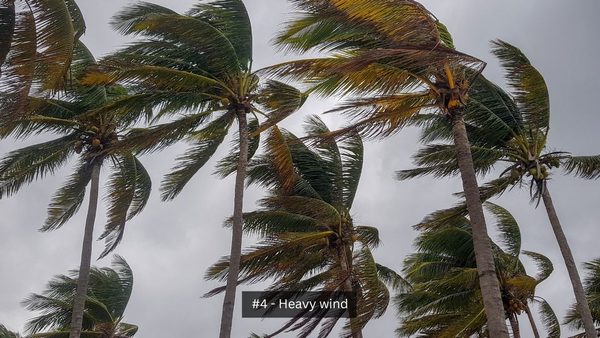
The effect can be even more noticeable when you pass an opening between trees or buildings. Large trucks can also create sudden changes in airflow as they approach and pass.
Check the Wind Gusts, Not Just the Average
Before traveling, check the weather along your entire route—not just at your current location or final destination.
Pay particular attention to the forecast wind gusts. A steady wind may be manageable, but a much stronger gust can arrive unexpectedly and move a large RV quickly.
Also consider the direction of the wind in relation to your route. A strong headwind can reduce fuel economy, but a strong crosswind can create a more serious handling problem.
Know When to Get Off the Road
If strong wind begins moving your RV around and you no longer feel comfortable maintaining control, slow down and find a safe place to stop.
Do not continue simply because you want to stay on schedule. Waiting a few hours—or even until the next day—is far better than risking an RV accident.
Your personal wind limit may be different from another RVer’s. The size and type of RV, its weight, the tow vehicle, road conditions, and your experience all affect how the rig responds.
So if the conditions do not feel right to you, do not let another driver pressure you into continuing.
5. Taking a Large RV onto the Wrong Road
An ordinary GPS app may calculate the fastest route without considering the height, length, width, or weight of your RV.
That can lead you toward low-clearance bridges, weight-restricted roads, narrow streets, tight turns, or roads where larger vehicles do not belong.
By the time you recognize the problem, turning around may be extremely difficult.
Use RV-Specific GPS Directions
Google Maps works very well for passenger vehicles, but it is not designed to route large RVs according to their dimensions and weight.
Instead, use a GPS device or navigation app designed for RV travel. Enter accurate information about the height, length, width, and weight of your rig so the system can choose an appropriate route.
I also recommend having more than one source of RV-friendly directions. Comparing two routes can alert you to a potential problem before you encounter it.
My article about how to use RV Trip Wizard explains one way to plan RV-friendly routes and transfer them to a mobile device for navigation.
Use Satellite Images to Examine Your Destination
Although Google Maps should not be your only routing tool, its satellite view can be very useful.
Before arriving at a campground, fuel station, or other destination, look at the property from above. Identify the entrance, internal roads, trees, buildings, fuel pumps, and possible places to turn around.
You can also check whether the campground office is located before or after a narrow turn. A few minutes of advance planning can prevent a difficult situation with a large RV.
6. Small RV Accidents Caused by Driver Error
Not every RV accident happens at highway speed. In fact, many RV owners damage their rigs while turning, backing, parking, refueling, or entering a campsite.
These accidents may involve a tree, post, building, fuel pump, campground pedestal, or another vehicle. They often occur because the driver misjudges how the rear of the RV tracks through a turn.
A motorhome with a long rear overhang can also swing outward in the opposite direction of the turn. Meanwhile, the wheels of a long RV may track much closer to the inside of a corner than the front of the vehicle.
Get RV Driver Training
Professional RV driver training can help you become more comfortable with turning, braking, backing, mirrors, and managing the size of your rig.
Training is especially valuable for first-time owners moving directly from a passenger vehicle into a large Class A motorhome, fifth wheel, or long travel trailer.
However, even experienced RVers can benefit from instruction when changing to a substantially larger or different type of RV.
Practice in an Empty Parking Lot
You can also build valuable experience by practicing in a large, mostly empty parking lot.
Use cones or other harmless markers to practice turning without cutting the corner too closely. Learn how the rear wheels track and how far the back of the RV swings during a turn.
Practice braking at low speeds so you become familiar with how the RV responds. You can also work on backing into a simulated campsite from both directions.
The purpose is not to perform every maneuver perfectly. It is to learn how your particular RV behaves before you must make the same maneuver around solid objects.
Get Out and Look
Before backing into a campsite or other confined area, get out and inspect it. I like to remember this with the letters GOAL: Get Out And Look.
Look for posts, tree branches, rocks, picnic tables, utility pedestals, ditches, and other obstacles. Do not forget to look upward for low branches and behind the RV for objects that may disappear below your mirrors or camera.
When traveling with another person, agree on simple hand signals before backing. If you lose sight of your spotter, stop immediately until you can see them again.
Even with a spotter and a backup camera, it is still the driver’s responsibility to stop whenever the situation becomes unclear.
Create a Simple RV Pre-Trip Routine
Many RV accident causes can be reduced by following a consistent routine before every travel day.
Your inspection does not have to be complicated. However, it should include the items that could affect your ability to control the RV or keep exterior components secured.
Before leaving, check:
- Tire condition and cold tire pressure
- Wheel and lug-nut condition
- Hitch, coupler, safety chains, and breakaway cable
- Trailer electrical connection
- Motorhome or tow-vehicle fluid levels
- Lights, turn signals, and brake lights
- Mirrors and backup cameras
- Steps, awnings, antennas, and slideouts
- Compartment doors and entry doors
- Loose exterior and interior cargo
- Your planned route and weather conditions
Walking around the RV one final time before pulling away only takes a few minutes. However, it can prevent expensive damage and serious trouble on the road.
For more ownership and upkeep information, visit my collection of RV maintenance tips.
Frequently Asked Questions About RV Accidents
What causes most RV accidents?
There is no single cause behind every RV accident. Common contributing factors include driver fatigue, excessive speed, inexperience, improper loading, tire failure, strong wind, poor route planning, and misjudging turns or stopping distances.
Distracted driving, following too closely, and failing to adjust for weather can also increase the risk.
What is a safe speed for driving an RV?
There is no single speed that is right for every RV and every road. Many RVers find that approximately 60 to 65 mph provides a comfortable balance under good highway conditions.
However, you may need to travel much slower because of traffic, rain, wind, road conditions, tire speed ratings, or the handling characteristics of your RV.
How often should I stop while driving an RV?
Plan regular stops before you begin feeling tired. The appropriate interval will depend on the driver, but stopping every couple of hours to walk, stretch, and inspect the RV is a reasonable routine.
If you are becoming drowsy or having difficulty concentrating, stop as soon as you can do so safely.
Can Google Maps route an RV safely?
Google Maps does not normally consider all the height, weight, width, and length restrictions that apply to a large RV. Therefore, it should not be your only source of directions.
Use an RV-specific GPS or navigation app for routing. Google Maps can still be helpful for reviewing traffic and examining destinations with satellite imagery.
Can an RV be overloaded even if there is storage space available?
Yes. Available storage space does not indicate available carrying capacity.
An RV can exceed its GVWR, axle rating, tire capacity, or hitch-related limits while cabinets and storage compartments are still partly empty. Weighing the fully loaded RV is the only reliable way to know where you stand.
Is professional RV driver training necessary?
It may not be legally required for many privately operated RVs, but it can be extremely helpful. Professional instruction can shorten the learning process and help you understand braking, turning, backing, blind spots, and emergency handling.
At a minimum, every new RV owner should practice in an open area before navigating busy roads or confined campgrounds.
Final Thoughts on Preventing RV Accidents
There are many possible causes of RV accidents, but fatigue, excessive speed, tire problems, high winds, poor routing, and driver inexperience are among the most preventable.
The goal is not to become afraid of RV travel. It is to respect the additional size and weight of your rig and leave yourself enough time, space, and flexibility to handle unexpected situations.
Slow down, stop before you become tired, monitor your tires, watch the weather, plan an RV-friendly route, and practice handling your rig. Those simple habits can help you avoid many of the problems that lead to RV collisions.
Most of all, remember that getting there safely is more important than getting there quickly.
Have safe and happy travels, my friends