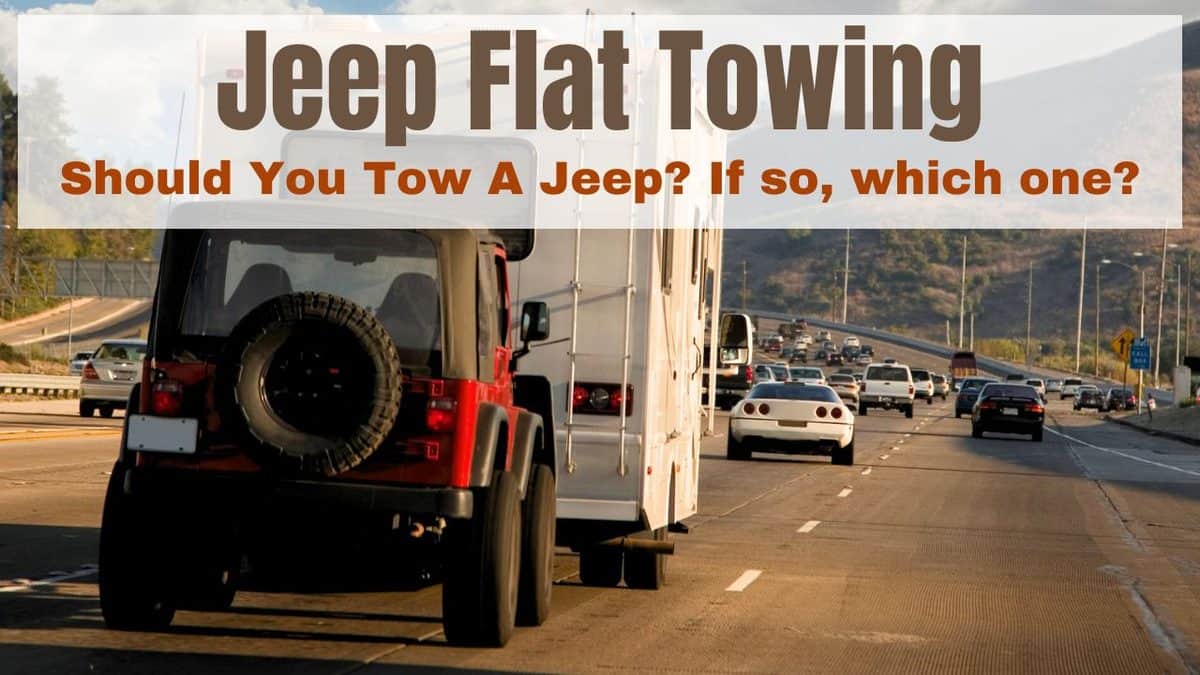
Flat towing a Jeep behind your motorhome can make RV travel much more convenient.
Because instead of breaking camp whenever you need groceries or want to explore the area, you can leave the motorhome connected and set up at the campsite. Then you can use the smaller vehicle for errands, restaurants, sightseeing, and day trips.
The larger your motorhome is, the more useful a towed vehicle can become.
And when it comes to choosing a vehicle to tow behind a motorhome, Jeep is one of the most popular brands among RVers. But although flat towing a Jeep is common, that does not mean every Jeep can be towed with all four wheels on the ground.
Choosing the wrong model or failing to follow the correct setup procedure can cause severe and expensive drivetrain damage.
So let’s discuss which Jeeps may be suitable for flat towing, which ones generally are not, and what equipment you need to tow one properly.
Quick Answer: Can You Flat Tow a Jeep Behind an RV?
Yes, several Jeep models and drivetrain configurations can be flat towed behind a motorhome.
Popular choices have included certain versions of the Jeep Wrangler, Gladiator, Grand Cherokee, and Cherokee. Some older Jeep Liberty and Patriot configurations may also be towable.
However, you cannot determine flat-tow compatibility from the model name alone.
Two Jeeps that look almost identical may have different transmissions, transfer cases, or drivetrain configurations. One may be approved for recreational towing while the other is not.
Before flat towing a Jeep, consult the owner’s manual for the exact model year and drivetrain. The recreational towing section should clearly explain whether the vehicle can be flat towed and which procedure must be followed.
What Does Flat Towing Mean?
Flat towing means towing a vehicle with all four of its wheels on the ground.
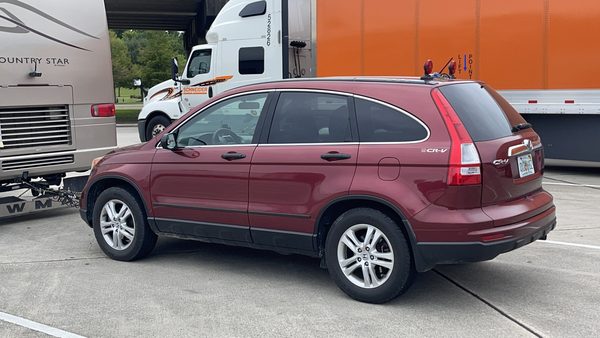
It is also called four-down towing or dinghy towing.
A tow bar connects the front of the Jeep to the receiver hitch on the motorhome. The Jeep then rolls behind the RV on its own tires.
This differs from using a tow dolly, where two of the vehicle’s wheels are carried on a small trailer. It also differs from a full vehicle trailer, which keeps all four wheels off the ground.
My complete article on the advantages and disadvantages of flat towing a vehicle can help you determine whether four-down towing is right for you.
Why Flat Towing a Jeep Is Popular With RVers
Jeeps are popular towed vehicles because many models are relatively compact, versatile, and enjoyable to drive.
They can be useful for running errands and visiting attractions, but some also provide the four-wheel-drive capability needed for exploring unpaved roads and remote destinations.
That makes a Jeep a good match for the adventurous side of RV travel.
But the vehicle itself is only part of the attraction. Flat towing also offers several practical advantages over using a trailer or tow dolly.
Connecting and Disconnecting Can Be Easier
Once the proper equipment is installed, connecting a flat-towed vehicle can be relatively simple.
You position the Jeep behind the motorhome, connect the tow-bar arms, attach the safety cables, connect the lighting cord, and install or activate the supplemental braking system.
Then you follow the Jeep’s exact recreational-towing procedure.
Disconnecting at the campsite can also be completed fairly quickly. That is helpful when you arrive after a long day of driving or need to disconnect before entering a difficult campsite.
There Is Less Equipment to Store
A tow dolly or vehicle trailer must be stored somewhere after you reach the campground.
Some campsites have enough room for the motorhome, towed vehicle, and towing equipment. Others do not.
With a flat-towing system, the tow bar can usually fold against the rear of the motorhome. Portable braking components and other accessories can be stored in a relatively small compartment.
That makes flat towing a Jeep especially attractive to RVers who visit smaller campsites or move frequently.
A Flat-Towed Jeep Usually Tracks Well
A properly connected flat-towed vehicle generally follows the motorhome smoothly around normal highway curves and turns.
There is no tow-dolly platform beneath the front wheels, and you are not adding the full length and weight of a vehicle trailer.
However, you normally cannot back up with a flat-towed vehicle connected.
Attempting to reverse can cause the Jeep’s front wheels to turn sharply, bind the tow bar, and damage towing components. If you enter a place where you cannot move forward, you may need to disconnect the Jeep before repositioning the motorhome.
Can Every Jeep Be Flat Towed?
No. This is the most important point in the entire article.
Not every Jeep model can be flat towed, and not every drivetrain configuration within a towable model is approved for it.
The vehicle may need a particular four-wheel-drive system and a transfer case with a true neutral position. Two-wheel-drive models and four-wheel-drive systems without the required transfer-case setting may not be suitable.
Flat towing an unapproved vehicle can damage its transmission, transfer case, or other drivetrain components. And damage caused by improper recreational towing may not be covered by the vehicle warranty.
That is why you should never rely exclusively on:
- A dealer’s statement
- A salesperson’s memory
- An online discussion
- A social media comment
- A list covering a different model year
- The fact that you saw someone else towing the same model
- A previous owner’s claim that the vehicle is towable
The owner’s manual for the exact vehicle is the final authority.
Check the Owner’s Manual Before Buying the Jeep
If you are shopping specifically for a vehicle to tow behind your motorhome, download the owner’s manual before agreeing to buy it.
You can usually find digital owner’s manuals online at no cost.

Locate the section titled “Recreational Towing,” “Towing Behind a Motorhome,” or something similar. It should tell you:
- Whether flat towing is permitted
- Which drivetrain configurations qualify
- Whether dolly towing is allowed
- Which transmission position to use
- Whether the transfer case must be placed in neutral
- How to verify that neutral is fully engaged
- Which ignition position is required
- Whether fuses must be removed
- Whether the battery needs charging support
- Whether there are speed or distance restrictions
- The exact preparation and disconnection procedures
Confirm the model year, engine, transmission, drive system, and transfer case on the actual Jeep.
A manual covering several configurations may say that one version is flat towable while another version must be carried on a trailer.
Best Jeep Models for Flat Towing
The following models have included versions approved for recreational flat towing.
But this is not a guarantee that every year, trim level, or drivetrain can be towed. Always verify the individual vehicle before buying or towing it.
Flat Towing a Jeep Wrangler
The Jeep Wrangler is probably the best-known flat-towed vehicle in the RV community.
It is easy to recognize, enjoyable to drive, and extremely capable when you leave the pavement. A properly equipped Wrangler can take you to places that many ordinary passenger vehicles cannot reach.
For RVers who enjoy back roads, desert trails, mountain areas, and other outdoor adventures, that capability is a major advantage.
Wranglers have traditionally used a transfer case that can be shifted into neutral for recreational towing. But you must still check the instructions for the exact model year and configuration.
Advantages of Flat Towing a Jeep Wrangler
The Wrangler offers several benefits:
- Excellent off-road capability
- Strong aftermarket support
- Wide availability of flat-towing equipment
- Removable tops and doors on many models
- Two-door and four-door choices
- High resale interest
- A large community of experienced owners
Because the Wrangler is so popular, it is usually easier to find a compatible base plate, wiring kit, braking equipment, and experienced installer.
Disadvantages of the Jeep Wrangler
The Wrangler may not provide the same highway comfort as a more road-oriented SUV.
Depending on the model, tires, suspension, and wheelbase, you may notice more road noise, a firmer ride, and less refined handling.
That does not make it a poor choice. It simply means that you should drive one in normal traffic and at highway speeds before deciding whether it fits your needs.
A Wrangler may be ideal if off-road enjoyment is your priority. But another Jeep may provide a better balance if you primarily want a comfortable sightseeing and road-trip vehicle.
Flat Towing a Jeep Grand Cherokee
The Grand Cherokee is another popular choice, but buyers must be especially careful about its drivetrain configuration.
Certain four-wheel-drive versions with the appropriate two-speed transfer case and neutral position have been approved for recreational towing. Other four-wheel-drive systems and two-wheel-drive versions may not be flat towable.
This is a good example of why the model name alone is not enough.
You need to identify the actual four-wheel-drive system and then confirm the instructions in the owner’s manual.
Advantages of the Grand Cherokee
The Grand Cherokee provides a more refined driving experience than a Wrangler.
It can be comfortable on highways and long road trips while still providing useful capability on unpaved roads and in poor weather.
It may also offer:
- A quieter interior
- More comfortable seating
- Additional cargo room
- More luxury features
- A smoother ride
- Stronger everyday practicality
That balance makes it appealing to RVers who spend more time sightseeing and traveling on pavement but still want some off-road capability.
Watch the Vehicle’s Weight
A Grand Cherokee may weigh considerably more than a smaller towed vehicle.
Before connecting it to your motorhome, confirm that the RV’s towing capacity, hitch rating, and gross combined weight rating can handle the Jeep’s actual weight.
My RV weight and towing guide explains how these ratings work and why you should not rely on only one number.
Flat Towing a Jeep Cherokee
The standard Jeep Cherokee is smaller than the Grand Cherokee and can offer a good combination of road comfort, manageable size, and off-pavement capability.
Although Jeep discontinued the Cherokee after the 2023 model year, used examples are still widely available.
Certain older four-wheel-drive configurations equipped with the appropriate transfer case were approved for recreational towing. But many other Cherokee configurations were not.
So if you are shopping for a used Cherokee, verify the model year and four-wheel-drive system carefully.
Do not assume that every Cherokee with a 4×4 badge can be flat towed.
Flat Towing a Jeep Gladiator
The Gladiator combines much of the Wrangler’s character and capability with the usefulness of a pickup bed.
That can make it an excellent towed vehicle for RVers who want to carry bicycles, outdoor equipment, firewood, tools, or other cargo.
Appropriately configured Gladiators can be flat towed, but the recreational-towing setup procedure must be followed precisely.
The transfer case must be placed into the required towing position, and the remaining steps must be completed in the correct order.
Consider the Gladiator’s Added Weight
The Gladiator’s pickup body and longer wheelbase can make it heavier than some Wrangler models.
That extra weight must be included when evaluating your motorhome’s towing and hitch capacity.
Remember that accessories also add weight. A hardtop, larger tires, aftermarket bumpers, winch, bed cover, tools, and cargo can increase the Gladiator’s actual traveling weight considerably.
Older Jeeps That May Be Flat Towable
If a newer Jeep is outside your budget, an older model may offer a more economical solution.
Some versions of the Jeep Liberty and Jeep Patriot were approved for flat towing in certain years and configurations.
But older vehicles require just as much research as newer ones—perhaps more.
Manufacturer requirements can change from year to year, and drivetrain choices within the same model may have completely different towing instructions.
In addition to checking the manual, have an older vehicle evaluated mechanically. Towing can add mileage and wear to tires, steering components, wheel bearings, suspension parts, and other equipment even when the engine is not running.
Jeeps That Generally Should Not Be Flat Towed
Models such as the Jeep Compass and Jeep Renegade have generally not been approved for flat towing with all four wheels on the ground.
Some versions may be transported using another method, but the correct method depends on their drivetrain.
Do not try to make a non-approved Jeep flat towable simply by placing the transmission in neutral. Transmission neutral and transfer-case neutral do not accomplish the same thing.
Aftermarket modifications that claim to make an unapproved vehicle towable can also create mechanical, warranty, and liability concerns.
If the manufacturer says the vehicle should not be flat towed, choose another vehicle or use an approved transportation method.
Follow the Flat-Towing Procedure Every Time
Owning a flat-towable Jeep does not protect you from damage if you prepare it incorrectly.
The setup procedure may involve shifting the transfer case into neutral, placing the transmission in a specific position, changing an ignition setting, releasing the parking brake, and confirming that the drivetrain is properly disengaged.
The order of those steps matters.
That is why I recommend keeping the procedure on your phone or carrying a printed checklist in the Jeep.
Follow the checklist every time, even after you have performed the setup hundreds of times. Familiarity can make us overconfident, and skipping one step could result in a very expensive mistake.
Verify That the Transfer Case Is in Neutral
Do not assume that the transfer case successfully entered neutral just because you pressed a button or moved a lever.
Follow the manual’s verification procedure.
Depending on the Jeep, that may involve shifting the transmission temporarily into drive and reverse to confirm that the vehicle does not move under its own power.
The exact test varies, so use the procedure for your specific vehicle.
Perform a Final Walkaround
Before leaving, walk completely around the motorhome and Jeep.
Check that:
- Both tow-bar arms are fully locked
- All pins and retaining clips are installed
- Safety cables are connected correctly
- The electrical cord has enough movement without dragging
- The breakaway cable is attached independently
- The supplemental braking system is operating
- Brake lights and turn signals work
- The parking brake is released when required
- The steering is unlocked if required
- The Jeep is in the proper towing configuration
- The tires appear properly inflated
- Nothing has been left on the roof, hood, or ground
Then stop after the first few miles and inspect the entire connection again.
Equipment Needed for Flat Towing a Jeep
Buying a towable Jeep is only the beginning. You also need equipment that matches the Jeep and your motorhome.
For a fuller explanation, see my guide to the three main things you need for flat towing.
A Vehicle-Specific Base Plate
The base plate attaches securely to the Jeep’s frame or other manufacturer-approved mounting points.
It provides the connection between the Jeep and the tow bar.
Base plates are vehicle-specific. A plate designed for one Jeep model or model year may not fit another.
Some aftermarket bumpers include towing attachment points, but you should not assume those points are approved for flat towing. Verify their rating and compatibility with both the bumper manufacturer and tow-bar manufacturer.
A Properly Rated Tow Bar
The tow bar connects the Jeep to the receiver hitch on the motorhome.
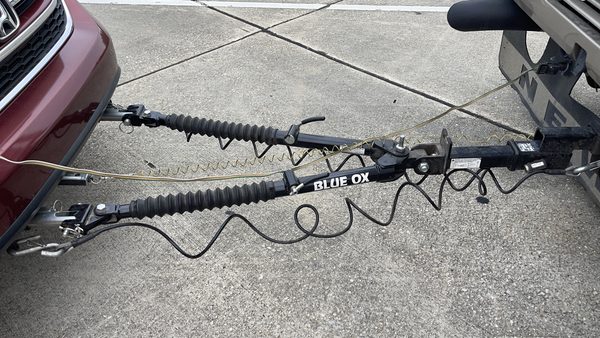
Its weight rating must exceed the Jeep’s actual loaded weight. Inspect the tow bar regularly for looseness, wear, corrosion, damaged boots, binding, and other problems.
Lubricate and service it according to its manufacturer’s instructions.
I learned firsthand why this matters when my RV tow bar broke during travel.
Safety Cables
Safety cables provide a backup connection if the tow bar, hitch, or related hardware fails.
They should be rated for the Jeep’s weight and connected to approved attachment points on both vehicles.
Route them according to the equipment manufacturer’s instructions so they do not drag, bind, or interfere with the tow bar.
A Towed-Vehicle Lighting System
The Jeep needs functioning brake lights, turn signals, and running lights that respond to the motorhome’s controls.
Lighting can be provided through permanently installed wiring, separate bulbs, or a portable system.
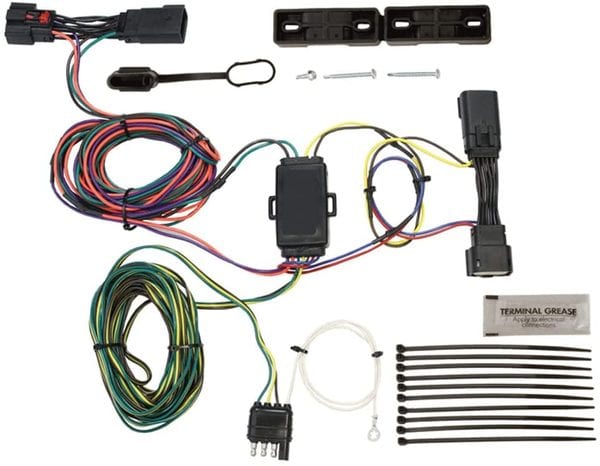
Each approach has advantages and disadvantages. Whichever system you choose, test all lights before every trip.
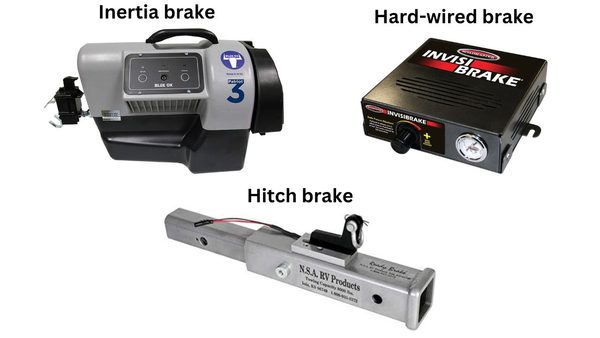
A Supplemental Braking System
A towed Jeep adds thousands of pounds to the combination.
The motorhome should not be expected to stop all of that additional weight without help. A supplemental braking system activates the Jeep’s brakes when the motorhome slows or stops.
Requirements vary by state and province, but the larger issue is maintaining control and reducing stopping distance.
You can compare the flat-tow braking systems I recommend before choosing one for your Jeep.
A Breakaway System
The breakaway system applies the Jeep’s brakes if it separates from the motorhome.
Its cable should be attached to the motorhome independently of the tow bar and safety cables.
If all the components are attached to the same removable or potentially failing point, one failure could defeat every backup system.
Make Sure the Motorhome Can Tow the Jeep
Even if the Jeep is approved for flat towing, your motorhome must be capable of handling it.
Check:
- The motorhome manufacturer’s towing limit
- The receiver hitch rating
- The gross combined weight rating
- The motorhome’s actual loaded weight
- The Jeep’s actual loaded weight
- The tow bar and base plate ratings
- Any limitations established by the chassis manufacturer
Use the lowest applicable rating as your limit.
For example, a motorhome may appear to have enough engine power, but its hitch or remaining combined-weight capacity may be insufficient for the Jeep.
Power alone does not determine towing capability.
What If Your Jeep Cannot Be Flat Towed?
A tow dolly may work for certain vehicles, especially some two-wheel-drive configurations.
But a dolly is not a universal solution for every Jeep.
Many four-wheel-drive and all-wheel-drive vehicles cannot be transported with only two wheels off the ground. They may require a full vehicle trailer with all four wheels raised.
Consult the Jeep owner’s manual to determine which towing methods are approved.
If both flat towing and dolly towing are permitted, my tow-dolly versus flat-towing comparison can help you choose between them.
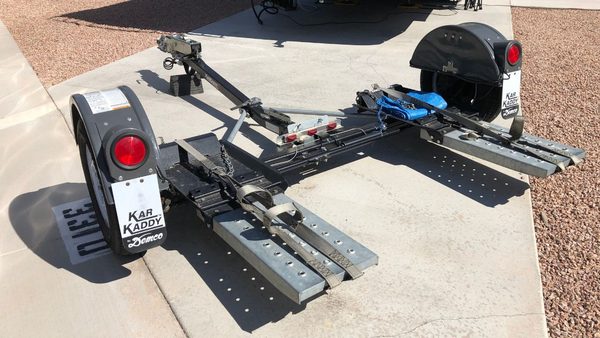
Tow-Dolly Disadvantages
Compared with flat towing, a tow dolly generally requires:
- More physical effort during loading and unloading
- Additional straps and connections
- Space at the campsite
- Maintenance for dolly tires, bearings, lights, and brakes
- More careful maneuvering
- A plan for storing the dolly at home
A dolly may still be the right choice if you tow different vehicles or want to avoid permanently installing a base plate.
Consider a Full Vehicle Trailer
A full trailer keeps all four Jeep wheels off the ground and can transport vehicles that are not approved for either flat towing or dolly towing.
It can also prevent towing mileage and tire wear on the Jeep.
However, the trailer adds substantial weight and requires considerably more storage space. The motorhome must be capable of towing the combined weight of the Jeep and trailer.
Frequently Asked Questions About Flat Towing a Jeep
Which Jeep is best for flat towing?
The Jeep Wrangler is one of the most popular choices because of its off-road capability, strong aftermarket support, and long history as a towed vehicle.
However, the Grand Cherokee may offer greater road comfort, while the Gladiator provides a useful pickup bed.
The best choice depends on your motorhome’s towing capacity and how you plan to use the Jeep.
Can every Jeep Wrangler be flat towed?
Do not assume that every Wrangler configuration or model year is approved.
Check the recreational-towing section of the owner’s manual for the exact Jeep. Follow its setup instructions precisely.
Can you flat tow a Jeep Grand Cherokee?
Certain Grand Cherokee four-wheel-drive configurations with an approved transfer case and neutral position can be flat towed.
Other four-wheel-drive systems and two-wheel-drive versions may not be approved. Verify the exact model year and drivetrain in the owner’s manual.
Can you flat tow a Jeep Gladiator?
Appropriately configured Jeep Gladiators can be flat towed behind a motorhome.
But you must follow the model-specific procedure for positioning the transmission and transfer case and confirming that the drivetrain is ready for towing.
Can you flat tow a Jeep Compass or Renegade?
Jeep Compass and Renegade models generally are not approved for recreational flat towing.
Depending on the drivetrain, they may require a tow dolly or full vehicle trailer. Consult the owner’s manual before choosing a towing method.
Can you tow a Jeep with an automatic transmission?
The transmission type alone does not determine whether flat towing a Jeep is allowed.
Some automatic-transmission Jeeps can be flat towed when equipped with the correct transfer case. Others cannot. The transfer case and overall drivetrain configuration are critical.
Does the Jeep odometer record miles while it is being flat towed?
That depends on the model and year.
Many modern vehicles do not add flat-towed mileage to the odometer, but you should verify this for the specific Jeep. The tires, wheel bearings, steering, and suspension are still accumulating wear even if the odometer does not record it.
Do I need a braking system when flat towing a Jeep?
A supplemental braking system is strongly recommended and may be legally required, depending on the combined weight and the states or provinces through which you travel.
It improves control and prevents the motorhome’s brakes from handling the Jeep’s entire weight during stops.
Can I back up while flat towing a Jeep?
You normally should not back up with a flat-towed Jeep connected.
The Jeep’s front wheels can turn improperly, causing binding and potential damage to the tow bar or steering components. Disconnect the Jeep before reversing the motorhome.
How often should I check the flat-towing setup?
Check every connection before departure and again after driving the first few miles.
Continue inspecting the equipment at fuel, meal, and rest stops. Look for loose pins, damaged cables, wiring problems, heat, unusual tire wear, and anything else that has changed.
Final Thoughts on Flat Towing a Jeep
A Jeep can be an excellent vehicle to bring along on your RV travels.
It can provide convenient transportation around town while also giving you the ability to explore places that would be difficult or impossible to reach in a large motorhome.
And flat towing a Jeep can make connecting, disconnecting, and storing your equipment easier than using a tow dolly or full trailer.
But not every Jeep can be flat towed.
Always verify the exact model year, transmission, drive system, and transfer case in the owner’s manual. Then follow the manufacturer’s recreational-towing procedure every single time you connect the Jeep.
You will also need a properly rated base plate, tow bar, safety cables, lighting system, supplemental braking system, and breakaway system.
If you select the right Jeep, use compatible equipment, stay within all weight ratings, and follow a written checklist, you can enjoy the convenience and adventure that make Jeeps such popular towed vehicles.