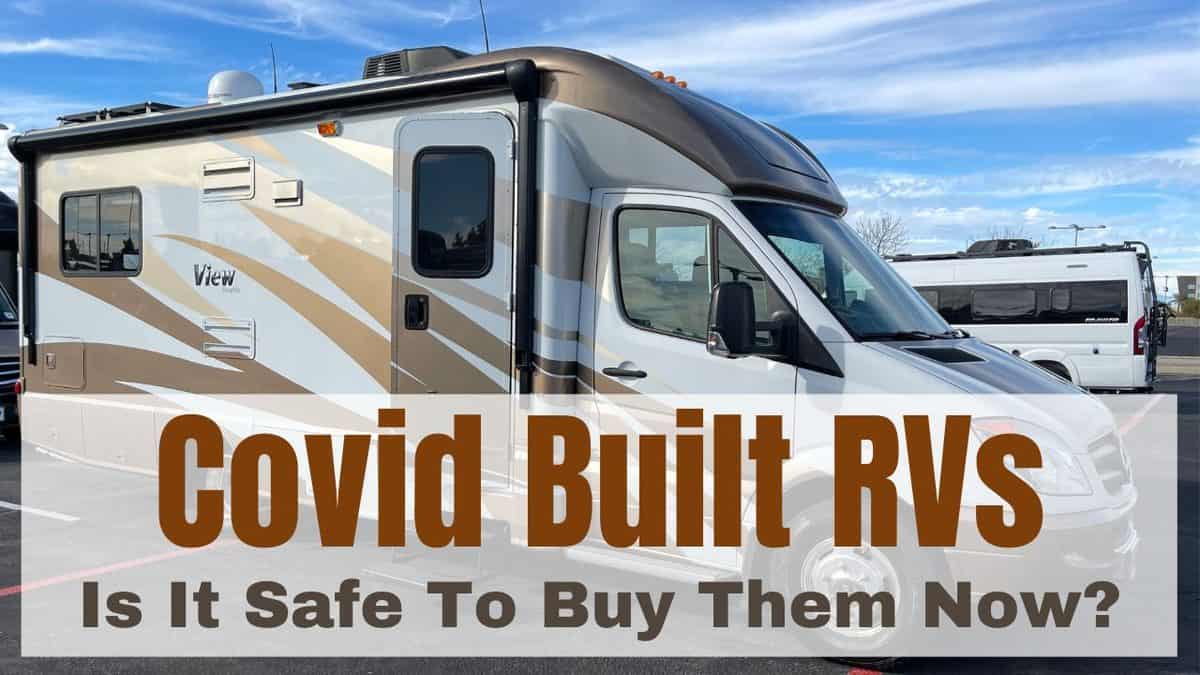
Should you consider buying a COVID-built RV on the used market?
Well, if you are shopping for a used RV, there is a good chance you will come across models built during the COVID-19 pandemic years.
These RVs are now several years old, and many are being offered at attractive prices. But should you consider buying one, or are the risks simply too great?
The answer is not as simple as saying that every pandemic-era RV is bad. Plenty of good RVs were built during that period, but the industry faced unusual problems that affected manufacturing quality across nearly every brand.
So if you are considering a 2020, 2021, or 2022 RV, you need to approach the purchase with extra care.
Quick Answer: Is It Safe to Buy a COVID-Era RV?
Yes, it can be safe to buy an RV built during the pandemic, but you should not treat it like an ordinary used RV purchase.
Some pandemic-era RVs were built well and have provided years of dependable service. Others left the factory with significant construction defects, missing components, or problems that may have required repeated repairs.
The key is to evaluate the individual RV rather than rejecting or accepting it based only on its model year.
Look carefully at its maintenance and repair history, verify that every system works properly, and have the RV thoroughly examined by a certified NRVIA inspector before you buy it.
Which RVs Are Considered COVID-Built RVs?
The COVID-19 pandemic disrupted RV production primarily during the 2020 through 2022 period. That is why RVs from the 2020, 2021, and 2022 model years usually receive the most attention from buyers.
However, model years and actual manufacturing dates do not always match perfectly.
An RV designated as a 2021 model, for instance, may have been manufactured sometime in 2020. Likewise, some early 2020 models may have been completed before the most serious manufacturing disruptions began.
Therefore, the model year is a useful warning sign, but it does not tell the entire story. The RV’s manufacturing date, ownership history, repair records, present condition, and inspection results are all more important than the year printed on the title.
This important to keep in mind before buying a COVID-built RV.
Why Did the Pandemic Affect RV Quality?
The pandemic created an unusual combination of extremely high demand, worker shortages, supply-chain disruptions, and pressure to increase production.
Any one of these problems could have affected RV quality. Unfortunately, the RV industry experienced all of them at approximately the same time.
RV Sales Increased Dramatically
During the pandemic, many people became interested in RVing for the first time.
Air travel, hotels, cruises, and other traditional forms of travel were restricted or viewed with concern. An RV appeared to offer families a way to get away from home while maintaining some distance from other people.
As a result, RV dealers experienced an enormous increase in demand.
Many of these new buyers were not necessarily planning to become lifelong RVers. They simply saw an RV as a useful and enjoyable way to travel during an unusual period.
But regardless of their long-term plans, they wanted RVs immediately. Dealers therefore placed intense pressure on manufacturers to supply more inventory.
Manufacturers Faced Serious Worker Shortages
At the same time that demand increased, RV manufacturers were dealing with worker shortages.
Factories were affected by illness, quarantines, shutdowns, and employees leaving the workforce. In some cases, manufacturers were trying to increase production while operating with far fewer experienced workers.
That is an especially difficult situation in the RV industry because most RVs are still largely assembled by hand.
And it’s one of the main reasons to be careful when buying a COVID-built RV.
The quality of the finished RV often depends on the training, experience, and attention of the workers building it. When experienced employees are unavailable and production must continue at a rapid pace, consistency can suffer.
Supply-Chain Problems Affected Parts and Components
RVs contain components supplied by many other companies, including refrigerators, furnaces, air conditioners, water heaters, electrical equipment, plumbing fixtures, windows, furniture, and appliances.
During the pandemic, many of these components became difficult to obtain.
Most RV manufacturers also rely on a relatively small group of suppliers. So when one supplier experienced a shortage or interruption, the effects could spread across several RV brands.
Manufacturers sometimes had to substitute different components, wait for missing parts, or complete RVs using whatever equipment was available.
This created more opportunities for installation problems, unfamiliar components, and incomplete work.
And it seriously affected those buying a COVID-built RV.
Production Speed Became the Main Priority
RV dealers needed inventory, and buyers were waiting to purchase it. Manufacturers therefore had a strong incentive to move RVs through their factories as quickly as possible.
But effective quality control requires time.
Inspecting construction work, testing systems, correcting mistakes, and verifying repairs all slow down production. During a period when manufacturers were trying to build more RVs with fewer experienced workers, quality-control procedures did not always receive the attention they deserved.
Consequently, some RVs left factories with serious defects. Others arrived at dealerships with unfinished work, improperly installed components, or missing parts.
Another reason to be wary of buying a COVID-built RV.
Were All Pandemic-Era RVs Poorly Built?
No. It would be inaccurate to say that every RV built between 2020 and 2022 was defective.
Many pandemic-era RVs were built reasonably well and have performed satisfactorily for their owners. Some buyers experienced only the kinds of minor problems commonly found in RVs from almost any production year.
However, the likelihood of encountering construction and quality-control problems was greater during this period.

The situation also affected more than just manufacturers with weak quality reputations. Even companies that normally produced better-than-average RVs faced worker shortages, component delays, substitutions, and production pressure.
So a respected brand name does not automatically make a pandemic-era RV a safe purchase.
The individual RV must prove itself through its documented history, current condition, and inspection results.
Have the Original Problems Been Repaired by Now?
This is where the age of these RVs can actually work in a buyer’s favor.
A pandemic-era RV has now been in use for several years. That means many of its original defects may have already appeared and been repaired by one or more previous owners.
If the RV has been used regularly, maintained properly, and tested under real camping conditions, its owner may have corrected most of the initial problems.
In that situation, the RV could now be a much better purchase than it was when it originally left the dealership.
But that does not happen in every case.
Some pandemic-era RVs were put together so poorly that they developed continuing problems. Repairs may have addressed the symptoms without correcting the underlying construction defects.
And an RV that was rarely used may still contain problems that have not been discovered yet.
That is why you cannot assume that age alone has eliminated the risk.
Five Tips for Buying a COVID-Era RV
If you are considering an RV from the pandemic years, these five recommendations can help you reduce your risk.
1. Treat Pandemic-Era RVs as Higher-Risk Purchases
The first step is to adopt the right mindset.
You should be cautious when buying any used RV. But when you are considering one built during the pandemic, you should be even more careful and skeptical.
Do not assume that an attractive appearance means the RV was built correctly. Cosmetic condition tells you very little about what may be happening inside the roof, walls, electrical system, plumbing system, or undercarriage.
Verify everything you can and do not rush the process.
This is a situation where you want to dot every “i” and cross every “t.” If the seller pressures you to skip important steps, be prepared to walk away.
2. Avoid These Years if You Are Very Risk-Averse
Not every buyer has the same tolerance for uncertainty.
Some people are comfortable buying a potentially problematic RV if the price reflects the risk and they have the ability to handle repairs. Others want the lowest-risk purchase they can reasonably make.
If you strongly dislike unexpected repairs or simply do not want to deal with the added uncertainty, there is nothing wrong with avoiding the 2020 through 2022 model years.
You do not have to buy a pandemic-era RV.
There are older RVs that have been maintained carefully and newer ones built after the worst disruptions eased. Expanding your search may help you find an RV that better matches your comfort level.
3. Ask Private Sellers for Maintenance and Repair Records
A private seller should be able to tell you how the RV has performed during their ownership.
Ideally, the seller will also have written records showing when the RV was serviced, what problems were discovered, which repairs were completed, and whether any work had to be performed more than once.
These records can reveal a great deal about the RV.
For example, one properly documented refrigerator replacement would not necessarily concern me. But repeated electrical problems, recurring water leaks, continuing slideout failures, or multiple unsuccessful repairs could indicate a much larger issue.
Good records can also show whether the owner maintained the roof, seals, tires, brakes, bearings, batteries, appliances, and other important components.
If a seller claims that extensive work was completed but cannot provide receipts or documentation, treat that claim with caution.
4. Do Not Rely on a Dealer’s Promises
A dealer may tell you that the RV has been inspected, serviced, and repaired. But you should not consider those statements a substitute for independent verification.
The term “pre-delivery inspection,” or PDI, does not guarantee that the RV received a detailed examination.
The quality of dealer PDIs varies widely. Some dealers have thorough procedures and qualified technicians, while others perform little more than a basic check before delivering the RV.
Statements such as “Everything has been fixed” or “This RV is in excellent condition” should therefore be treated as sales claims until they are independently confirmed.
You should also ask for repair orders and other written documentation. If the dealer says a major problem was corrected, find out exactly what was repaired, who performed the work, and whether any warranty applies to it.
5. Always Get an Independent RV Inspection
Never buy a pandemic-era RV without having it thoroughly examined by an independent certified NRVIA inspector.
The inspection should cover the RV from roof to undercarriage and include the major structural areas, appliances, electrical systems, plumbing, propane equipment, slideouts, heating and cooling systems, and visible signs of water intrusion.
Tell the inspector that the RV was built during the pandemic and that you are concerned about possible construction and quality-control issues.
Ask the inspector to pay especially close attention to evidence of unfinished work, unusual component substitutions, recurring repairs, improper installations, and defects that may have been hidden rather than corrected.
An inspection cannot guarantee that an RV will never develop a problem. But it can give you valuable information about its present condition and help identify warning signs before you commit to the purchase.
Warning Signs That Deserve Extra Attention
Some problems can be found in an RV from any year, but they deserve added attention in a pandemic-era model.
Be especially cautious if you discover:
- Evidence of current or previous water intrusion
- Soft areas in the roof, walls, or floor
- Delamination or exterior wall separation
- Loose cabinets, trim, furniture, or interior panels
- Exposed, unsupported, or poorly routed wiring
- Plumbing lines that leak or appear improperly installed
- Appliances that do not operate correctly
- Slideouts that bind, leak, or move unevenly
- Recurring electrical or plumbing repairs
- Missing labels, manuals, or component information
- Improvised repairs or modifications
- Components that do not match the manufacturer’s original specifications
- A lack of maintenance and repair documentation
One minor problem does not necessarily make the RV a bad purchase. But several unrelated problems can reveal a pattern of poor construction or neglect.
Consider How the RV Was Used
Ownership history can be just as important as the original construction quality when buying a COVID-built RV.
An RV that was purchased during the pandemic, used for one or two trips, and then stored for years may not be as thoroughly tested as it appears. Low mileage and a clean interior can be attractive, but they do not prove that all systems function correctly.
Long periods of storage can also create problems with tires, batteries, seals, plumbing, generators, brakes, and appliances.
On the other hand, an RV that has been used regularly and maintained carefully may have already gone through a valuable shakedown period. Its original problems may have been identified and professionally corrected.
The goal is not necessarily to find the RV with the least use. It is to find one with the best combination of responsible use, proper maintenance, documented repairs, and good present condition.
Is a Low Price Worth the Added Risk?
Some pandemic-era RVs may be priced lower because buyers are cautious about those model years.
A reduced price can make the RV appealing, but only if its condition supports the purchase.
An RV that needs significant structural, electrical, plumbing, or water-damage repairs can quickly consume any money you saved. In severe cases, repairs may cost more than the RV is worth.
Use the inspection findings to estimate the true cost of ownership. Include immediate repairs, overdue maintenance, tire replacement, battery replacement, and any work that may be needed soon.
A bargain is only a bargain if the RV is fundamentally sound.
Frequently Asked Questions About COVID-Built RVs
What RV model years were most affected by the pandemic?
The 2020, 2021, and 2022 model years are generally associated with pandemic-related production problems. However, actual manufacturing dates vary, so buyers should look at the RV’s production date as well as its stated model year.
Should I automatically avoid every RV built from 2020 through 2022?
No. Many perfectly usable RVs were built during those years.
However, these RVs deserve additional scrutiny because manufacturers were dealing with worker shortages, supply interruptions, component substitutions, and unusually high demand.
Are some RV brands safer than others from those years?
Manufacturers with stronger construction practices may still be worth considering, but no brand was completely protected from pandemic-related disruptions.
Judge the individual RV by its condition, history, documentation, and independent inspection instead of relying on the brand name alone.
Can an inspection find every possible problem?
No inspection can uncover every hidden defect or guarantee that nothing will fail later.
However, a thorough independent inspection can identify many existing problems, reveal signs of poor construction or neglected maintenance, and help you make a much better-informed decision.
Is buying from a private seller better than buying from a dealer?
Neither option is automatically better.
A responsible private seller may provide detailed ownership and repair records. A reputable dealer may also provide documentation and perform necessary repairs, but you should never rely entirely on either seller’s statements.
Independent verification is important in both situations.
What if the RV has no service records?
A lack of service records does not prove that the RV is bad, but it increases your uncertainty.
Without documentation, you will have a harder time determining whether the RV received proper maintenance or experienced repeated problems. That makes a detailed inspection even more important.
Could a pandemic-era RV be better now than when it was new?
Yes. Several years of use may have revealed the original defects, and a careful owner may have had them repaired properly.
But you should confirm that history through documentation and inspection rather than simply assuming all the problems have been corrected.
Final Thoughts
Buying an RV built during the COVID-19 pandemic does involve added risk, but the model year alone should not make the decision for you.
Not every pandemic-era RV was poorly built. Some have performed well, and others became dependable RVs after their original problems were identified and corrected.
But there were also RVs from that period with serious construction and quality-control issues that may never be completely dependable.
So be extra cautious, investigate the RV’s history, ask for maintenance and repair records, and never rely entirely on a seller’s promises. Most importantly, have the RV thoroughly examined by an independent certified NRVIA inspector before you buy it.
That is the best way to put the odds in your favor and determine whether a particular pandemic-era RV is a good opportunity—or a potential money pit.