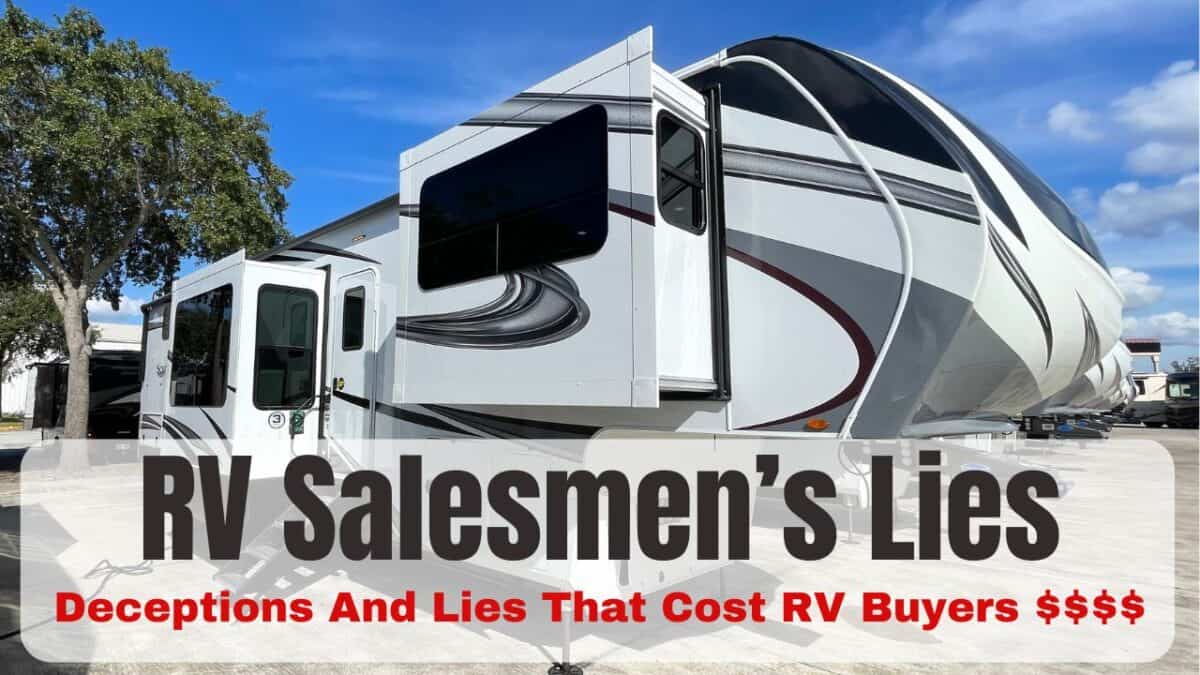
Buying an RV should be an exciting experience. But all too often buyers have to deal with RV dealer lies.
And unfortunately, it can become an expensive mistake if you rely too heavily on everything an RV salesperson tells you.
I’m Duane, a certified RV inspector, and one thing that has always concerned me is how much trust many buyers place in an RV salesperson. They assume that the person helping them knows RVs, understands towing, and has their best interests in mind.
However, that is not always the case.
Some RV salespeople are knowledgeable, experienced, and honest. But others are primarily focused on making the sale and earning their commission.
That means they may tell you what you want to hear, even when the information is incomplete, misleading, or simply untrue.
So let’s examine four common RV dealer lies and deceptions that can cost buyers thousands of dollars. More importantly, I’ll explain how you can protect yourself from each one.
Why RV Buyers Should Be Careful at the Dealership
An RV is a complicated purchase because you are buying much more than a vehicle or trailer.
You are also buying plumbing, electrical, heating, cooling, propane, wastewater, and appliance systems. In the case of a towable RV, you must also determine whether your vehicle can handle the trailer safely.
And many RVs cost as much as a house once did.
Despite that, some buyers do less research before purchasing an RV than they would before buying a new television. They visit a dealership, find an RV that looks attractive, and allow the salesperson to guide most of the decision.
But the salesperson works for the dealership, not for you.
Their job is to sell RVs, arrange financing, and help the dealership earn a profit. That does not automatically make them dishonest, but it does mean that you must verify the information they give you.
The more you know before arriving at the dealership, the less likely you are to fall for these common RV salesman lies.
RV Dealer Lies #1: “Your Vehicle Can Definitely Tow This RV”
This is one of the most common and potentially dangerous statements made to RV buyers.
You show the salesperson your truck, SUV, or other tow vehicle, and they assure you that it can easily pull the RV you want. Sometimes they may reach that conclusion after asking only what make and model you own.
However, matching a tow vehicle to a trailer is not that simple.
Towing Capacity Is Only One Part of the Calculation
A vehicle’s advertised maximum towing capacity is important, but it is not the only number that matters.
You also need to consider:
- The vehicle’s payload capacity
- The trailer’s loaded weight
- Tongue weight or pin weight
- The weight of passengers
- Cargo carried in the tow vehicle
- Accessories added to the vehicle
- The vehicle’s gross combined weight rating
- The ratings of the hitch, tires, and axles
Two trucks that look almost identical can have very different towing and payload capacities. Engine size, drivetrain, axle ratio, cab configuration, bed length, and installed equipment can all affect the ratings.
So a salesperson usually cannot determine whether your vehicle is suitable simply by looking at it in the parking lot.
Dry Weight Can Be Misleading
Another common RV dealer trick is focusing only on the trailer’s unloaded or “dry” weight.
The dry weight normally does not include all the camping gear, food, water, propane, batteries, and other items you will add. Therefore, the RV can weigh substantially more when you are ready to travel.
And that added weight can also increase the amount of tongue or pin weight placed on your tow vehicle.
This is why buying based solely on dry weight can leave you with a trailer that is too heavy for your vehicle. In fact, it is one of the biggest travel trailer buying mistakes that buyers make.
What Happens If You Buy Too Much RV?
Some buyers do not discover the mismatch until after they have signed the paperwork and taken the RV home.
Then they are left with two unpleasant choices.
They can sell or trade the RV, which may produce an immediate financial loss. Or they can replace their tow vehicle with a more capable one, which could cost tens of thousands of dollars.
Neither choice is good.
So research RV towing capacity before you visit the dealership. Find the specific ratings for your vehicle and calculate how passengers, cargo, tongue weight, and other loads affect its capacity.
Do not allow a salesperson’s verbal assurance to replace the actual numbers.
RV Dealer Lies #2: “We Can Give You the Best Financing Available”
The dealership may tell you that its finance department can offer a lower interest rate than anyone else.
Is this just one of the RV dealer lies they tell?
Well, actually that could be true. However, you should never automatically assume that dealer-arranged RV financing is your least expensive option.
The finance office can be one of the dealership’s biggest profit centers. In addition to arranging the loan, it may sell extended service contracts, protection packages, insurance products, and other add-ons.
Why the Monthly Payment Can Be Misleading
Some buyers focus mainly on whether the monthly payment fits their budget.
However, the dealership can lower that payment by extending the length of the loan. A longer loan term may make an expensive RV appear affordable, but it can also greatly increase the amount of interest you pay.
Even worse, you may owe more on the RV than it is worth for many years.
This is especially important because RVs generally depreciate quickly. If you decide to sell or trade the RV while you are upside down on the loan, you may have to bring a substantial amount of money to the transaction.
Therefore, do not evaluate an RV loan by monthly payment alone.
Look carefully at:
- The interest rate
- The length of the loan
- The total amount financed
- The total interest paid
- Loan fees
- Prepayment penalties, if any
- Optional products added to the contract
Arrange Financing Before Visiting the Dealership
One of the best ways to protect yourself is to speak with your bank or credit union before shopping for an RV.
If you have good credit and an established relationship with a financial institution, you may be able to obtain an attractive rate on your own. You will also have a financing offer you can use for comparison.
Then, if the dealership truly offers better terms, you can choose its financing. But if it does not, you already have another option available.
Arranging financing in advance also helps you establish a realistic budget. That makes it easier to resist the temptation to buy more RV than you can comfortably afford.
RV Dealer Lies #3: “This Older New RV Is an Incredible Deal”
You may visit a dealership to look at the current model-year RVs, only to have a salesperson direct you toward an older unit.
They may tell you that the older RV is essentially the same and that buying it will save you a large amount of money.
And sometimes it really can be a good deal.
However, you need to understand why the dealership is eager to sell it.
Why Dealers Want to Move Older Inventory
An RV that has remained on the lot through one or more model years ties up the dealership’s money. The dealer may also be paying interest and other expenses while the RV remains unsold.
Therefore, salespeople may be given special incentives to move aging inventory.
The discount may be legitimate, but that does not automatically make the RV a smart purchase. Before proceeding, find out how long the RV has been on the lot and why it has not sold.
You should also compare the discounted price with the market value of that specific model year. Even though the RV has never been titled, it is still an older model and should be priced accordingly.
The Danger of RV Lot Rot
RVs do not necessarily remain in perfect condition while sitting unused on a dealership lot.
They may spend months or even years exposed to intense sunlight, rain, snow, freezing temperatures, and temperature changes. Meanwhile, seals can begin to deteriorate, batteries can discharge, tires can age, and moisture can find its way inside.
This deterioration is often called lot rot.
A neglected RV may also develop problems with appliances, plumbing fixtures, slideouts, generators, and other components that need regular operation or care.
And because the RV is technically new, buyers sometimes assume that all of these systems must be in excellent condition.
That can be an expensive assumption.
When an Older New RV May Be Worth Buying
An unsold previous-model-year RV is not automatically a bad choice.
If the discount is large enough and the RV is in excellent condition, it could provide good value. However, the discount must justify buying an older model, and you need to verify the RV’s condition before signing anything.
Look closely for:
- Cracked or deteriorated exterior sealant
- Evidence of water intrusion
- Weathered or damaged tires
- Weak or neglected batteries
- Faded or damaged exterior surfaces
- Rust or corrosion
- Malfunctioning appliances
- Plumbing leaks
- Slideout or awning problems
- Signs that rodents or insects have entered the RV
You can also learn more about how to spot good and bad new RV quality before visiting the dealership.
Most importantly, have the RV independently inspected. A discounted price is not a bargain if you immediately inherit thousands of dollars in repairs.
RV Dealer Lies #4: “Our PDI Is Just as Good as an Independent Inspection”
This is more than a misleading sales claim. In many cases, it is simply untrue.
A dealer’s pre-delivery inspection, commonly called a PDI, is not the same as an inspection performed for the buyer by a qualified independent RV inspector.
What Is an RV Pre-Delivery Inspection?
The dealership’s PDI is generally intended to prepare the RV for delivery.
Its staff may check certain systems, correct obvious problems, clean the RV, and make sure it is ready for the customer walkthrough. The thoroughness of this process can vary enormously from one dealer to another.
Some dealerships do a reasonably good job. Others perform only a limited check, and a few may do very little unless the buyer points out a problem.
The person conducting the PDI may also have limited training or experience.
And there is another important difference: The dealership is inspecting its own product.
How an Independent RV Inspection Is Different
An independent inspector works for the buyer.
A qualified inspector normally spends hours examining the RV from top to bottom. The inspection may include the roof, exterior, interior, plumbing, electrical components, appliances, life-safety equipment, and other accessible systems.
The buyer then receives a detailed report explaining the inspector’s findings.
The goal is not to prepare the RV for delivery. It is to give the buyer an independent assessment of the RV’s condition before the purchase is completed.
That information can help you decide whether to continue with the transaction, request repairs, renegotiate the price, or walk away.
This is especially important with new RVs because “new” does not always mean problem-free. RVs can leave the factory with incomplete work, damaged components, poorly installed equipment, and other defects.
My Buying an RV resource page has more information on comparing RVs, evaluating quality, and making sure problems are corrected before delivery.
What If the Dealer Refuses an Outside Inspection?
Occasionally, a dealer will refuse to allow an independent RV inspection on its property.
The salesperson may claim that the dealership’s PDI is all you need or that outside inspectors are not permitted.
If that happens, my recommendation is simple: Find another dealer.
A dealer that is confident in its RVs should not be afraid of a qualified inspector examining one before the sale. Refusing an independent inspection raises serious questions about the dealership’s priorities and what it may not want you to discover.
You are preparing to spend a substantial amount of money. You should not be pressured into accepting only the seller’s opinion about the condition of the product being sold.
Not Every RV Salesperson Is Dishonest
It is important to be fair here.
Not every RV salesperson will lie to you or intentionally provide misleading information. There are knowledgeable and ethical salespeople in the RV industry, especially those who have years of experience and understand the importance of long-term customer relationships.
A good salesperson will acknowledge when they do not know the answer to a technical question. They will help you find reliable information instead of making something up.
They will also give you time to conduct research, compare financing, and arrange an independent inspection.
However, too many dealerships have adopted high-pressure tactics associated with the car sales industry. Their focus is on completing the transaction quickly instead of building a lasting relationship with the customer.
This can be especially common at some large national RV dealership chains, where sales volume and short-term profit may be the primary goals.
So listen to the salesperson, but verify important claims independently.
How to Protect Yourself From RV Dealer Lies And Tricks
The best defense against RV dealer lies is preparation.
Do your research before walking onto the lot. Begin by deciding what type of RV fits your intended travel style, camping preferences, storage situation, and budget.
Next, research manufacturers, brands, models, and model years. My RV brand and model resources can help you narrow your search before visiting dealerships.
If you are buying a towable RV, calculate your vehicle’s real towing and payload limitations in advance.
Then arrange outside financing so you can compare the dealer’s offer with another lender. And before signing a purchase agreement, make sure you understand whether your deposit is refundable and whether the sale is contingent on an acceptable independent inspection.
Finally, slow the process down.
High-pressure RV sales tactics depend on getting you to make an emotional decision before you have time to investigate. A good RV should still be a good choice after you have researched it, reviewed the numbers, and slept on the decision.
Frequently Asked Questions About RV Dealer Lies
Can I trust an RV salesperson?
Some RV salespeople are knowledgeable and honest, but you should independently verify important claims about towing, financing, warranties, and the RV’s condition. Remember that the salesperson represents the dealership and earns money by completing the sale.
Can an RV dealer tell me whether my truck can tow a trailer?
A salesperson may offer an opinion, but you should not rely on it without checking the actual ratings for your specific vehicle. Towing capacity, payload, tongue or pin weight, passengers, cargo, and the trailer’s loaded weight must all be considered.
Is dealer financing always more expensive?
No. A dealership may sometimes offer the best loan available, especially when a manufacturer or lender is running a promotion. However, obtaining an offer from your bank or credit union gives you a reliable comparison and prevents you from having only one financing option.
Is a previous-model-year RV still considered new?
An RV may be sold as new if it has never been titled, even if it is one or more model years old. However, its age affects its market value, and extended outdoor storage may have caused deterioration.
What is RV lot rot?
RV lot rot is the deterioration that can occur while an RV sits unused on a dealer lot. Common problems include aging tires, discharged batteries, deteriorated sealant, water intrusion, corrosion, fading, pest damage, and malfunctioning equipment.
Is a dealer PDI the same as an independent RV inspection?
No. A dealership’s pre-delivery inspection is performed by or for the seller to prepare the RV for delivery. An independent RV inspection is performed for the buyer and is intended to provide an impartial evaluation of the RV’s condition.
Should I buy from a dealer that refuses an independent inspection?
I would not recommend it. Refusing to allow a qualified independent inspection is a major warning sign. There are other dealerships that will respect your right to verify the RV’s condition before completing the purchase.
Conclusion
Buying the right RV can lead to years of enjoyable travel. But buying the wrong one can leave you with towing problems, excessive debt, unexpected repairs, and a major financial loss.
So do not allow an RV salesperson to make important decisions for you.
Verify your towing numbers, arrange financing in advance, carefully evaluate older inventory, and insist on an independent RV inspection before you buy.
Most of all, be willing to walk away.
The goal is not merely to buy an RV. The goal is to buy the right RV, at the right price, and in the right condition so you can enjoy safe and happy travels for years to come.