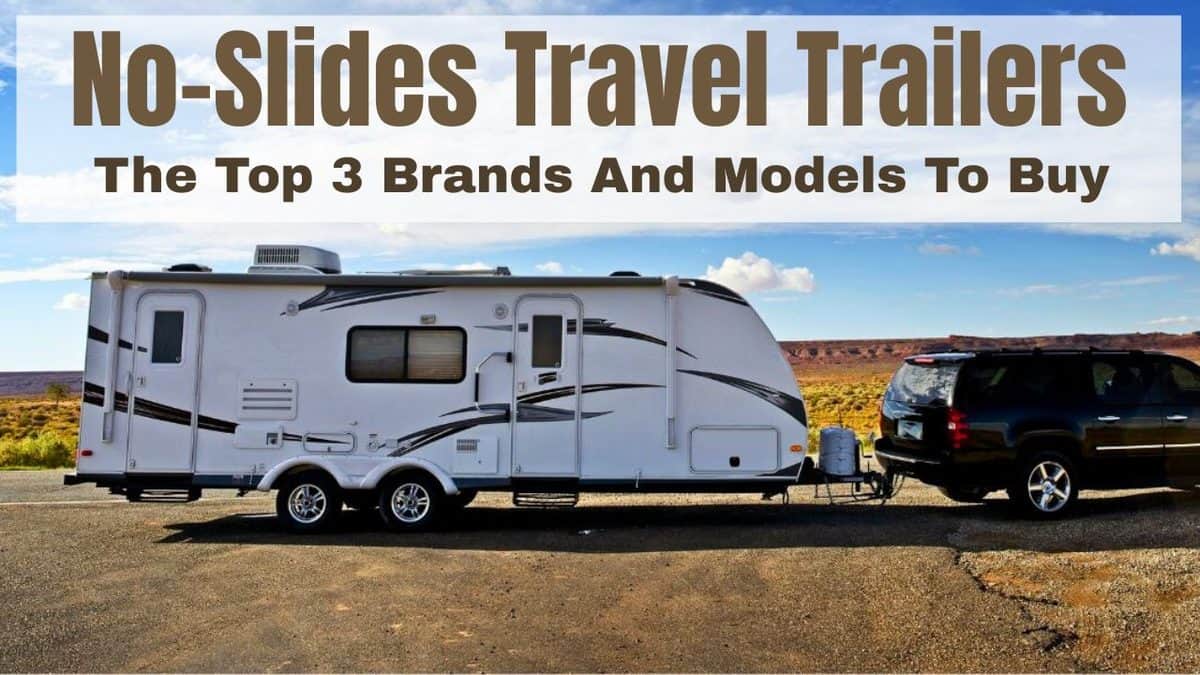
If you’re looking for the best no slide travel trailers, you probably want fewer moving parts, fewer slide seals to maintain, and one less system that could interrupt a camping trip. And I certainly understand that.
Slide rooms provide wonderful living space, but some RVers would rather have a simpler trailer than a larger interior. Fortunately, you still have some good brands and floor plans to consider.
Quick Answer: Which No Slide Travel Trailers Do I Recommend?
Airstream is my premium choice, Ember Overland is worth considering for versatile layouts and camping beyond developed campgrounds, and Winnebago Micro Minnie is my more budget-conscious option.
However, these are starting points for your search, rather than a guarantee that every trailer from these brands will be right for you. The individual floor plan, model year, condition, price, and towing requirements still matter.
Why Choose a Travel Trailer Without Slides?
The biggest benefit is simplicity. Without a slide room, you eliminate its operating mechanism and the seals surrounding that moving room.
That means you won’t have a slide motor, slide alignment problem, or slide room that refuses to retract when you’re ready to leave. For some RVers, that peace of mind matters more than extra floor space.
Slide Seals Need Attention
A slide room moves through an opening in the RV’s sidewall. Seals help keep weather outside, but those seals need regular inspection and appropriate care.
As an RV inspector, I have seen owners overlook that maintenance. And when water intrusion goes unnoticed, the resulting damage can become far more serious than the original seal problem.
However, poor maintenance isn’t the explanation for every slide leak. Installation, alignment, damaged components, and other defects can also cause trouble.
If you already own an RV with slides, my article about avoiding expensive RV slide out repairs explains why ongoing care matters.
The Slide Mechanism Must Suit the Room
Another concern is whether the operating system is properly matched to the slide room it moves. A large, heavy room places different demands on its mechanism than a small wardrobe slide.
So I don’t judge a slide system by its name alone. Its application, installation, condition, and maintenance all affect how well it performs.
My comparison of the best RV slide-out systems will help if you’re still deciding whether to rule slides out completely.
The Tradeoff Is Less Interior Space
Of course, choosing a travel trailer without slides means accepting a fixed amount of living space. You can’t expand the room after arriving at your campsite.
For a couple who spends much of the day outside, that may be perfectly comfortable. But a family spending several rainy days indoors might feel differently.
And remember, no-slide doesn’t mean leakproof or maintenance-free. Roof openings, windows, plumbing, exterior seams, appliances, and running gear still need attention.
How I Selected These Three Brands
When I make a top-three list, I try to include choices that work for different buyers. A list made up entirely of expensive trailers wouldn’t be very useful to someone shopping on a tighter budget.
So this comparison includes a premium option, an adventure-oriented alternative, and a more affordable compact trailer line. Actual prices can overlap depending on size, equipment, and whether you’re buying new or used.
I’m also leaving molded-fiberglass shell trailers out of this particular comparison. They deserve a separate discussion, and my Oliver travel trailers review is a good place to explore that alternative.
Airstream uses a different construction method from conventional flat-wall trailers, but it belongs here as an important aluminum-bodied option.
The models below include current offerings and earlier floor plans worth considering. Always confirm the exact model year, because manufacturers change their lineups and specifications.
So let’s get started on my best no slide travel trailers list for this article.
Airstream: My Premium Choice
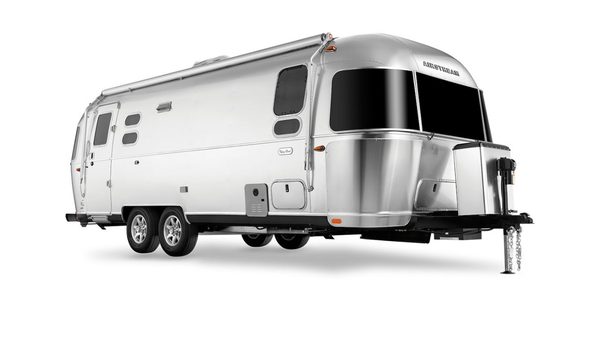
Airstream is the first brand I would consider if your budget allows a premium travel trailer and you want to avoid slide rooms.
Its recognizable rounded aluminum body makes it different from most trailers on a dealer’s lot. And in my opinion, its construction approach makes it well worth investigating for long-term ownership.
Airstream and Slide Rooms
Current Airstream travel trailers use fixed living spaces without slide rooms. However, Airstream did build some slide-equipped trailers in the past, so inspect older listings carefully if avoiding slides is essential.
The absence of a slide removes one potential source of mechanical repairs. But it doesn’t guarantee that an Airstream will never leak or need expensive work.
A well-maintained trailer can provide many years of service, while a neglected one can become costly regardless of the badge on its side.
Is an Airstream Comfortable Without Slides?
That depends on the floor plan and the way you camp.
Before buying, sit where you would relax in the evening, stand at the kitchen counter, and move around the bed. Have your traveling partner do the same things at the same time.
A layout that looks spacious when you’re touring it alone may feel quite different when two people are getting ready for the day.
My article about Airstream travel trailers and full-time RVing discusses more of these everyday advantages and compromises.
Don’t Assume Aluminum Means Easy Towing
Aluminum construction doesn’t automatically make every Airstream suitable for an SUV or smaller pickup. Larger models still require a carefully matched tow vehicle.
And purchase price is another consideration. I would compare the exact Airstream you want against other trailers that meet your needs, rather than deciding based on the brand’s least expensive starting price.
For buyers who value its construction and enjoy its fixed floor plans, Airstream deserves a place near the top of the shopping list.
Ember Overland: Flexible Layouts for Adventurous Camping
Next is Ember, spelled E-M-B-E-R. Its Overland series appeals to buyers who want a trailer for developed campgrounds and more remote camping locations.
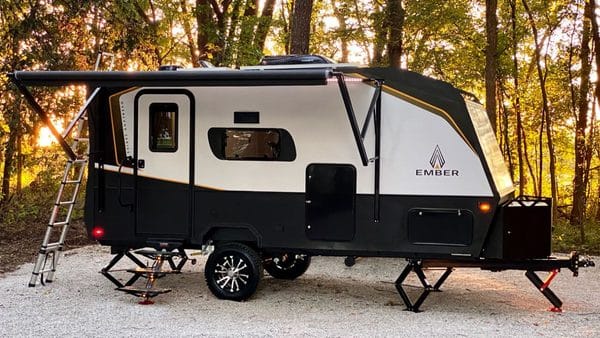
Ember markets this series around features such as independent suspension, outdoor capability, and flexible interior spaces. However, always evaluate the specific route and trailer rather than assuming an off-road label means it can go anywhere.
The 190MDB and 190MSL
The 190MDB mentioned in my original recommendations is an earlier no-slide bunkhouse floor plan. Ember’s older floor-plan material confirms its double-over-double bunks and removable tables.
That makes it worth investigating when shopping used or checking remaining inventory. But don’t assume that every model mentioned in an older video remains available to order new.
The 190MSL is another compact option to investigate. Ember currently lists it at 22 feet 6 inches overall, with a published GVWR of 5,930 pounds.
GVWR means gross vehicle weight rating, or the maximum permitted loaded weight of the trailer. It is different from the advertised dry weight, so don’t mix those figures when choosing a tow vehicle.
A Larger Option: The 240TKR
The 240TKR offers another direction for buyers who want a larger layout with a rear ramp door and convertible twin/king Murphy-bed arrangement.
Ember currently lists its overall length at 28 feet 3 inches and its GVWR at 9,995 pounds. That puts it in a substantially different towing category from many compact campers.
So if this model interests you, evaluate the tow vehicle before getting attached to the floor plan. The larger trailer’s cargo possibilities also make careful loading important.
A Newer No-Slide Choice: The 220MSL
There is also an update worth adding to the original list. Ember introduced the no-slide 220MSL for the 2027 model year.
It provides a tandem-axle platform, a walk-around queen Murphy bed, and Ember’s reconfigurable bunk, desk, and storage area. That gives buyers another option when they like the smaller MSL concept but want more room.
However, an Ember Overland isn’t automatically an inexpensive alternative to every Airstream. Compare actual equipped models and dealer quotes, because their price ranges can overlap.
Winnebago Micro Minnie: A More Affordable Option
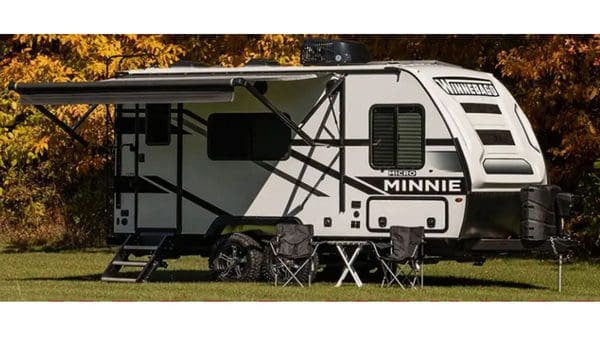
My third recommendation is the Winnebago Micro Minnie. This is where I would direct buyers who want to explore a smaller trailer at a lower purchase price than many premium options.
But check the floor plan carefully. The Micro Minnie family includes both slide-equipped and no-slide layouts.
The 1800BH Bunkhouse
The 1800BH is a useful starting point for families wanting a compact travel trailer without slides. Winnebago’s current description identifies a front bed, convertible dinette, rear bathroom, and bunkhouse.
Its published overall length is 21 feet 11 inches, and its GVWR is 5,500 pounds.
That corrects an important point from the original discussion: the 1800BH should not be grouped with the 1700BH as though both have a 4,200-pound GVWR.
Even trailers with similar names and appearances can have different ratings. Check the certification and cargo labels on the actual trailer you’re considering.
Earlier Options: The 1700BH and 1720FB
The 1700BH and 1720FB are also worth researching if you’re looking at earlier model years or remaining dealer stock.
For reference, Winnebago’s 2025 specifications list the 1700BH at 20 feet 9 inches with a 4,200-pound GVWR. The 1720FB is listed at 20 feet 5 inches with a 5,500-pound GVWR.
Those figures are specifically a 2025 reference, rather than a statement that every year has identical specifications. They also show why the model number alone doesn’t tell you the trailer’s overall length.
The bunkhouse arrangements are worth considering for children or occasional guests. Meanwhile, a front-bed layout may appeal to a couple who doesn’t need bunk beds.
How to Choose the Right No-Slide Trailer
Before deciding which of these brands is best for you, spend time testing how the trailer will work during an ordinary camping day.
Can you use the bathroom comfortably, prepare a meal, reach your storage, and move around each other? And if a bed or table must be converted daily, are you happy doing that?
Match the Trailer to Your Tow Vehicle
Don’t rely on a salesperson saying, “Your SUV can pull that.”
Compare the trailer’s anticipated loaded weight with the vehicle’s towing limits, and account for passengers, cargo, hitch equipment, and loaded tongue weight. Payload, receiver limits, axle ratings, and combined weight ratings all matter.
A weight-distribution hitch can help distribute loads when properly specified and adjusted. However, it does not increase the tow vehicle’s capacity.
Inspect Before Buying
A no-slide trailer still deserves a thorough inspection before purchase. Check the roof, seals, floors, plumbing, electrical systems, appliances, tires, brakes, and chassis condition.
And if you’re comparing a cheaper new trailer with a better-built used one, condition and maintenance history should carry plenty of weight.
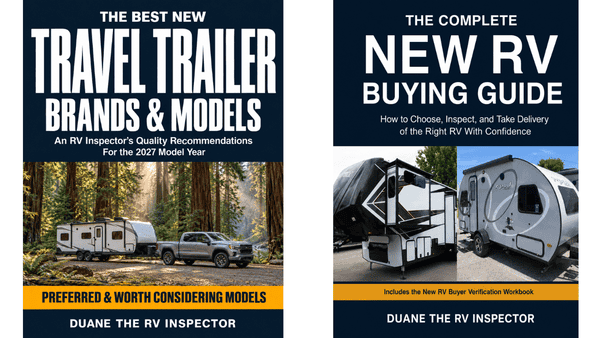
For a broader shortlist, my travel trailer brands guidebook can help you explore additional choices. Pairing that research with my new RV buying guide can also help you approach the purchase more confidently.
Just click on the image below to learn more about them.
Frequently Asked Questions
Are travel trailers without slides more reliable?
They eliminate slide-specific failures and maintenance, which simplifies ownership. But overall reliability still depends on construction quality, individual components, maintenance, and how the trailer is used.
Do no-slide travel trailers still leak?
They can. Removing slide openings doesn’t eliminate potential leaks around windows, roof equipment, seams, doors, or plumbing.
Can an SUV tow a no-slide travel trailer?
Some properly equipped SUVs can tow certain models. However, avoiding slides doesn’t establish towing compatibility, and every vehicle-and-trailer combination needs its own weight check.
Which no-slide trailer is best for couples?
Airstream is worth exploring for buyers with a premium budget, while Ember and earlier Micro Minnie front-bed layouts offer other possibilities. Your comfort with the bed, bathroom, seating, and storage matters more than a general ranking.
Are no-slide trailers good for families?
A bunkhouse layout can work well for a family that is comfortable with a smaller shared living area. Just remember that sleeping capacity and comfortable daytime living space are different things.
Conclusion: Choose Simplicity That Fits Your Camping Style
The best no slide travel trailers give you a comfortable place to camp while removing the complexity of an expanding room. And for many RVers, that is a worthwhile tradeoff.
Airstream, Ember Overland, and Winnebago Micro Minnie are three brands of the best no slide travel trailers I recommend investigating. Each serves a different kind of buyer, and the right floor plan matters as much as the brand.
So take your time, verify the specifications, test the living space, and inspect the individual trailer before buying. That gives you a much better chance of choosing an RV you’ll enjoy for years to come.
Have safe and happy travels, my friends!