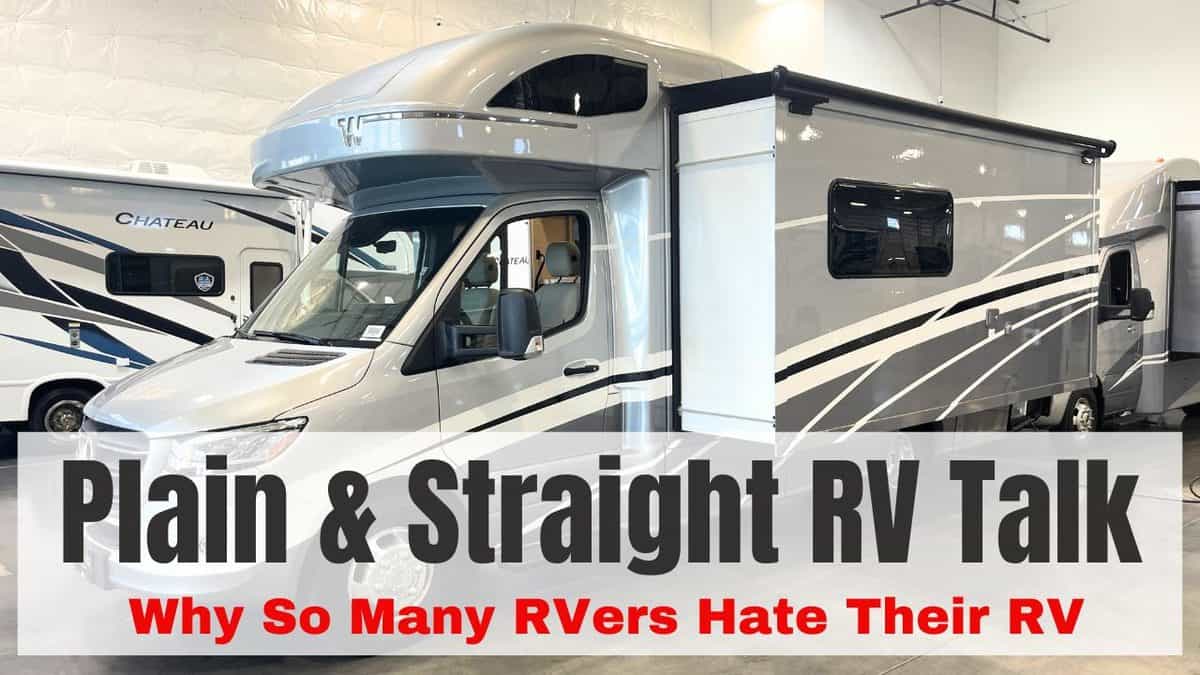
So why are so many RV owners unhappy while millions of others enjoy years of satisfying RV travel?
Spend a little time in RV groups, forums, or video comment sections, and you will find plenty of unhappy RV owners.
Some say their RV has spent more time at the dealership than at a campground. Others describe repeated water leaks, electrical failures, appliance problems, unfinished factory work, or poor support after the sale.
Those experiences are real, and they should not be dismissed.
However, there are also millions of RV owners who are generally satisfied with their RVs. Their units may not be perfect, but they provide years of travel, camping, and enjoyable memories.
So why is there such a large difference between these two groups?
Why do some people love the RV lifestyle while others come to hate their RV?
Poor factory workmanship and dealer service are certainly part of the answer. But there are also several other factors that do not receive nearly as much attention.
Let’s examine four of the biggest reasons some buyers wind up unhappy with their RVs—and what you can do to avoid the same experience.
RV Quality Problems Are Real
Before considering buyer decisions, we need to acknowledge the RV industry’s responsibility.
Manufacturers sometimes allow RVs with significant defects to leave their factories. Dealers may then fail to identify or correct those problems before delivery.
And when owners return for repairs, they can encounter parts delays, long service appointments, unclear warranty responsibility, and poor communication.
I have been very critical of these parts of the RV industry because improvement is clearly needed.
Manufacturers should strengthen quality control, dealers should perform better pre-delivery checks, and both should provide more responsive service after the sale.
However, focusing only on factory failures does not explain why one owner may be reasonably satisfied while another is overwhelmed by problems.
The RV selected, how it is used, and the buying process also make an enormous difference.
Reason #1: Buyers Expect Too Much From an Entry-Level RV
RV manufacturers build products for different customers and price ranges.
Some RVs are designed as affordable entry points for buyers who want to camp occasionally. These units make RV ownership possible for people who cannot or do not want to spend much more.
There is nothing automatically wrong with an entry-level RV.
If it is reasonably well constructed, maintained properly, and used for several weekends and a vacation each year, it may serve its owner well.
Problems often develop when an RV designed for occasional recreational use is expected to withstand constant or full-time use.
Not Every RV Is Built for the Same Purpose
A lightweight entry-level travel trailer may have thinner materials, lighter cabinetry, less insulation, smaller tanks, basic furniture, and less durable hardware.
Those choices help lower its price and weight. They can also make it towable by a wider variety of vehicles.
However, those same materials may wear more quickly when the RV is occupied continuously.
A cabinet hinge that works perfectly when used a few weekends each year may loosen much sooner when opened every day. Lightweight furniture, plumbing fixtures, flooring, and appliances can also wear faster under constant use.
That does not necessarily mean the RV is defective. It may mean the buyer selected an RV that was not designed for the way it would be used.
Match the RV to Your Camping Style
Before shopping, be realistic about your plans.
Will you camp four or five weekends a year? Will you take several long trips? Are you planning to travel for months at a time, or will the RV become your full-time home?
The more frequently you use an RV, the more important durability, storage, insulation, tank capacity, cargo-carrying capacity, and overall construction become.
For example, most travel trailers are not designed for continuous residential use. My article about choosing a travel trailer for full-time living explains why construction and intended use matter so much.
Also, do not rely entirely on a salesperson’s claim that a particular RV is “full-time capable.” Ask the manufacturer whether it approves the model for full-time use and whether continuous occupancy affects the warranty.
Most importantly, examine how the RV is actually constructed.
A label, package name, or sales description is not a substitute for durable materials and good workmanship.
Reason #2: Some Buyers Make the Lowest Price Their Main Priority
Everyone wants a good deal.
There is nothing wrong with negotiating, comparing prices, or staying within a reasonable budget. In fact, buyers should do all of those things.
However, the cheapest RV is not necessarily the best value.
Some buyers have the budget to purchase a better-built RV but choose the least expensive model they can find. They then expect it to deliver the construction quality, durability, and refinement of a much more expensive RV.
That is usually unrealistic. And it is a major reason why RV owners are unhappy at times.
Price and Quality Are Often Connected
As a general rule, better materials, more careful construction, experienced workers, stronger frames, durable furniture, and effective quality control cost money.
That does not mean every expensive RV is well built.
A high price can reflect luxury features, a large floor plan, brand positioning, or dealer markup rather than superior construction. And occasionally, a lower-priced RV may be assembled very well.
But manufacturers cannot continually remove cost from an RV without making compromises somewhere.
Those compromises may appear in the structure, cabinetry, furniture, insulation, running gear, appliances, hardware, or time spent on quality control.
So the goal should not be to buy the cheapest RV available. It should be to obtain the best combination of suitability, condition, construction quality, and price.
My article on whether you should buy a cheap travel trailer explores this tradeoff in more detail.
A Quality Used RV May Be a Better Choice
If your budget is limited but construction quality is important, consider buying a better-built used RV instead of a cheaply made new one.
Depreciation may bring an RV that was originally outside your price range into a more affordable category after several years.
This can allow you to buy better construction, stronger components, and more durable materials for the same amount you would spend on an entry-level new RV.
However, age alone does not make an RV a good value.
The previous owner’s care matters enormously. A well-built RV that has suffered water intrusion or years of neglect can still become an expensive money pit.
So research the manufacturer, model, and model year. Review its maintenance history, establish a fair market value, and have the individual RV inspected before buying it.
My comparison of buying a new versus used RV can help you evaluate which choice fits your budget and priorities.
Reason #3: Buyers Do Not Understand How RVs Are Built
Many consumers expect RV manufacturing to resemble modern automobile production.
Automobiles are assembled with extensive automation, standardized components, precision equipment, and highly repeatable processes. Although human workers are still involved, machines perform much of the work with remarkable consistency.
Most RVs are built differently.
They are still assembled largely by hand. Workers install walls, roofs, plumbing, wiring, cabinets, appliances, trim, sealant, and many other components as the RV moves through the factory.
That makes individual workmanship extremely important.
Hand-Built RVs Are Vulnerable to Human Error
The quality of an individual RV can be affected by the training, experience, concentration, and workmanship of the people who assembled it.
A worker may miss a fastener, damage wiring, apply sealant poorly, overtighten a fitting, misalign a cabinet, or forget to complete a task.
Production speed can make these problems worse.
When a manufacturer emphasizes volume over careful workmanship, employees have less time to identify and correct mistakes. If quality-control procedures are also weak, the RV may leave the factory with those problems still present.
This lack of consistency is one of the greatest challenges in RV manufacturing. And a big reason why RV owners are unhappy with their RV.
Even a Good Brand Can Produce a Bad RV
Some manufacturers have better materials, production methods, quality standards, and customer support than others.
Choosing one of those manufacturers can improve your odds of getting a good RV. However, no brand produces every unit perfectly.
You can find a poorly assembled RV from a respected manufacturer. And you may occasionally find an individual RV from a less consistent manufacturer that was put together unusually well.
That is why brand research and an individual inspection must work together.
The brand helps you identify which manufacturers and models deserve your consideration. But the inspection tells you whether the specific RV sitting in front of you is worth buying.
You can learn more about the visual clues that reveal good and bad new RV quality.
Look Beyond the Floor Plan and Décor
Many buyers choose an RV primarily because they like its floor plan, colors, countertops, furniture, or entertainment features.
Those things matter because you need to feel comfortable inside the RV. But they do not tell you how well it was assembled.
Open every cabinet and drawer. Look at the fit of doors, trim, walls, flooring, and molding.
Inspect visible plumbing and wiring. Check the sealant around windows, doors, roof penetrations, and exterior openings.
Poor workmanship in visible areas can be a warning about the quality of work hidden behind walls, under floors, and inside the roof.
You do not need to be an RV construction expert to notice crooked doors, loose trim, unfinished openings, damaged components, or careless sealant work.
Reason #4: Most Buyers Do Not Follow a Smart RV Buying Process
This may be the most important reason some people wind up hating their RV.
They become emotionally attached to an RV, accept the dealer’s assurances, sign the paperwork, and take it home without independently verifying its condition.
In many cases, they refuse to hire a qualified RV inspector. And then these RV owners are unhappy with their purchase.
That decision is difficult to understand when everyone already knows that RV quality can be inconsistent.
An RV Is a House Traveling Down the Highway
Most people would not buy a conventional house without having it inspected.
Yet many of those same people will buy an RV without an inspection, even though an RV contains many of the systems found in a home.
It may have:
- 12-volt and 120-volt electrical systems
- Freshwater and wastewater plumbing
- Propane equipment
- Heating and air conditioning
- Refrigerators and other appliances
- A roof with numerous sealed openings
- Slide rooms and moving components
- Tires, brakes, suspension, or a motorized chassis
And all of this equipment travels down the highway, where vibration and movement can loosen connections and expose weaknesses.
An RV may also have traveled hundreds or thousands of miles between the factory, transport company, dealership, RV shows, and storage lots before the buyer ever sees it.
So “brand new” does not mean “fully functional and problem-free.”
Why the Dealer’s PDI Is Not Enough
Some dealers tell buyers that their pre-delivery inspection will identify and correct every problem.
A good dealer PDI can be helpful, but it is not the same as an independent inspection performed for the buyer.
The dealer is the seller. Its goal is to prepare the RV for delivery and complete the transaction.
An independent inspector works for the buyer and provides an unbiased assessment of the RV’s condition.
A thorough inspection can uncover problems before the dealership has received all of your money. That gives you the opportunity to request repairs, renegotiate the agreement, select another RV, or walk away.
My complete guide to RV inspections explains what an inspector does and why the process can be so valuable.
Get Problems Corrected Before Taking Delivery
An inspection report does more than tell you whether the RV is worth buying.
It can also create a written list of problems that need to be addressed before delivery.
This is important because the buyer usually has the most negotiating power before the transaction is complete. Once the dealer has been paid and the RV has left the lot, repairs may become much more difficult to arrange.
You could find yourself waiting weeks or months for a service appointment while making payments on an RV you cannot fully use.
So make the purchase contingent on an acceptable inspection whenever possible. Put agreements in writing, and do not rely on verbal promises about repairs.
After the work is completed, verify it. A checkmark on a service list does not always mean that the underlying problem was corrected properly.
The RV Industry and RV Buyers Both Influence the Outcome
None of this excuses poor workmanship.
RV manufacturers should not send unfinished or defective RVs to dealerships. Dealers should not pressure customers into accepting units with known problems, and warranty service should not take months to complete.
The industry needs to improve. If they wish to resolve the reasons why RV owners are unhappy at times.
But buyers also have considerable power.
Manufacturers pay attention to what consumers purchase. If buyers consistently choose RVs based mainly on low price, superficial features, and attractive monthly payments, manufacturers will continue emphasizing those qualities.
On the other hand, if buyers research construction, ask difficult questions, insist on inspections, and support manufacturers that build better products, the industry has a financial reason to respond.
RV manufacturers follow demand.
So better-informed consumers can help push the industry toward better construction and quality control.
How to Improve Your Chances of Loving Your RV
No buying process can guarantee a perfect RV.
However, you can improve your odds dramatically by making a series of careful decisions instead of one emotional decision at the dealership.
Start by identifying how you will actually use the RV. Then establish a complete budget that includes the purchase, taxes, insurance, maintenance, storage, repairs, campground fees, and necessary equipment.
Next, research RV types, manufacturers, models, and model years. Compare build quality, customer support, owner experiences, resale value, and suitability for your intended use.
The resources on my Buying an RV page can help you work through those decisions in the right order.
Then inspect promising RVs carefully, compare their prices with the market, and hire a qualified independent inspector before completing the purchase.
Finally, be willing to walk away. Not doing that is why RV owners are unhappy with their purchase in many cases.
The goal is not to find a perfect RV because perfect RVs do not exist. The goal is to eliminate the wrong ones until you find an RV that fits your needs, budget, and expectations.
Frequently Asked Questions About RV Buyer Satisfaction
Why do so many RV owners complain about their RVs?
Common reasons why RV owners are unhappy include poor factory workmanship, ineffective quality control, long warranty delays, poor dealer service, and unreliable components. Some buyers also select an RV that is not designed for their intended use or fail to inspect it before taking ownership.
Are all new RVs poorly built?
No. RV quality varies by manufacturer, model, factory, and individual unit. Even a manufacturer known for good quality can occasionally produce a poorly assembled RV, which is why every RV should be evaluated individually.
Are entry-level RVs bad?
Not automatically. An entry-level RV can work well for occasional weekend and vacation use. Problems are more likely when a lightweight budget RV is expected to withstand continuous travel or full-time occupancy.
Does spending more guarantee a better RV?
No. A higher price may pay for luxury features, size, or brand recognition rather than better construction. However, durable materials, careful workmanship, and effective quality control do cost money, so the lowest-priced RV often involves compromises.
Is a used RV better than a new entry-level RV?
A well-maintained used RV from a quality manufacturer may provide better construction for the same price as a new entry-level model. However, it must be researched and inspected carefully because neglect and water damage can turn any used RV into a money pit.
Can a good RV brand still produce a bad unit?
Yes. Since RVs are assembled largely by hand, individual workmanship can vary. Choosing a respected brand improves your odds, but it does not replace an inspection of the specific RV.
Should a brand-new RV be independently inspected?
Yes. New RVs can have incomplete factory work, transportation damage, malfunctioning equipment, plumbing leaks, electrical problems, or defective components. An independent inspection can identify these issues before delivery.
Why not rely on the dealership’s pre-delivery inspection?
A dealer PDI is performed by the seller and varies greatly in thoroughness. An independent RV inspector works for the buyer and provides an unbiased report on the RV’s condition.
Can I completely avoid RV problems?
Probably not. RVs contain many systems and experience vibration, weather, and road movement, so maintenance and occasional repairs are part of ownership. However, choosing carefully and inspecting before buying can help you avoid severe problems and immediate repair surprises.
Conclusion
Some RV owners have every reason to be unhappy.
They bought an RV with serious defects, received poor support, and spent months trying to get problems corrected. The RV industry must accept responsibility for those failures and improve its performance.
However, many disappointing ownership experiences can also be traced to buying an RV that does not fit the owner’s needs, making the lowest price the main priority, misunderstanding how RVs are built, or skipping an independent inspection.
So approach RV buying as a process rather than an impulse purchase.
Choose an RV built for the way you intend to use it. Be realistic about the connection between cost, materials, and durability.
Research manufacturers and models, but remember that the individual RV matters too. Most importantly, verify its condition before you complete the purchase.
If buyers become better informed, demand better construction, and reward manufacturers that provide it, the RV industry will have to respond.
And if you follow a smart buying process yourself, your odds of becoming a happy and satisfied RV owner will be much higher.