
Choosing the right RV generator can be confusing. So it’s easy to ask – “What size generator do I need for my RV?”
Well, you have to consider watts, amps, battery charging, air conditioners, and whether your RV has 30-amp or 50-amp service.
But the decision becomes much easier when you focus on one simple question: What do you actually want the generator to power?
Some RV owners only need to recharge their batteries while boondocking. Others want to run an air conditioner or enjoy almost the same experience they have on campground shore power.
Each goal calls for a different size. So let’s determine what size generator you need for your RV.
How an RV Gets Electrical Power
Most RVs use both 12-volt direct current, usually called DC power, and 120-volt alternating current, usually called AC power.
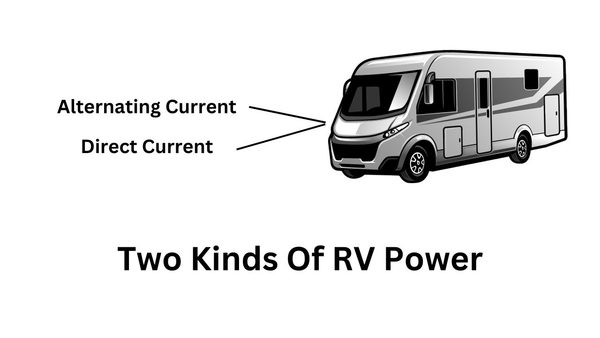
Your RV house batteries supply 12-volt DC power. Depending on the RV and its equipment, that power can operate lights, control boards, the water pump, vent fans, the furnace blower, and other important components.
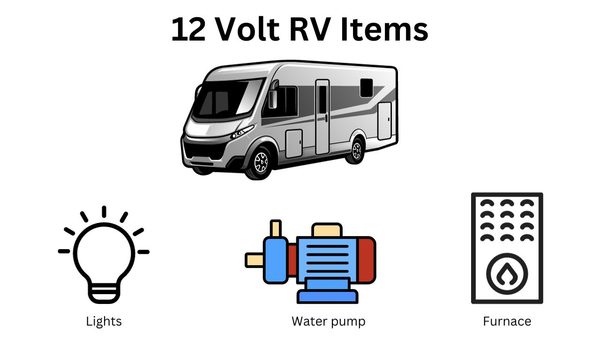
However, some appliances may use propane while relying on 12-volt electricity for their controls. And a 12-volt compressor refrigerator can draw much more battery power than a propane absorption refrigerator, so every RV is a little different.
The problem with battery power is that once electricity leaves the batteries, it eventually has to be replaced. In other words, you need a way to recharge your RV battery bank.
Shore Power, Solar Power, and Generators
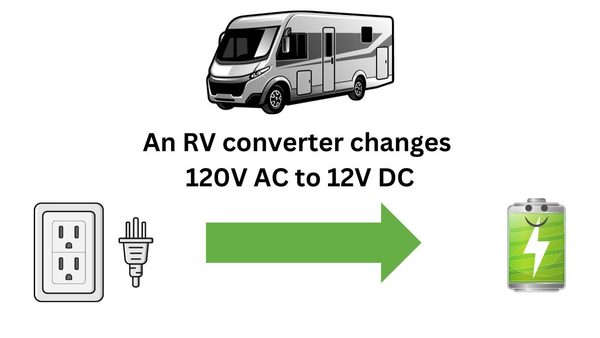
One way to recharge the batteries is to connect the RV to shore power at a campground or RV park.
Your RV’s converter then changes some of that 120-volt AC power into 12-volt DC power for the RV and its batteries.
If you would like a clearer explanation of that process, read my article on the difference between an RV converter and inverter.
Solar panels are another popular option. They can recharge the batteries when sufficient sunlight is available, and they are especially useful for RVers who camp off-grid regularly.
However, solar production varies with the weather, the season, shade, and the size of the system. So many boondockers still carry a generator as either their primary charging source or a backup.
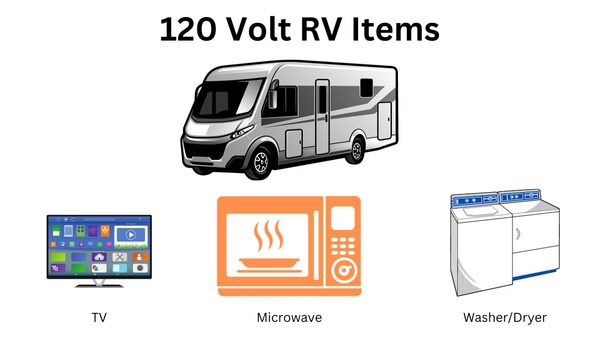
A generator can also directly supply 120-volt AC power. That means it can operate wall receptacles, microwave ovens, air conditioners, and other AC equipment within its limits.
An inverter and sufficiently large battery bank can also power AC equipment. But that requires a properly designed system with enough battery capacity, inverter capacity, wiring, and a reliable way to replace the energy being consumed.
What Determines the Right RV Generator Size?
The best generator size depends mainly on the electrical loads you want to operate at the same time.
And here is the general rule to remember: The more equipment you want to run simultaneously, the larger the generator must be. A larger generator will usually be heavier, more expensive, and more fuel-hungry too.
So buying the biggest portable generator you can find is not always the best answer. The goal is to buy enough capacity for the way you camp without carrying unnecessary weight or spending more than needed.
Understand Running Watts and Starting Watts
Before comparing generator sizes, it is important to understand the difference between running watts and starting watts.

Running watts describe the power a generator can supply continuously. Starting watts, sometimes called surge or peak watts, describe the extra power it can supply briefly when a motor-driven appliance starts.
An RV air conditioner is the most common example. It requires a surge of power when its compressor starts and then uses less power while running.
For that reason, never choose a generator based only on the large wattage number printed prominently on the box. Check both its continuous running-watt rating and its starting-watt rating.
You should also leave yourself a reasonable safety margin. Operating a generator at or near its maximum output for long periods is not an ideal plan, especially in hot weather or at higher elevations where some engines produce less power.
How Much Power Does a 30-Amp RV Have?
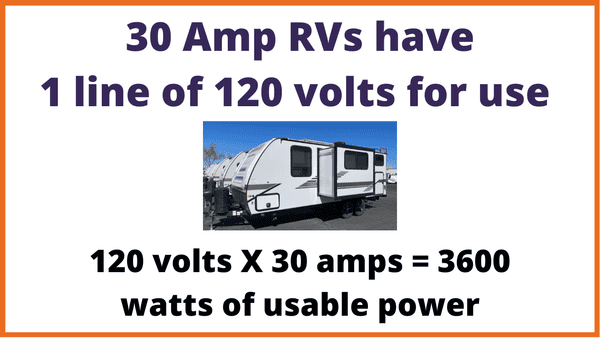
A 30-amp RV uses one 120-volt line of electrical power. To estimate its maximum wattage, multiply volts by amps:
120 volts × 30 amps = 3,600 watts
So a 30-amp RV can theoretically use up to 3,600 watts at one time when connected to a full 30-amp shore-power source.
However, that does not mean you always use 3,600 watts. Many RV owners operate far below that level most of the time.
It also does not mean that a generator advertised with 3,600 peak watts can continuously replace a 30-amp pedestal. Its continuous rating must be high enough for the loads you plan to run.
How Much Power Does a 50-Amp RV Have?
A 50-amp RV has two separate 120-volt power lines. Each line can provide as much as 50 amps.
That gives the RV a theoretical total capacity of:
120 volts × 50 amps × 2 lines = 12,000 watts
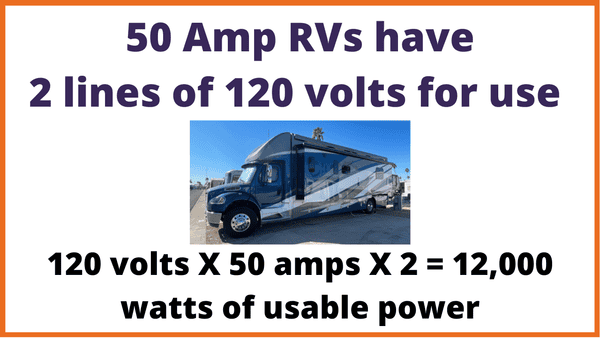
That is much more electrical capacity than a 30-amp RV provides. It explains why large fifth wheels and motorhomes can have multiple air conditioners, residential refrigerators, electric water heaters, fireplaces, washers, dryers, and other high-demand equipment.
But most owners do not use the full 12,000 watts continuously. Therefore, owning a 50-amp RV does not automatically mean that you need a 12,000-watt generator.
Generator Size for Charging RV Batteries
Suppose you only want a generator to recharge your RV house batteries while camping without hookups. You plan to operate your normal 12-volt equipment from the batteries and do not intend to run an air conditioner or several large AC appliances.
In that situation, a 2,000-watt inverter generator is usually a very practical choice. It provides ample capacity for most RV converter-chargers while remaining relatively compact, portable, and fuel-efficient.
Your actual charging time will depend on the battery type, battery-bank capacity, state of charge, and output of your converter or battery charger. A larger generator does not necessarily charge the batteries faster if the charging equipment cannot use the extra power.
For many boondockers, running a small generator for a while in the morning and again later in the day can replace much of the power they have used. However, the exact schedule will vary, especially if the RV has a large battery bank or a power-hungry 12-volt refrigerator.
To learn more about choosing the battery bank itself, see my guide to the best RV batteries for the house and chassis.
Generator Size for One RV Air Conditioner
Now suppose you want to recharge the batteries and have the ability to run one RV air conditioner when the weather becomes hot.
For reliable operation in a wide range of conditions, a generator in the 3,000-to-3,600-watt range is usually the better choice. This gives you more room for the air conditioner’s starting surge and for smaller electrical loads that may operate at the same time.
The exact requirement depends on the air conditioner’s BTU rating, efficiency, age, and starting characteristics. It also depends on whether another major load—such as the microwave, electric water heater, or converter—is running.
Some RV owners operate one air conditioner from a smaller 2,000-watt generator, especially after installing an approved soft-start device. A soft start reduces the compressor’s startup demand, but it does not reduce the air conditioner’s normal running consumption nearly as dramatically.
So you still need to compare the generator’s ratings with the air-conditioner manufacturer’s electrical specifications. And before adding a soft start, check whether the modification could affect the appliance warranty.
Manage Other Loads While the Air Conditioner Runs
Even with a 3,000-to-3,600-watt generator, you may need to manage your electrical use.
For example, avoid using the microwave at the same time as the air conditioner if their combined load approaches the generator’s continuous capacity. You can also switch the refrigerator and water heater to propane, if they are designed for it, to reduce AC demand.
This kind of load management is normal in a 30-amp RV, even when you are connected to shore power.
Generator Size for a 30-Amp RV
If you want to come reasonably close to replacing a 30-amp campground connection, look for a generator that can provide approximately 3,600 continuous watts at the correct 120-volt output.
That does not guarantee that every appliance can start at the same moment. But with sensible load management, it can power most of what a typical 30-amp RV is designed to operate.
Remember to confirm the continuous rating, receptacle type, and adapter arrangement before buying. A generator’s peak rating alone does not tell you how much power it can deliver continuously to the RV.
Generator Size for a 50-Amp RV
A 50-amp RV presents a different challenge because its shore-power service can supply as much as 12,000 watts. Fortunately, most owners do not need to duplicate all of that capacity while camping away from hookups.
If your only goal is battery charging, the same 2,000-watt inverter generator that works for a smaller RV may be enough. If you want to run one air conditioner, a 3,000-to-3,600-watt model may still meet your needs.
However, if you want to run multiple air conditioners and use most of the RV much as you would on shore power, a built-in generator around 8,000 watts is common in larger motorhomes. That capacity can support many normal loads, although you may still need to avoid operating every high-demand appliance simultaneously.
Large built-in generators are heavy and expensive, but the RV manufacturer accounts for their installation, fuel supply, exhaust system, ventilation, and controls. Cummins Onan is one of the best-known manufacturers in this category, and you can learn more in my article about Cummins Onan RV generators.
A Quick RV Generator Size Guide
Here is a simple way to narrow down your choices:
- Battery charging and light AC use: A 2,000-watt inverter generator is often sufficient.
- Battery charging plus one RV air conditioner: Consider roughly 3,000 to 3,600 watts, depending on the air conditioner and other loads.
- Most of the capability of a 30-amp connection: Look for about 3,600 continuous watts and manage simultaneous loads.
- Multiple air conditioners and extensive use in a large 50-amp RV: A built-in generator around 8,000 watts is a common solution.
- The full theoretical capacity of 50-amp shore power: Up to 12,000 watts, although very few RVers need to duplicate it.
These figures are useful starting points, but your appliances and camping habits should make the final decision.
Why an Inverter Generator Is Usually Best for RV Use
If you are buying a portable generator for camping, I strongly recommend choosing an inverter generator.
Open-frame construction generators are designed mainly for jobsites and emergency work. They are often much louder, which nearby campers will not appreciate.
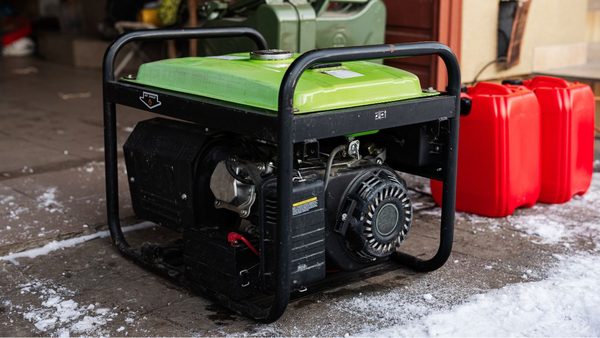
Inverter generators are generally quieter and can adjust engine speed according to demand. They also provide stable power that is well suited to the electronic equipment found in modern RVs.
Of course, no portable generator is silent. Always obey campground generator-hour and noise rules, and be considerate of everyone around you.
For a more detailed comparison, see my guide to the pros and cons of RV inverter generators.
Important Generator Safety Reminders
Never operate a portable generator inside an RV, basement compartment, truck bed with a cover, garage, or other enclosed or partly enclosed area. Generator exhaust contains carbon monoxide, which can cause severe injury or death.
Place the generator outdoors and well away from doors, windows, vents, and neighboring RVs, following the generator manufacturer’s instructions. Also make sure your RV has working carbon-monoxide detectors.
Use the correct heavy-duty cord and properly rated adapters for the connection. And never improvise a connection that could energize exposed contacts or backfeed an electrical system.
Finally, protect the generator from rain and weather without enclosing it or restricting the airflow it needs for cooling and safe exhaust dispersal.

You can find more practical information about RV electricity, generators, air conditioning, and other components on my RV Systems and Equipment page.
Frequently Asked Questions About RV Generator Size
Will a 2,000-watt generator run an RV air conditioner?
Sometimes it can, especially with an efficient air conditioner and a properly installed soft start. However, the available margin may be small, and other electrical loads may have to be turned off.
For more dependable operation, a generator in the 3,000-to-3,600-watt range is usually a better choice for running one RV air conditioner.
Is a 3,500-watt generator enough for a 30-amp RV?
It is enough for many normal uses, but check whether 3,500 watts is the generator’s continuous or peak rating. You may still need to manage large loads, especially when the air conditioner, microwave, and electric water heater could overlap.
Can I use a small generator with a 50-amp RV?
Yes. The RV’s 50-amp rating describes the maximum power it can accept, not the minimum power it requires.
With the correct connection and careful load management, a small generator can charge the batteries or operate selected equipment in a 50-amp RV.
Do I need an 8,000-watt generator for every 50-amp RV?
No. An 8,000-watt generator makes sense when you want to operate multiple air conditioners and many of the conveniences of a large RV while away from shore power.
If you only need battery charging or one air conditioner, a much smaller generator may be all you need.
Does a bigger generator charge RV batteries faster?
Not necessarily. Charging speed is limited by the converter or charger, battery chemistry, battery temperature, and the battery’s ability to accept current.
Once the generator can comfortably supply the charger, additional generator capacity may not shorten charging time.
Should I buy a portable or built-in RV generator?
A portable inverter generator often fits towable RVs and occasional backup use. It is usually less expensive and can be removed when not needed.
A built-in generator is more convenient for larger motorhomes and frequent generator use. However, it adds cost, weight, maintenance requirements, and fuel consumption.
Conclusion
So, what size generator do you need for your RV? The answer depends much more on what you want to operate than on the size or electrical rating of the RV itself.
For battery charging, a 2,000-watt inverter generator is often a very practical choice. To run one air conditioner more reliably, move into the 3,000-to-3,600-watt range.
And if you have a large 50-amp RV and want to run multiple air conditioners along with most of your normal appliances, a built-in generator around 8,000 watts may be appropriate.
Before buying, list the appliances you expect to use at the same time. Then compare their running and starting requirements with the generator’s continuous and surge ratings, while leaving a reasonable safety margin.
That approach will help you choose an RV generator that does what you need without paying for—or carrying—far more generator than you will actually use.
Have safe and happy travels, my friends!