
If you have followed my RV content for a while, you have probably heard me mention Oliver travel trailers.
I have included them in discussions about four-season travel trailers and alternatives to Airstream, and there are good reasons for that.
However, many RV buyers still don’t know much about Oliver or what makes these trailers so different.
So let’s take a closer look at how they are built, the models available, their towing requirements, and the type of RVer most likely to enjoy owning one.
Before we begin, I want to make it clear that I am not affiliated with Oliver Travel Trailers.
I am not being paid or compensated by the company, and the opinions in this article are my own.

Who Makes Oliver Travel Trailers?
Oliver Travel Trailers was founded in 2007, and the first Legacy Elite went into production in 2008.
The company builds its trailers in Hohenwald, Tennessee, far from the large concentration of RV manufacturers around Elkhart, Indiana.
But that location is only the beginning of what makes Oliver different.
Instead of trying to produce a wide range of entry-level trailers as quickly as possible, Oliver has traditionally concentrated on a very small number of premium molded-fiberglass models.
The trailers are hand-built in relatively small quantities.
And that production philosophy allows the company to focus more attention on construction quality, materials, and long-term durability.
What Makes Oliver Travel Trailers Different?
Most conventional travel trailers are built by attaching laminated or framed sidewalls to a floor, front wall, rear wall, and roof.
And every place where those components meet creates a joint or seam.
Those seams must be inspected and maintained because failed sealant can allow water to enter the walls, roof, or floor.
And once water gets into a conventionally constructed RV, it can cause wood rot, mold, delamination, and expensive structural damage.
Double-Hull Fiberglass Construction
But Oliver takes a very different approach to RV construction.
Its trailers use molded-fiberglass construction similar in concept to the way fiberglass boats are built.
The body consists of molded upper and lower sections joined together to form the exterior shell.
But Oliver goes further by using both an outer fiberglass shell and an inner fiberglass shell.

And that means the living area is surrounded by a double-hull structure.
So insulation and an air gap between the hulls help reduce heat transfer between the interior and exterior.
Oliver describes its construction as four molded fiberglass shells bonded into a unified structure.
This gives the trailer a strong body without relying on conventional wood-framed walls.
Molded construction also eliminates many of the long roof and corner seams found on ordinary travel trailers.
And that can substantially reduce the number of areas where water intrusion is likely to develop.
However, no RV is maintenance-free. Windows, roof-mounted equipment, vents, exterior attachments, and other penetrations should still be inspected regularly.
Four-Season RV Capability
The double-hull design is also one reason Oliver travel trailers are considered four-season RVs.
In addition to the insulated space between the shells, current models include dual-pane acrylic windows, an enclosed plumbing area, and heat directed into protected areas of the trailer.
And these features help keep the interior comfortable and reduce the risk of frozen plumbing.
So an Oliver can be a very good choice for RVers who travel in both hot and cold weather.
However, owners still need to use good judgment and winterize the trailer when it will be stored without heat in freezing temperatures.
Oliver provides more information about its cold-weather design on its four-season travel trailer page.
Aluminum Frame and Chassis
Another important feature is the trailer’s aluminum frame.
Oliver uses a welded frame constructed from heavy-duty aluminum rather than the conventional painted steel frame found under most travel trailers.
Because aluminum is resistant to rust and helps provide a strong foundation without adding unnecessary weight.
But the plumbing, tanks, wiring, and other components are also installed with serviceability in mind.
And because many systems are accessible between the inner and outer hulls, owners and technicians can inspect areas that might be hidden inside the walls of another RV.
Oliver Travel Trailer Models
Oliver has traditionally concentrated on two models: the Legacy Elite and the larger Legacy Elite II.
Here is a general comparison using published specifications available at the time of writing:
| Specification | Legacy Elite | Legacy Elite II |
|---|---|---|
| Exterior length | 18 feet 5 inches | Approximately 24 feet |
| Axles | Single axle | Tandem axle |
| Approximate dry weight | 3,700 pounds | 4,900 pounds |
| GVWR | 5,000 pounds | 7,000 pounds |
| Approximate cargo capacity | 1,300 pounds | 2,100 pounds |
| Interior height | About 6 feet 1 inch | About 6 feet 6 inches |
| Sleeping capacity | Up to 3 | Up to 3 |
Of course, these figures can change with the model year, floor plan, equipment package, batteries, and factory-installed options.
And always use the certification label on the individual trailer when calculating cargo capacity and tow-vehicle requirements.
The Oliver Legacy Elite
The Legacy Elite is the smaller of the two models. At approximately 18 feet 5 inches long, it is compact enough to fit into many campsites that would be difficult for a larger travel trailer.
Its GVWR is 5,000 pounds, while the approximate unloaded weight is 3,700 pounds.
So that leaves around 1,300 pounds for water, propane, camping gear, food, clothing, and other cargo, depending on how the individual trailer is equipped.
And that is a respectable cargo carrying capacity for a travel trailer of this size.
Because of its compact dimensions and weight, the Legacy Elite may be towable by certain properly equipped SUVs and midsize pickups.
But the vehicle must have enough towing capacity, payload capacity, hitch capacity, axle capacity, and gross combined weight rating.
But never choose a tow vehicle by looking at the advertised tow rating alone.
Passengers, cargo, aftermarket accessories, and trailer tongue weight all consume payload capacity.
So Who Is the Legacy Elite Best For?
The Legacy Elite is particularly well suited to solo RVers and couples who value maneuverability and do not need a large amount of interior space.
It can also appeal to travelers who visit national parks, state parks, and older campgrounds where shorter campsites are common.
And its smaller size makes it easier to store and maneuver than many conventional trailers.
However, the compact floor plan requires some compromises. Buyers who want separate permanent sleeping and dining areas may prefer the larger Legacy Elite II.
The Oliver Legacy Elite II
The Legacy Elite II is the larger and more popular choice for buyers who want additional storage, headroom, and living space.
Current published specifications list it at approximately 24 feet long with a 7,000-pound GVWR.
And a base dry weight around 4,900 pounds can provide roughly 2,100 pounds of cargo capacity, although heavily optioned versions may have less.
That is an impressive cargo allowance for a trailer of this size.
It gives owners more flexibility for batteries, camping equipment, food, clothing, water, and other travel necessities.
The Legacy Elite II also has approximately 6 feet 6 inches of interior headroom.
So it will accommodate many taller RVers more comfortably than the smaller model.
Oliver currently offers standard-bed and twin-bed floor plans in the Elite II.
Both are designed primarily for couples, although the trailer can sleep up to three people.
You can see the latest layouts and specifications on the official Legacy Elite II model page.
What Is an Oliver Like Inside?
A while back, my wife and I stopped at a rest area while returning from the Hershey RV Show.

An Oliver Legacy Elite II pulled in, so naturally I wanted to speak with its owners.
Bill and Nancy were kind enough to tell us about their experience and invite us inside.
They were very happy with their Oliver and allowed me to photograph the interior for my viewers.
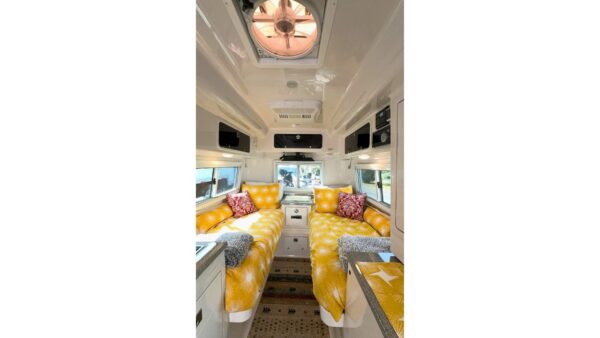
Their Elite II had the twin-bed floor plan. Looking toward the rear of the trailer, the two beds were positioned along the sides with storage available nearby.
Then looking toward the front, the kitchen occupied the middle portion of the trailer.
It included useful drawer and cabinet storage, while a dinette was located on the opposite side.
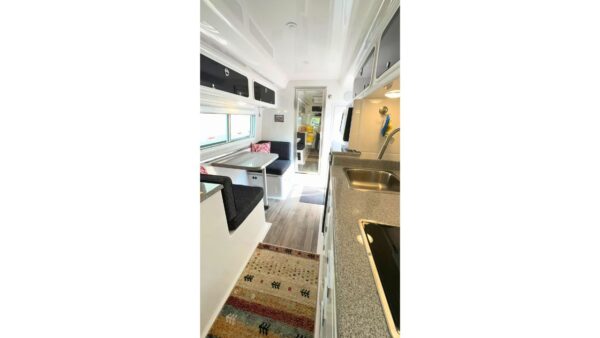
At the front was the wet bath, which combines the toilet and shower in one waterproof compartment.
A wet bath saves space, but some buyers prefer the larger separate shower commonly found in bigger travel trailers.
Outside, Bill and Nancy had a rear-mounted bike rack positioned behind the full-size spare tire.
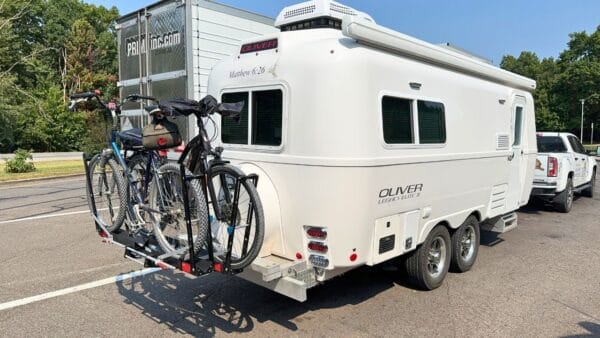
Their setup demonstrated how a relatively compact trailer can still carry the equipment needed for extended travel.
They were towing their Oliver with a GMC Canyon and said they were pleased with its performance.
However, that does not mean every midsize truck is suitable for every Elite II.
Tow-vehicle specifications vary significantly, even within the same model line.
So every buyer should verify the truck’s payload sticker, receiver rating, axle ratings, towing capacity, and the loaded tongue weight of the trailer.
Major Advantages of Oliver Travel Trailers
The greatest advantage of an Oliver is its overall construction.
The molded-fiberglass body is not vulnerable to rot in the same way as a wood-framed wall or floor.
And the reduced number of exterior seams helps lower the opportunity for damaging water intrusion.
The aluminum frame is another major benefit because it does not develop the widespread surface rust commonly seen on painted steel RV frames.
Also, Oliver travel trailers also offer strong cargo carrying capacity for their size.
And the combination of insulation, protected plumbing, dual-pane windows, and a quality heating system makes them a legitimate option for extended-season camping.
Another advantage is longevity. In fact, with proper care, the fiberglass shell and aluminum chassis can remain structurally sound for a very long time.
That does not mean every appliance or component will last forever.
Air conditioners, refrigerators, water heaters, pumps, electronics, suspension parts, and other equipment will eventually require service or replacement.
But the basic structure is capable of outlasting many conventional trailers.
Reasons an Oliver May Not Be Right for You
As much as I respect Oliver travel trailers, they are not perfect for everyone.
Limited Interior Space
The largest traditional Oliver model is only about 24 feet long. Molded-fiberglass manufacturing becomes increasingly difficult and expensive as trailers get much larger.
So if you want a 30-foot or 35-foot travel trailer with a residential-style living area, an Oliver probably will not satisfy you.
No Slide-Outs
Oliver does not use slide-outs in its Legacy trailers.
That eliminates the seals, motors, cables, tracks, and structural openings associated with slide mechanisms. But it also limits the amount of interior floor space.
For some RVers, avoiding slide-related problems is a major advantage. However, others may feel confined without the extra room a slide provides.
Primarily Designed for Couples
These trailers make the most sense for solo travelers and couples.
Although they can provide an additional sleeping position, they are not ideal for larger families who need private sleeping areas, multiple beds, or room for children to spread out.
Premium Pricing
Price will be the biggest obstacle for many buyers.
At the time of writing, advertised pricing for a new Legacy Elite II begins around $85,000, and higher equipment packages can push the price considerably above that amount.
Current inventory and package pricing are available through Oliver’s official listings.
That is a lot of money for a travel trailer under 25 feet long. But you are paying for materials, construction methods, limited production, and long-term durability rather than maximum interior space.
Are Oliver Travel Trailers Worth the Money?
Whether an Oliver is worth the price depends on what you value most.
If your priority is getting the largest possible floor plan for the least amount of money, an Oliver is probably not the right choice.
Many conventional manufacturers will sell you a much larger trailer with slide-outs for considerably less.
But if you value build quality, four-season capability, reduced structural maintenance, cargo capacity, and long-term ownership, the equation changes.
A less expensive conventional trailer may need to be replaced several times during a long RVing life.
Meanwhile, a properly maintained Oliver has the potential to serve the same owner for decades.
That does not automatically make the Oliver cheaper. However, it can make the higher initial investment easier to justify for someone who plans to keep the trailer for a very long time.
Frequently Asked Questions About Oliver Travel Trailers
Are Oliver travel trailers really four-season RVs?
Oliver travel trailers have double-hull fiberglass construction, insulation, dual-pane windows, protected plumbing, and heated interior spaces that make them well suited to hot and cold weather.
However, owners must still operate the heating system properly and winterize the trailer when it is stored without heat in freezing conditions.
Do Oliver travel trailers leak?
Any RV can develop a leak around windows, vents, air conditioners, plumbing connections, or other openings.
However, Oliver’s molded-fiberglass shell eliminates many of the long roof and wall seams found on conventional travel trailers, reducing the number of potential leak points.
Can an SUV tow an Oliver Legacy Elite?
Some properly equipped SUVs may be capable of towing a Legacy Elite.
But you must verify the SUV’s payload, towing capacity, receiver rating, axle ratings, and gross combined weight rating before deciding that it is safe.
Do you need a half-ton truck for an Oliver Legacy Elite II?
Many buyers use a properly equipped half-ton pickup to tow the Legacy Elite II. Certain midsize trucks or SUVs may also have adequate ratings, while some buyers prefer a three-quarter-ton truck for additional payload and stability.
The correct choice depends on the tow vehicle’s actual ratings and the fully loaded weight of the trailer.
Do Oliver trailers have slide-outs?
No, the Legacy Elite and Legacy Elite II do not have slide-outs.
This reduces mechanical complexity and potential maintenance, but it also means the interior is narrower than trailers that expand at the campsite.
How long can an Oliver travel trailer last?
The fiberglass shell and aluminum frame have the potential to last for decades with proper care.
Appliances, sealants, tires, suspension parts, batteries, and other components will still require routine maintenance and eventual replacement.
Are Oliver travel trailers good for families?
They can accommodate a small family for shorter trips, but their compact layouts are generally better suited to solo RVers and couples.
Families wanting bunk beds, separate bedrooms, or extensive living space will probably prefer a larger conventional travel trailer.
Conclusion: Is an Oliver the Perfect Towable RV?
There is no perfect RV for everyone. Every RV design involves tradeoffs involving price, size, weight, interior space, complexity, and construction quality.
And Oliver travel trailers trade large floor plans and slide-outs for durability, four-season capability, manageable size, and high-quality construction.
So they are not the best choice for large families, buyers on a limited budget, or anyone who wants a spacious residential interior.
However, for a solo RVer or couple who values quality more than size and intends to keep the same trailer for many years, an Oliver deserves serious consideration.
You could buy a conventional travel trailer and potentially replace it several times during your years of travel.
Or you could invest in a well-maintained Oliver that may be capable of lasting throughout your RVing life.
Ultimately, the right choice depends on your budget, travel style, tow vehicle, and priorities.
But if long-term quality is near the top of your list, Oliver builds one of the most compelling molded-fiberglass travel trailers available today.