A 50 Amp To 30 Amp Adapter – Is It Safe?

This article is about using a 50 amp to 30 amp adapter when you have a 30 amp RV.

In a previous blog post I discussed the possibility of needing to adapt a 30 amp campground service to a 50 amp RV. This is a very common scenario in many campgrounds.

But a less common scenario is just the opposite. And that’s when you need to run a 30 amp RV from a 50 amp campground pedestal.

So can you use a 50 amp to 30 amp adapter safely in this case? Let’s see!

Disclosure: Please note this post may contain affiliate links. This means โ€“ at no additional cost to you โ€“ I earn a commission if you make a purchase using our affiliate links. I only link to products and companies I use and feel comfortable recommending. The income goes toward supporting the free content on this website.

Why Is An Adapter Needed?

There are a lot of RVs on the road that are wired for a 30 amp electrical service. To understand what this means, it’s good to have a mental picture of what an amp is. And while we are at it let’s also do the same for volts too.

The best analogy I have heard to describe the relationship between amps and volts is to picture a water hose. There are different sizes of water hoses, some big, some small.

For instance, a garden hose will put out a steady stream of water. But a fire hose is much larger and therefore will put out a lot more water at the end.

Volts are like the water pressure that goes into the hose. There has to be some water pressure to move the water along.

But if you have a consistent water pressure, the fire hose will move more water than a garden hose. So in RVs, a 30 amp service is like the garden hose. It moves electricity along to the appliances in the RV.

But a 50 amp RV service can move a lot more electricity at the same time because the wiring is much larger and more capable.

The difference between a 30 amp and a 50 amp RV service becomes especially apparent when using air conditioners. A 30 amp service will usually only allow the operation of one AC unit in the RV.

But a 50 amp service can run more than one AC unit and even provide plenty of extra power at the same time. Why? Let’s take a look at a very useful electrical formula to understand why 50 amp RVs can do that.

A Useful Electrical Formula

The volts at the campground pedestal should remain at 120 volts no matter what RV is plugged into it. So we can determine how much difference there is in consumable power between 30 amps and 50 amps by using a common electrical formula.

It says that you multiply the amps times the total volts. Then you will know the maximum simultaneous power capability of any electrical system (the watts).

So if we multiply 30 amps times 120 volts, a 30 amp RV can consume 3600 watts of power at one time. But a 50 amp RV has two legs of service going into the rig instead of just one.

So if you add the two lines of 120 volts, that is a total of 240 volts. Then multiply that by 50 amps for each line and you have 12,000 watts of consumable power at one time.

Clearly then, a 50 amp RV uses a lot more power than a 30 amp RV. So what happens if you use a 50 amp to 30 amp adapter for your 30 amp RV?

How Does A 50 Amp To 30 Amp Adapter Work?

Since a 30 amp RV has wiring that can only safely handle 30 amps of power, you don’t want to overload it.

If you were to somehow plug the 30 amp RV service into the 50 amp campground pedestal without an adapter, it could easily overload.

So there is a need to step down the power of the 50 amp campground pedestal to the 30 amp RV service.

That is where the adapter comes in. It does that work for you. Even though there is a lot more electrical power available at the pedestal, it restricts the total output.

That means that it steps it down to the power that will not harm your RV or your devices. Think of it as an adapter at the end of the fire hose that steps down the water stream to the size of a garden hose.

Click on the link below to find out more about 50 to 30 amp adapters like this one.

Click here for a 50 amp to 30 amp RV plug adapter

(This is an affiliate link for the product on Amazon. It does not cost you any extra to buy the product using my affiliate link if you choose to do so)

A 30 Amp Plug In A 50 Amp Adapter

As mentioned above, a 50 amp RV outlet has two lines of power instead of just one. And the 30 amp RV plug only uses one line of 120 volt power.

So the 50 amp to 30 amp adapter renders the second line useless. That way only one line of power is coming into the 30 amp RV at that point.

Of course, the remaining 120 volt line of power still has a maximum amperage of 50 amps.

But the 30 amp RV is not capable of using more than 30 amps of power without tripping a panel breaker in the RV.

It’s a safety provision to make sure that you don’t overload the 30 amp wiring in the RV.

So a 50 amp to 30 amp RV adapter should work just fine on its own.

A Failsafe Electrical Protection System

However, there are some who feel that more is needed to make sure that an electrical overload does not happen.

They recommend the use of a 30 amp RV surge protector that is an EMS (electrical management system).

An EMS monitors your electrical line and shuts off power to the RV if it exceeds 30 amps.

So they feel that using the 30 amp surge protector EMS along with the 50 amp to 30 amp adaptor provides the maximum electrical safety possible.

Click here to view a 30 amp surge protector EMS

The choice is yours, but many RVers have used the adaptor alone with very good results.

What does All Of This Mean For Your 30 Amp RV?

So what does this mean in terms of what you usually do with your RV? Does this adapter change the way you use your appliances or devices? Not really.

Since you still have the full 30 amps of power that you always use, nothing will change when you plug into a 50 amp service with an adapter.

On the other hand, RVs with a 50 amp service that plug into a 30 amp receptacle will have to make changes in their power usage. Otherwise, they would easily overload the electrical service and could blow some of the RV panel breakers.

But not those who have a 30 amp RV who plug into a 50 amp pedestal. You don’t get any additional power , but you don’t lose any power either.

I hope this helps you understand how RV electrical services work and how adapters help in special situations. Let us know if you have had any interesting experiences with 50 amp to 30 amp adapters in the comments below.

Have safe and happy travels my friends!

A 30 Amp to 50 Amp Adapter – A Good Idea?

There is often confusion about what happens when you try to use a 30 amp to 50 amp adapter (sometimes called a “dogbone”) at a campground pedestal. Actually, there is confusion when any adapter is used to adjust the electricity provided to an RV.

But in this article we will discuss whether or not you should use a 30 amp to 50 amp adapter. And we will explain what happens when you do.

Disclosure: Please note this post may contain affiliate links. This means โ€“ at no additional cost to you โ€“ I earn a commission if you make a purchase using our affiliate links. I only link to products and companies I use and feel comfortable recommending. The income goes toward supporting the free content on this website.

A 50 Amp RV Electrical Service – What Does It Mean?

If you have an RV with a 50 amp electrical service it means that you have a thick and heavy electrical cord. And at the end of that cord you have a 4 prong 50 amp plug. So what does all those prongs do? And why is the cord so heavy?

A 50 amp RV electrical service comes with 2 wires that are rated to supply 50 amps of power to the RV. Then there is also a neutral wire and a ground wire.

That makes up all four prongs on the plug. And because wires that are rated to carry 50 amps are large, the cord becomes very heavy.

Essentially, you have 2 legs of 50 amp electrical service going into the RV. That is a lot of power. And if you multiply the amps by the total volts, you get the total power available to you in watts.

In other words, the wattage figure that you get tells you how much power can be consumed at one time safely. So two legs of 120 volts equals 240 volts.

If we multiply that by 50 amps that each leg can carry, that leaves us with 12,000 watts. This means that a 50 amp RV electrical service can run devices that total up to 12,000 watts of power simultaneously.

And in the real world that means that you can run a lot of devices and appliances without overloading the service.

30 Amps To 50 Amps – What Happens?

So when you plug your 4 prong 50 amp power cord into a 3 prong 30 amp service, what happens? Well obviously, one leg of power has been taken away.

This is because all electrical services need a neutral and a ground wire. And the positive wire has been stepped down to using only 30 amps at the pedestal.

A comparison of the 4 prong 50 amp plug and the 3 prong 30 amp plug

So does this create any problems for your 50 amp RV electrical service? Not at all. This is because the adapter adjusts the power going into your RV to use only 30 amps.

And since 30 amps is lower than 50 amps, nothing will be overloaded. This is because the wiring used for 50 amps is much larger than what is used for 30 amps.

If someone tried to run 50 amps through 30 amp wires, that could be a problem! But not the other way around.

30 Amps To 50 Amps – What’s The Difference?

So it is safe to use 30 amps of power going into an RV that has a 50 amp electrical service. But what does that mean in power usage?

Well, now you only have one leg of 30 amp power times 120 volts. And that means that your total usable power at one time is only 3600 watts. What a drop in simultaneous usable power.

So for an RV that has a 50 amp service, you probably have a lot of power hungry appliances. You may have 2 or more air conditioners, a microwave, a washer/dryer setup, and more.

If you now only have less than a third of the usable power going into the RV, adjustments must be made. This means that you probably can only safely run one air conditioner at a time.

And you may have to limit how many other power hungry devices you use simultaneously. In many cases you can still use them, just not all at once.

It may take a little fiddling around with to determine what can be used and when, but you will eventually get it. Every RV is a little different, so you will learn where the limits are for your particular rig.

Obviously if the main power fuse is tripped, you have gone too far. So it’s best to try to stay on the conservative side to prevent that from happening in the first place.

Click here for a 30 amp to 50 amp RV plug adapter

(This is an affiliate link for the product on Amazon. It does not cost you any extra to buy the product using my affiliate link if you choose to do so)

I hope this has cleared up some of the confusion about RV amp ratings in the RV and at the pedestal.

Have safe and happy travels my friends!

Your RV Water Heater Anode Rod – DIY!

If you have an RV water heater anode rod, then you have a Suburban water heater. There are two main brand names of RV water heaters. One is made by Suburban and the other is made by Atwood. Both are fine water heaters and last a long time with regular maintenance.

But a Suburban water heater has a porcelain lined steel tank. This kind of water heater tank is very similar to the kind used in your home water heater.

The only problem with this kind of tank is that it can corrode inside over a long period of time if it is not maintained properly. But to make the tank last a long time an anode rod is inserted into the tank.

This anode rod attracts the corrosive elements in the water and sacrifices itself to protect the tank lining. So every so often you need to replace the corroded anode rod with a new one.

Watch my video about RV water heater anode rod replacement

This will keep your Suburban water heater working like it should for a long time!

Table of Contents

Annual RV Water Heater Maintenance

It’s generally accepted that you should inspect your Suburban water heater once a year. This involves draining all of the water out, flushing it thoroughly, and replacing the anode rod if needed.

It may sound like a lot to do but the truth is that it is fairly simple and most RV owners can do it themselves.

As you get started, be sure to turn off the water heater itself. It often has a power button on the tank side, so just turn it off. But I always recommend to also turn off all of the power to the RV at the same time. This is just a precaution.

Then turn off the LP gas at the tank too. Finally, turn off the water source to the RV. If you are connected to a city water connection, turn off the faucet at the connection.

If you are using water from your fresh water tank, turn off the water pump. Then let the water in the heater tank lower in temperature until it’s comfortable. This may take a while so I often turn off the water heater hours before I inspect it.

Inspecting Your Suburban Water Heater

Pull the pressure relief valve straight out to release water from the tank

With all of the preparation done, open the pressure relief valve at the top of the water heater. Just pull it straight out. Let the water that escapes drip out until there is no more coming out of the tank.

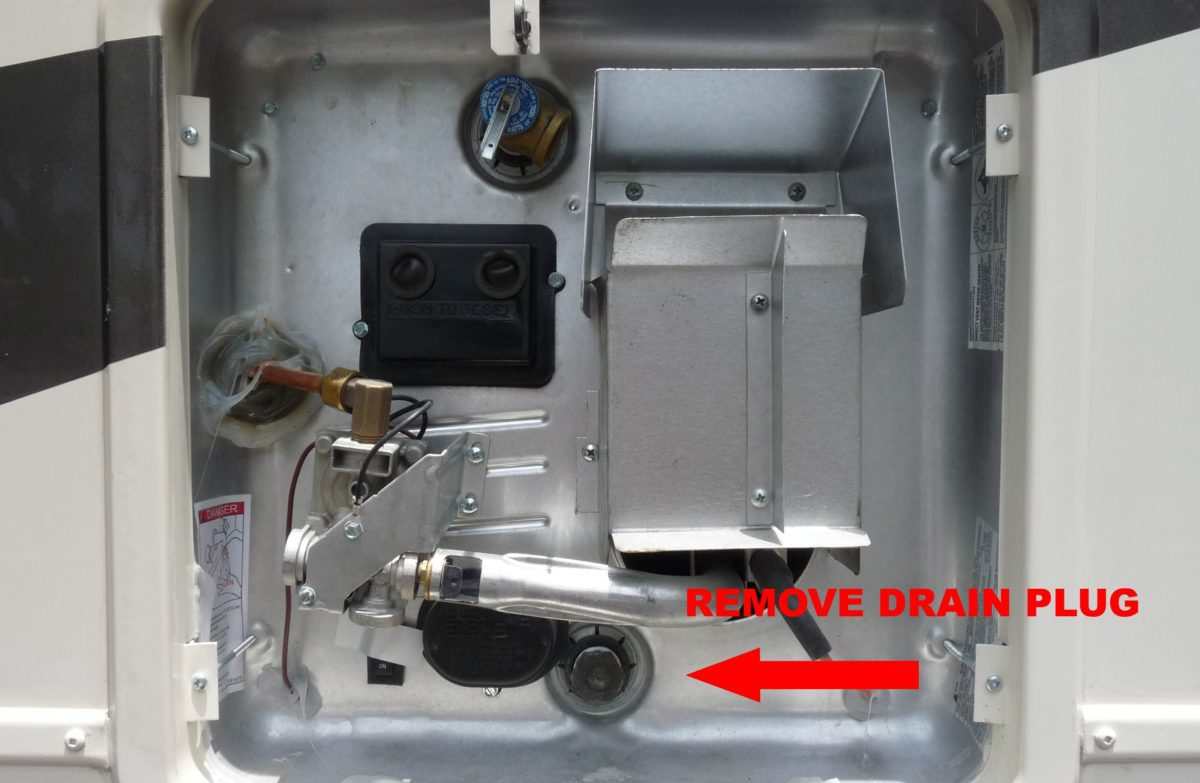
Now you can begin to remove the RV water heater drain plug that has the anode rod attached to it. You will need a 1- 1/16 socket with an extension and attach it to either a socket wrench or a breaker bar.

I prefer the breaker bar because sometimes the drain plug can get really tight. This is where the breaker bar helps provide more force to remove the plug.

There is also a special tool made for removing both the water header anode rod and the electric heating element. It’s an all-in-one tool and these can be very handy to have as well.

Click here to view the anode rod/ heating element removal tool

Remove the drain plug at the bottom of the water heater to see the condition of the anode rod

Inspect the condition of the Water Heater Anode Rod

Once the plug is removed you should be able to see what kind of condition the anode rod is in. If it is lightly corroded, you can use it again.

But if it is heavily corroded, be sure to have a spare RV water heater anode rod handy for replacement.

The next step is to thoroughly flush the water heater tank with an RV water heater flush wand. These can fit right on the end of a garden hose and you insert it into the tank for flushing.

Click here to view an RV water heater tank wand

Once the tip is inside the tank move the water stream around in all directions. But pay particular attention to stirring up any sediment that may have fallen on the bottom of the tank.

By doing this the sediment is blown up into the water that is escaping at the drain plug. Make sure that you flush the tank thoroughly for a while!

Replacing The Water Heater Anode Rod

After the tank is completely flushed, you can re-insert the old anode rod if it is not badly corroded. If it is in bad shape, just replace it with a new one.

Click here to view a new Suburban Water Heater Anode Rod

And be sure to use plumbers tape on the threads of the new anode rod. Just apply the plumbers tape manually around the threads of the anode rod a couple of times or so.

Then you can insert the anode rod into the water heater and begin to tighten it down. How tight should the anode rod be? Just snug, don’t over-tighten it!

At this point you can turn on the water to the RV again. But be sure to leave the pressure relief valve open as the water goes into the tank. That way the air has somewhere to go as the water fills up in the tank.

When the water starts coming out of the pressure relief valve, you can close it. At this point the RV water heater tank is full.

Now you turn on the faucets inside the RV to remove trapped air on the hot water side. After that is done, you can turn on the LP gas at the tank again.

And then finally the power to the RV can be restored. At this point you should be able to turn on the water heater again and in about 20 – 30 minutes you will have nice hot water in your RV.

And your annual RV water heater maintenance is done!

I hope you enjoyed this article on Suburban water heater anode rod inspection and replacement.

Have happy and safe travels my friends!

Get My FREE Camping Guide

“The Top 5 Ways To Save Money On Campground Costs”

Get My Newsletter

Save on RV repairs

Get the best RV gear

Learn about RV life

RV tips and tricks

And get my free guide – The Top 5 Ways To Save Money On Campground Costs”